Showing posts with label intelligence. Show all posts

September 4, 2026

The Bowe Bergdahl Saga – Is It Finally Over?


Bowe Bergdahl’s 2017 desertion and misbehavior before the enemy conviction has been reinstated by a federal court. The court ruled – correctly in my non-lawyer opinion – that a district court judge does not have the authority to interfere in any way with the military justice system. Let’s review this case.


On the night of June 29-30, 2009, U.S. Army Private First Class Bowe Bergdahl deserted his post at Observation Post Mest in Paktika Province, Afghanistan. Bergdahl was assigned as an infantryman to the 1st Battalion, 501st Parachute Infantry Regiment, 4th Brigade Combat Team, 25th Infantry Division. He had enlisted in the Army in 2008.


Bergdahl was captured relatively soon after deserting his post. The exact date is unknown; however, the Taliban released a video of Bergdahl in captivity on July 18, 2009. This began his five years of captivity by the Haqqani network under extremely harsh conditions.


In May of 2014, in a colossal lapse of judgment, the Obama administration agreed to release five extremely dangerous and notorious senior Taliban leaders from the U.S. detention center in Guantanamo, Cuba in exchange for Bergdahl’s release.


On May 31, 2014, Bergdahl was released to a U.S. special operations team at a helicopter landing zone in Afghanistan. The “Taliban Five” were transported to  Qatar who had agreed to hold them and restrict their travel. Chalk up another failure for the Obama team – the "Taliban Five" later all became involved again in operations in Afghanistan.  


Following an investigation to confirm what virtually everyone already knew – on March 25, 2015, the Commanding General of U.S. Army Forces Command authorized charges to be brought against Bergdahl under the Uniform Code of Military Justice (UCMJ):


- Article 85 — Desertion with intent to shirk important or hazardous duty


- Article 99 — Misbehavior before the enemy


The charges were referred to a military court for an Article 32 preliminary hearing.


It was noted in the charges that several U.S. troops were injured in attempts to locate Bergdahl after his initial disappearence/desertion. Members of his unit believe that other soldiers lost their lives in these searches.


For those of us who have served in combat zones, these two articles are considered to be as bad as it gets. Desertion (Article 85) is extremely serious and potentially punishable by death if committed in time of war. We can argue over the question of whether Afghanistan was a war or not. This was one of the Obama Administration talking points as several officials and supportive media attempted to downplay Bergdahl’s desertion. At one point, Obama's National Security Advisor Susan Rice declared that Bergdahl "served the United States with honor and distinction." Nothing could be further from the truth.


However, the charge of “misbehavior before the enemy” (Article 99) is the big one. It is explicitly punishable by death or another punishment directed by a court-martial.


In September 2015, the Article 32 preliminary hearing was convened. There were attempts by some in the Obama Administration to downgrade this into a lower-level special court-martial, but in the end, the Army stuck to their guns (no pun intended) and referred the charges to the highest level, a general court-martial. Bergdahl was arraigned at Fort Bragg, North Carolina, on December 22, 2015.


In December 2016, Bergdahl asked President Obama for a pre-emptive pardon ahead of his trial. To his credit, in a rare moment of moral clarity, Obama did not do so.


On October 16, 2017, Bergdahl voluntarily pleaded guilty without a plea bargain and opted for a military judge only trial. Probably a smart move –  presenting these serious charges to a full general court-martial panel in the face of overwhelming inculpatory evidence likely would have resulted in a harsher sentence.*


On November 3, 2017, the military judge sentenced Bergdahl to a dishonorable discharge, reduction in rank to Private (E-1), and forfeiture of pay, but no prison time, despite prosecutors seeking 14 years of incarceration. I agreed with the judge's decision to not impose prison time.


After his sentencing, the military appellate system kicked in. These are serious charges, with a serious sentence – a dishonorable discharge from the armed forces carries serious consequences.

- July 16, 2019 — Army Court of Criminal Appeals (ACCA): Affirmed Bergdahl's conviction and sentence.


- August 27, 2020 — Court of Appeals for the Armed Forces (CAAF): Affirmed the ACCA decision, upholding the conviction.


- February 2, 2021 — Final military appeal: CAAF denied Bergdahl's writ-appeal petition, exhausting his military appellate remedies.


On February 17, 2021, Berdahl’s lawyers filed a lawsuit in the U.S. District Court for the District of Columbia asking the court to review the military justice proceedings and declare that Bergdahl's conviction was unconstitutional and should be vacated.


On July 25, 2023, a U.S. District Judge in that court vacated Bergdahl's conviction on procedural grounds.


On September 1, 2026, the D.C. Circuit struck down that decision because a federal district court lacks authority to vacate a court-martial conviction. The court ordered Bergdahl's lawsuit dismissed, leaving his original military conviction in effect. His dishonorable discharge was effectively reinstated.


Eugene R. Fidell, Berdahl’s very capable and experienced attorney said the case is about “the integrity of the military justice system,” and added that “there is a grave command influence problem that has pervaded this case from the very beginning.” Fidell’s team has 45 days to weigh several options for challenging the ruling, including asking the same panel to reconsider or seeking a discretionary review by the Supreme Court.


My take: Give it up, Fidell. The guy is a confessed deserter. He pleaded guilty to that and, even worse, misbehavior before the enemy. He got what he deserved. The prosecution wanted 14 years of incarceration at the U.S. Military Disciplinary Barracks at Fort Leavenworth, Kansas. I was among those who supported the dishoorable discharge and the non-custodial sentence. His five years at the hands of the Taliban were enough punishment, albeit self-induced. It’s over – move on.


ADDENDUM: When Bergdahl was returned to American control, I was a military analyst for CNN. As such, I was interviewed extensively about this case, and wrote several articles detailing my personal views and analysis (see links below). I stand by every word.


The Bowe Bergdahl exchange - a mixed blessing (June 1, 2014)


Military chiefs support the release of the "Taliban Five" for Sergeant Bergdahl - well, sort of.... (July 12, 2014)


The Bergdahl court-martial recommendation - has someone leaned on the Army? (October 12, 2015)

Bergdahl - the Army does the right thing (March 25, 2015)


Bergdahl - the deflective media campaign begins (March 28, 2015)

__________________
* Personal note: Shortly after I was commissioned, I was selected to be a member of a general court-martial panel. I was ordered to present myself to the military judge (in this case, a USAF colonel). The defense counsel took one look at me, called for a pre-emptory challenge, and asked that I be excused. I was dismissed without saying a word, no explanation other than, “Thank you, Lieutenant, you are excused.”


I asked a mentor, a USAF colonel, what happened. He asked about the case. A staff sergeant had killed his five-year old son in base housing and was being charged with murder. The local police in Denver, Colorado, wanted no part of it – let the Air Force figure it out. 


The colonel explained: "You showed up as required in full service dress ('dress blues') which requires all awards, decorations, and badges to be worn. The defense counsel, also a USAF officer, read your ribbons – he saw a prior service NCO, aircrew wings, nine Air Medals, Vietnam campaign medals – you are the last person he wants judging his NCO client. “


July 17, 2025

Russian Deployment of North Korean Artillery in Ukraine


170mm Koksan self-propelled howitzer in Iraq

A recent article in Military Watch magazine reported on Russia's use of North Korean-made heavy artillery in Ukraine. The article was based on comments made by the commander of the Ukrainian Defense Intelligence Directorate.

“Unfortunately, this gun is demonstrating itself quite well in battle. It’s firing from quite a long range, and it’s quite good in terms of accuracy. We have data that the Russian Federation was provided 120 pieces. But I think that supply will continue because these guns are demonstrating themselves quite well. This is unfortunate for us because this is artillery for long-range firing.” 

Why I am writing about a North Korean artillery piece being used by Russian forces in Ukraine? This is, after all, Middle East Perspectives by Rick Francona. Read on.

I am very familiar with the Koksan gun. In fact, I believe I am one of the few Americans who have ever had the opportunity to get in, on, and under the weapon. I took the above photograph in 1988 at an Iraqi Army artillery depot south of Baghdad. At the time, I was serving as a liaison officer to the Iraqi Directorate of Military Intelligence at the U.S. Embassy in Baghdad. It was the eighth year of the Iran-Iraq War; we had developed a relationship with the Iraqis to prevent a recurrence of Iraq's mistaken attack on the USS Stark in the Persian Gulf in 1987 in which 37 sailors were killed.

I wrote about this experience in my book, Ally to Adversary - An Eyewitness Account of Iraq's Fall from Grace. From the book:

PROJECT MORNING STAR

Our cooperative relationship with the Iraqis allowed us unprecedented access to the Iraqi military. For example, the Iraqis had captured a large artillery piece from the Iranians during the liberation of Al-Faw. They could not identify its origin and were perplexed by the unusual 170-mm bore. Artillery pieces worldwide are generally manufactured in standard bore sizes, normally 122-mm, 130-mm, 152-mm, 155- mm, 175-mm, and 203-mm. We knew they had captured this gun: Army Colonel Gary Nelson—our newly assigned defense attaché in Baghdad and an artillery officer by training—had seen it while it was on display at a victory celebration in Baghdad. We knew what it was, and we wanted it.


The Iranians had acquired this self-propelled howitzer in 1987. At that time, it was the longest-range artillery piece made anywhere in the world, capable of firing a rocket-assisted projectile to a range of almost sixty kilometers. It had been used by the Iranians to conduct harassment fire from the Al-Faw Peninsula into Kuwait’s northeastern oil fields. The Iranians were applying military pressure on the Kuwaitis in a variety of ways, as punishment for supporting Iraq in the war and for alleged violations of oil export and pricing policies of OPEC (Organization of Petroleum Exporting Countries). This artillery fire was complemented by Chinese-made “Silkworm” cruise missile attacks on Kuwait’s oil ports and by naval attacks on Kuwaiti shipping in the Gulf. 


The attacks were the catalyst for the March 1987 decision to register Kuwaiti oil tankers under the American flag (a procedure called “reflagging”) to offer some protection for oil shipping in the region. The U.S. Navy could not legally protect foreign shipping, but a merchant ship flying the U.S. flag was entitled to armed escort through the Persian Gulf war zone.


The high level of U.S. interest in the gun had little to do with the situation in the Persian Gulf and rested instead on the fact that the weapon had been designed half a world away to fire on the capital city of a close U.S. ally, South Korea. What the Iraqis had captured on the Al-Faw Peninsula, though they did not realize it, was a weapon designed and built by North Korea to fire on Seoul from the North Korean side of the Demilitarized Zone. The U.S. military refers to it as a Koksan gun.


While inspecting the gun (the project was called Morning Star), we discovered more evidence of Iraq’s use of nerve gas. As I rooted around the cramped driver’s station of the gun system looking for anything of intelligence value—maps, notes, logs, manuals, firing tables, communications charts, and so forth—I found several used atropine injectors. These auto-injectors had been manufactured in Iran and were similar to those I had found earlier on a battlefield on Al-Faw. I showed one of the injectors (and pocketed another) to both Majid and the brigadier general commanding the artillery depot, explaining that these used injectors indicated to me that a nerve agent had been used at Al-Faw. 


I was careful not to accuse the Iraqis, but the implication was clear. The brigadier general replied that Iraqi artillery doctrine calls for use of obscurant smoke in the preparatory artillery barrages. His “analysis” was that the Iranians mistook the smoke rounds for nerve gas and, therefore, self-administered atropine. 


Not wanting a confrontation while standing in the middle of an Iraqi military installation, I did not mention to the Iraqi officers that we had also discovered decontamination fluid in many places on the weapon, most noticeably trapped in the headlights. It would make no sense for the Iraqis to decontaminate the vehicle if they had only fired smoke rounds at the Iranians.


In the end, the Iraqis decided not to allow us to move the gun back to the United States, so I arranged for a small team of artillery experts and engineers to fly to Iraq and do a field exploitation of the piece. I remember that working on the gun in the blazing sun in the Iraqi desert was, and still is, the hottest I have every been. My insides felt like I was being roasted.

Just as the Ukrainian intelligence chief noted, the gun was well-engineered and manufactured. It was an intelligence boon - these guns pose a threat to U.S. forces in South Korea. 


October 6, 2024

Movie Review: Damascus Cover (Vertical Entertainment - 2017)


Damascus Cover is a 2017 espionage film, based on the 1977 Howard Kaplan novel of the same name. The book is the first of four in Kaplan’s The Jerusalem Spy Series. I have not read the book. There are a few confusing scenes, but it can be difficult to boil 321 pages into a 90-minute screenplay.


Mossad officer Ari Ben-Sion, working undercover as German businessman Hans Hoffmann in Berlin in 1989, is recalled and ordered to Damascus to help a Jewish family flee the country. This turns out not to be his actual mission, which is revealed to him only once he is on the ground in Syria. I am not sure why he was not just briefed with the real mission so he could properly prepare and train.


There is, of course, the required romantic entanglement – this with an American photojournalist.


There is also the required double-crossing and changes of allegiance as the story unfolds. Hoffman/Ben-Sion adjusts his operation to exfiltrate a Syrian scientist and quickly finds himself in way over his head with lessening chances of success.


I will not describe what happen so as not to spoil it for any of you who wish to see it. You will have to watch it to the very end – I was surprised.


The movie stars Jonathan Rhys Meyers, Olivia Thirlby, Jürgen Prochnow, Igal Naor, Navid Negahban and John Hurt (in his final role).


I must compliment the producers for the excellent attention to detail when it comes to replicating the country of Syria and the city of Damascus in the Moroccan countryside and city of Casablanca, even down to the accurate Damascus street signs, including shari’ madhat basha (A Street Called Straight) and the Hamidiyah suq.


The movie received mixed reviews. I enjoyed it, not only because it took me back to my posting at the US Embassy in Damascus, but because it was a good story not requiring too much suspension of disbelief (except maybe at the very end).


Watch it on Amazon Prime.


January 23, 2022

Movie Review: Munich – The Edge of War (Netflix, 2021)


Yes, I know this is not about the Middle East. I am reviewing this because of the intelligence aspects of the movie.


As with all good fiction, the reader must exercise what authors refer to as “the suspension of disbelief” - avoidance of critical thinking or logic in examining something unlikely or impossible in reality. Watch it, and go along with it for the sake of enjoyment. This movie does a fair job in blurring that line between belief and disbelief, although there are a few scenes of various meetings that are pretty far-fetched.


The movie, an adaptation of British author Robert Harris’s novel Munich, is set in 1938 as Adolph Hitler threatens to seize the Sudetenland portion of Czechoslovakia, claiming it to be rightfully German territory. Of course, as anyone remotely familiar with modern history knows, there were negotiations between British Prime Minister Neville Chamberlain and Hitler. Yes, the Italians and French were there as well, but this was basically London versus Berlin. This is where “appeasement diplomacy” began.


The talks took place in Munich. The two lead characters who walk us through these events turn out to be a British civil servant (Hugh Legat) and a German diplomat (Paul von Hartmann), both of whom attended Oxford for a period of two years in the early 1930’s, and struck up a friendship.


At some point in the preparations for the talks, Legat is summoned to a meeting with a colonel from MI-6 (British Military Intelligence, now the Secret Intelligence Service, although the MI-6 moniker is still heard). At that meeting, a plan is set in motion that utilizes the untrained Legat as an intelligence operative.


I will leave the political and other aspects of the movie to others, and don’t want to provide any more spoilers that I may have inadvertently done. I will focus on the intelligence aspects of the movie.


First, dispatching a completely untrained civil servant on a dangerous intelligence operation into "unfriendly" territory without any preparations whatsoever is a recipe for disaster. At the very minimum, Legat should have been given some rudimentary counterintelligence training – basic do’s and don’t, some simple surveillance detection concepts (there was no time for real training), some sort of concealment device for documents, a communications plan, and emergency/distress signals. He got none of that.


It gets worse – he is tasked by the MI-6 colonel to carry out this operation without notifying his superiors. Not a good idea, when you are working at the level of the prime minister and his most senior adviser Sir Horace Wilson. What might be sound operational procedure could very appear to be to working at odds with your own government.  At least the colonel provided some clandestine support, but I’ll stop there.


It becomes obvious that there has been an MI-6 penetration of the German government at the highest levels – that’s a real intelligence success. I suspect there was a "walk-in" to the defense attache office at the British Embassy, but that's just speculation. It rarely gets any better than what we deduce is happening, but in this case, it could have been just that. Unfortunately, they never take it to the next level.


In any operation, the overriding concern is collection of the intelligence. I remember having that drilled into me at intelligence operations school – get the intelligence, get the intelligence, get the intelligence. That’s why you are there, that’s why we spend the money, that’s why we take the risks. You’ll see that Legat never got that admonition.


The other overriding concern is the security and safety of your asset. Both of the main characters, mostly through no fault of their own, repeatedly put each other at risk. It’s so obvious, there is no need to belabor it.


One more comment about the historical and political aspect of the movie. At the end, in what appears to be an attempt to rehabilitate Neville Chamberlain and his legacy as the prime minister who appeased Hitler. The producers put forth the supposition that Chamberlain knew Hitler would not be satisfied, but sacrificed the Sudetenland to buy time to allow the Allies (which at that time did not include the United States) to prepare for inevitable war. Interesting, but not accurate.


BOTTOM LINE: As far as historical fiction goes, it takes a lot of liberties, but with enough suspension of disbelief, it’s a good story. It’s not The Hunt for Red October, but it will keep you entertained.


It should also provide a badly-needed reminder that appeasement does not work.


Netflix: https://www.netflix.com/watch/81144852


October 24, 2021

Movie Review – Official Secrets (2019)


Official Secrets poster

Here we have yet another fact-based movie about an intelligence officer who betrays her country and her oath. Here again, we have yet another whitewash by the entertainment industry who appear to hold these traitors in high esteem.


This is the story of a linguist – Katharine Gun – employed by the highly secretive Government Communications Headquarters (GCHQ), the signals intelligence organization of the United Kingdom, the counterpart of the American National Security Agency (NSA).


Note how the movie is described by Netflix, Rotten Tomatoes, and IMDB.


You see the same mantra repeated over and over to the point that people start believing it. Terms like “whistleblower,” “illegal,” “spy,” and “unlawful” are just incorrect when applied to Katherine Gun and her betrayal. The movie also repeats these falsehoods ad nauseam, also adding the ludicrous charge that the United States was seeking information to blackmail fellow members of the United Nations Security Council.


Katharine Gun is not a whistleblower, which is a specific legal term here in the United States – I am not sure about British law. Here there are specific requirements for someone to qualify for “whistleblower” protection, including how and to whom to report illegal activities. None of those involve leaking highly classified defense or intelligence information to the media – which is exactly what she did.


Nothing that NSA did violates U.S. law – in fact, there are statutory legal protocols that allow for just this activity. Collecting intelligence from foreign communications is what NSA does. If the communications occur in the United States, it requires a warrant from the Foreign Intelligence Surveillance Court. None of the countries mentioned in the Koza email enjoy any immunity from surveillance by American intelligence services.


Read the email for yourself. I see no indication of blackmail or anything that would violate U.S. law.


Text of a Top Secret/Comint email claimed to have been sent by Frank Koza of the NSA Regional Threats (RT) office on January 31, 2003. The recipients were officials of NSA’s British counterpart, Government Communications Headquarters (GCHQ): 


As you've likely heard by now, the Agency is mounting a surge particularly directed at the UN Security Council (UNSC) members (minus US and GBR of course) for insights as to how to membership is reacting to the on-going debate RE: Iraq, plans to vote on any related resolutions, what related policies/ negotiating positions they may be considering, alliances/ dependencies, etc - the whole gamut of information that could give US policymakers an edge in obtaining results favorable to US goals or to head off surprises. In RT, that means a QRC surge effort to revive/ create efforts against UNSC members Angola, Cameroon, Chile, Bulgaria and Guinea, as well as extra focus on Pakistan UN matters.


We've also asked ALL RT topi's to emphasize and make sure they pay attention to existing non-UNSC member UN-related and domestic comms for anything useful related to the UNSC deliberations/ debates/ votes. We have a lot of special UN-related diplomatic coverage (various UN delegations) from countries not sitting on the UNSC right now that could contribute related perspectives/ insights/ whatever. We recognize that we can't afford to ignore this possible source.


We'd appreciate your support in getting the word to your analysts who might have similar, more in-direct access to valuable information from accesses in your product lines. I suspect that you'll be hearing more along these lines in formal channels - especially as this effort will probably peak (at least for this specific focus) in the middle of next week, following the SecState's presentation to the UNSC.


Thanks for your help.


No one should be surprised that the U.S. and UK intelligence communities collect foreign communications – that is the core mission of both NSA and GCHQ. To imply that this email indicates illegal, illicit, or immoral activity is ludicrous.


As for the movie production itself – it has well-known British actors who are skilled at their craft. That said, I am disappointed that they chose to appear in this anti-American whitewash of treasonous activity. Are they condoning such behavior? It would appear so.


Pass on this one.


June 15, 2021

NSA leaker Reality Winner released from prison – now what?

That’s not a rhetorical question – I think I have a fairly good idea of what comes next for Reality Winner. She will gain fame and fortune as a darling of the left-wing media.


Winner was arrested in 2017 for the unauthorized release of a Top Secret/Sensitive Compartmentalized Information report produced by the National Security Agency about Russian attempts to interfere in U.S. elections. See my earlier views on this: Reality (is the) Winner - former NSA contractor pleads guilty.


Winner has become the new darling of the left, following in the footsteps of fellow felon Bradley/Chelsea Manning. Many of their supporters believe them to be noble whistleblowers – they’re not. Both are misguided traitors who released highly classified information to the media.


There are avenues for actual whistleblowers to report irregularities and possible illegalities – releasing top secret intelligence documents to the media is not one of those avenues. Winner was caught, and admitted her felonious activity. Her plea agreement allowed her to receive a sentence of just over five years (plus three years of supervised release) instead of the 10 years she could have received.


Winner has been released from prison after just four years and will remain in a halfway house until November, at which time she will begin the three years of supervised release. She is prohibited from public appearances and contact with the media while at the halfway house.


I hope these restrictions continue during the supervisory period as well. If not, I can guarantee you that she will become a media darling, fawned over by the left-wing media and portrayed as a heroine standing up to the government. As I said, she’s not – she’s a convicted felon who betrayed her oath to safeguard intelligence sources and methods.


Winner sought a pardon from President Trump, who declined to interfere. She did the crime, let her do her time. I am not sure how you can request a pardon for a crime you admit you committed.


Now she is seeking the same from President Biden, who just might go along with the cries from the left-wing media to grant her a pardon. I think that would send the wrong signal to the men and women of the armed forces and the intelligence community.


Watch for a book deal….


March 21, 2021

Movie Review: Security Risk (Allied Artists, 1954)


Normally I review movies and series that are based on or about the Middle East. However, I did spend my entire career as a professional intelligence officer – about half the time as a signals intelligence officer and the other half as a clandestine human resources intelligence officer, more commonly referred to as a case officer.


One of my pet peeves is the arbitrary use of the term spy. I was not a spy – I recruited spies, foreign officers and officials who had access to their government’s secret and sensitive information to provide that information clandestinely to U.S. intelligence services. They were the spies – I was an American intelligence officer “running” or “handling” them on behalf of my country. Spies agree to betray their countries for a variety of reasons, some honorable, some not – it depends on which side of the equation you are.


Security Risk is a 1954 film by Allied Artists, directed by Harold Schuster, and written by Jo Pagano and John Rich. The film stars John Ireland, Dorothy Malone, Keith Larsen, Dolores Donlon, John Craven and Susan Cummings. It’s just 69 minutes long, so it does not require a huge investment of your time.

The write-up on several classic movie sites describes this as an American action film. I would call it an espionage drama, but in terms of the genre in 1954, it might also qualify as an action thriller. There is a lot of action packed into just 69 minutes.


The story line: (I will avoid spoiling the film for those of you who plan to watch it.)


In the early 1950’s as the Cold War between the two major post World War II powers – the United States and the Soviet Union – heated up, the Soviets were very interested in knowing what research and development was taking place in the greater Los Angeles area. At that time, southern California was the epicenter of American high-tech defense and aerospace research and development.


The film synopsis describes the scientist who is the focus of a Soviet espionage cell as a nuclear physicist. I never got that from the film – all we are really told is that he was a government researcher and was working on an undefined “formula.” The cell was tasked with acquiring the formula from the scientist.


The venue for the story is the Big Bear ski resort in San Bernardino County. The resort is 100 miles east of Los Angeles, about a three-hour drive in 1954. The scientist, Dr. Lanson (we never hear his first name), decides to take a short respite from his research by going skiing at Big Bear. Obviously, the cell tasked with acquiring his research notes and “the formula” had him under surveillance; at least three members of the cell follow him to the resort.


There is also a support asset in residence at Big Bear, which leads me to believe that the Soviets considered the area a popular area for the defense and aerospace researchers and contractors in the Los Angeles area, and likely similar facilities in Palmdale and Edwards Air Force Base.


As you would expect, the Federal Bureau of Investigation (FBI) was concerned with the activities of Soviet and other hostile intelligence services – the Bureau is the primary counterintelligence agency in the United States. As such, there is an FBI agent in Big Bear to make sure these hostile intelligence services are kept at bay. You decide whether he is successful.


So as not to spoil the viewing experience for those who wish to watch the movie, I will only say that the Soviet cell at some point in the past recruited Dr. Lanson’s assistant at whatever research facility that employed him. This sets up a series of events that are interesting, and yet a bit implausible. It is the assistant who is tasked by the cell to clandestinely acquire the research papers and “the formula” from Dr. Lanson’s personal effects in the lodge suite that he shares with his assistant.


Okay, you see why I am baffled by this. If the cell has already recruited Dr. Lanson’s assistant, there should be no need to even mount this operation in Big Bear. Recruiting the assistant would have been a major intelligence coup, providing direct access to virtually all of the doctor’s research projects. Even if much of it was compartmented and not directly accessible by the assistant, the chances of accessing at the main research facility are far greater than a chance acquisition at a ski resort. Of course, without that, there would be no basis for the movie.


Continuing, when the assistant gets a chance to search the doctor’s desk, papers, and personal effects at the lodge, he pretty much ransacks the place. This is counterproductive. The goal of a clandestine intelligence operation is to acquire the information without anyone knowing that the acquisition has even occurred. Tossing an office or room only tells the security officials that something has likely been compromised.


Of course, this begs the question – why was Dr. Lanson in possession of these highly classified papers while ostensibly on vacation? Isn’t the purpose of a vacation to vacate your mind from the job? Merely having the materials with him and working on them in a non-secure facility violates virtually every security protocol there is.


The assistant is successful in discovering the research papers, including “the formula.” As any good intelligence asset, he properly photographed all of the materials. He is discovered while photographing the documents, a fight ensues, and the assistant is able to make his escape.


Read this-> When the assistant leaves the lodge, he leaves behind the documents out (he should have replaced them) and get this, leaves his camera there. In other words, he left the very items he was sent to acquire. Sort of like the current joke, “You had one job….”


The very first thing you learn at the Intelligence Operations Course, Tradecraft 101, or just plain old “spy school” is GET THE INTELLIGENCE. That’s why we do this.


Bottom line: It’s an entertaining story, especially if you have any background in intelligence operations.


Watch it for free at the Russian classic film site Odnoklassniki:  https://ok.ru/video/1735416220340


November 22, 2020

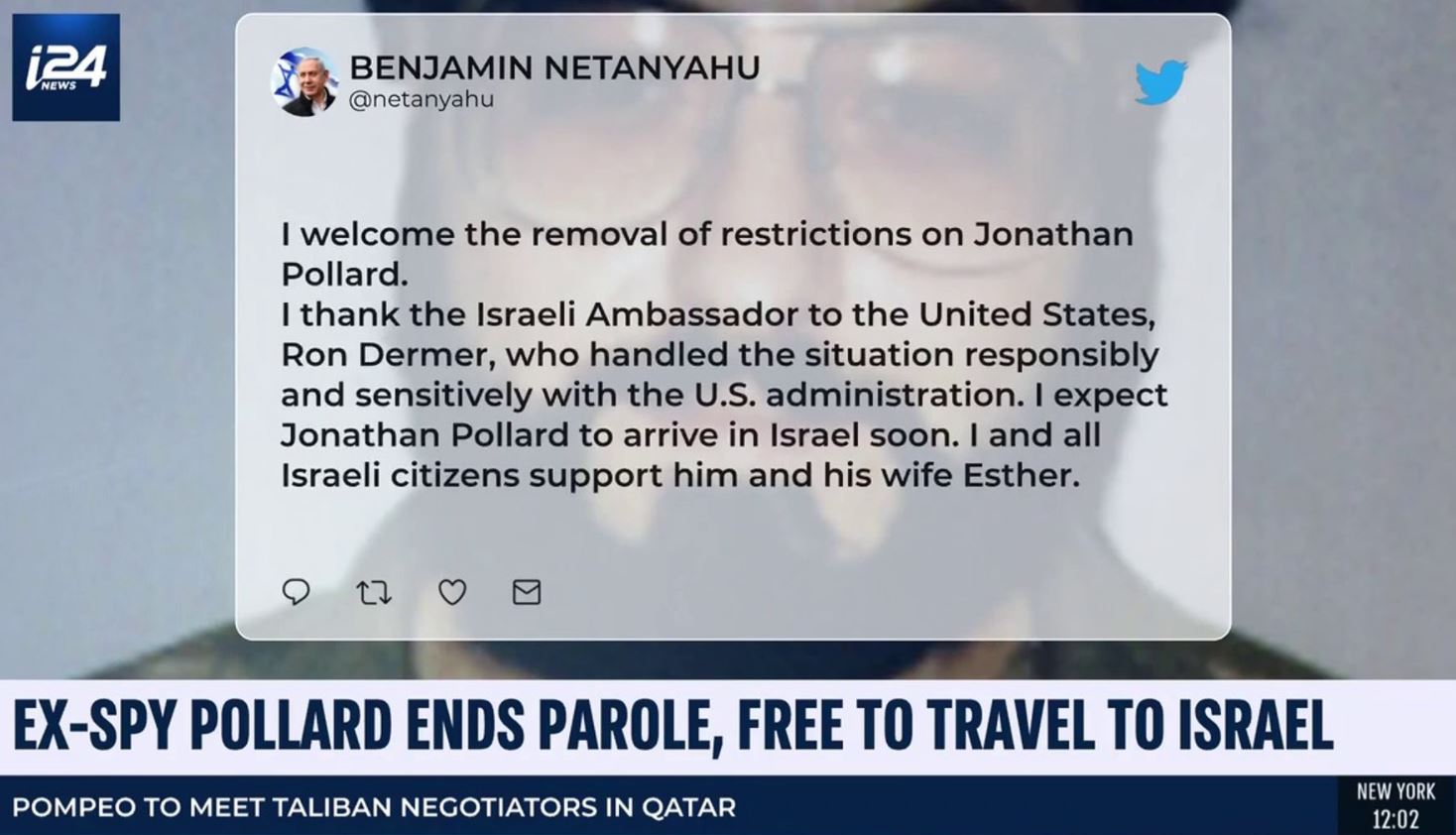
Traitor Jonathan Pollard free to go to Israel - good riddance

Netanyahu tweet on Pollard release

On November 20, Jonathan Pollard, a former U.S. Navy intelligence analyst convicted for betraying his country and selling national defense information to Israel, was freed from the terms of his post-confinement parole. That means he is now free and will undoubtedly relocate to the country he spied for, Israel, where he will be welcomed as a national hero.


Yes, that Israel, one of America's closest allies and a major benefactor of American aid, political support, intelligence sharing, and other largesse. I have stated unequivocally in the past, and will do so again - Pollard did irreparable harm to U.S. intelligence capabilities at the behest of his Israeli masters, and got only partially what he deserved. If it was up to me, he would still be in prison.


For those who may not be familiar with the treachery of Jonathan Pollard, let’s recap.


Jonathan Pollard was employed as an analyst at the what is now the U.S. Navy’s  National Maritime Intelligence Center in Suitland, Maryland. He had been granted a Top Secret clearance with access to Sensitive Compartmented Information (TS-SCI) and other special access programs (SAP). Readers with experience in the military or intelligence community will recognize those designations.


In 1984, Pollard volunteered his services to an Israeli Air Force officer attending university in the United States. He continued to work for the Israeli intelligence services until his arrest on November 21, 1985 as he and his co-conspirator wife Anne attempted to enter the Israeli embassy in Washington, DC, hoping to seek asylum.


Pollard made a plea deal with the U.S. government under which he would plead guilty to one count of conspiracy to deliver national defense information to a foreign government. Although that offense carries a maximum sentence of life imprisonment, the prosecution agreed to recommend "only a substantial number of years in prison." 


However, citing Pollard’s repeated violations of multiple terms of the agreement, on March 4, 1987, the judge adjudicating the case imposed the maximum penalty, a life sentence. That sentence was also greatly influenced by the classified damage-assessment memorandum provided by Secretary of Defense Caspar Weinberger. I have seen the damage assessment – it is truly devastating.


Apologists for Pollard claim that spying for Israel is "not really spying" since Israel is an ally of the United States. One has to consider that blanket statement that Israel is an ally of the United States with some reticence. Israel used the information provided by Pollard as "trade material" with the Russians - during the height of the Cold War - in return for the release of Jews detained in Russia. That is hardly the action of an ally of the United States.


There is speculation that American agents, people the U.S. intelligence agencies had recruited to collect information for us at great risk, were uncovered and executed because of the information the Israelis provided to the Russians. If that is the case, Pollard should have been executed instead of being sentenced to life in prison.


There is a group of Pollard supporters who claim that Pollard has been treated more harshly than others, but they fail to mention that others in the same class as Pollard - CIA officer Aldrich Ames and FBI agent Robert Hanssen - were also sentenced to life in prison. My response to the claim that other traitors have been given lesser sentences - the judges in those cases got it wrong; the judge in the Pollard case (as well as with Ames and Hanssen) got it exactly right. Unfortunately, prevailing laws at the time limits his “life” sentence to 30 years. That ended on November 21, 2015. He has been on post-confinement parole since then. While he could have been kept in that status for 15 years, he has been freed after five.


Many Israeli leaders and media outlets are citing this as a great day for Israel. It is not at all – this merely reminds that 36 years ago, someone in the Israeli intelligence services thought it would be a good idea to steal intelligence information from their greatest ally and staunchest supporter, then later reveal the sources and methods used to acquire that information to America’s greatest foes. Hardly a great day for Israel.  


So, the convicted felon/traitor Jonathan Pollard is now free to go to Israel. If he’s not in prison where he belongs, then I am glad he is not walking free in my country. Good riddance. Israel, you can have him – after all, you bought him.


To my Israeli and pro-Pollard Jewish friends (and I have many): I know we disagree vehemently on this issue. I will not change my mind, nor will I get involved in a drawn-out discussion where we are unlikely to resolve our differences. This is my view - you are free to voice your own. I simply will not respond to your misguided attempts to justify Pollard’s betrayal of my - and what was once his - country.


September 1, 2020

Movie Review: Escaping Tel Aviv (Sharif Arafah - 2009)


Escaping Tel Aviv is a 2009 Egyptian movie that takes place in mostly in Israel (filmed in South Africa). The plot involves two intelligence officers - one works for the Egyptian General Intelligence Directorate (GID), and the other is an Israeli Arab who is an officer in Mossad, Israel's civilian intelligence agency.

Both officers speak fluent Arabic and Hebrew and have similar backgrounds, so much so that the Arabic title of the movie is Wilad al-'Am (ولاد العم‎) which translates to "the cousins."

The movie begins with the Mossad officer Daniel, using the Arabic name 'Izzat (played by Sherif Mounir), leaving Port Said, Egypt, with his Egyptian Muslim wife Salwa (played by Mona Zaki) and their two children. The wife is unaware of his true identity, having met him while he was living as an Egyptian for seven years. She was also unaware that the departure was planned. Once in Tel Aviv, she is desperate to return to Egypt with her children.

Egyptian intelligence officer Mustafa (played by Karim Abdel Aziz) is assigned the mission of repatriating Salwa and the two children from Tel Aviv back to Egypt. The movie revolves around his operation to do just that.

Some comments on the production. I was surprised at the scenes supposedly set in Tel Aviv - it was convincing. I don't speak Hebrew, so I will leave an assessment of that to someone who does. I was impressed that both of the lead actors, both Egyptians, were able to sound convincing (at least to me) in Hebrew. The majority of the movie was in pure Egyptian dialect.

It has been a long time since I have used Egyptian Arabic - it took me about half an hour to get my ear re-tuned to it. This movie was made for an Egyptian audience, so they are not speaking anything resembling Modern Standard Arabic. Egyptians speak fast, and have a unique staccato style of talking. I had to pay close attention.

As many of you know, I often criticize the subtitling of Arabic soundtracks. I found this one to be about as close as could be to the original Arabic. Some colloquialisms were changed to make sense to an English-speaking (or in this case, reading) audience. The Hebrew dialogue was subtitled in both English and Arabic.

A few criticisms. The thought that the Egyptian GID would dispatch one of its best officers to Israel to repatriate a housewife and two children is a bit far-fetched. This would normally be handled diplomatically - Egypt and Israel have had full diplomatic relations since 1980. In the movie, Salwa at one point asked an Israeli Arab to direct her to the Egyptian embassy.

I will not spoil the movie, but suffice it to say that some of the tactics used by Egyptian officer Mustafa are off-the-chart unrealistic. I will let you decide which.

It's a two hour movie, and with a fair amount of the suspension of disbelief required for most fictional stories, it is entertaining. As a former operations officer, it was interesting to watch a movie about intelligence officers where Mossad is not the dominant player.

It is available on Netflix.


June 26, 2020

Movie Review: Wasp Network (Netflix - 2019)


Penelope Cruz and the movie poster

The Wasp Network (known in Spanish as La Red Avispa), released by Netflix in the United States last week, depicts a fairly successful Cuban intelligence operation conducted in the Miami area in the 1990s. The effort was focused on collecting intelligence on Cuban exile groups who were planning and conducting operations against the Castro regime. 


Many of us remember the 1996 shoot down of two Cessna 337 Skymaster aircraft belonging to an exile group named the Brothers to the Rescue (Hermanos al Rescate). The group conducted surveillance flights over the waters between Cuba and Florida, providing humanitarian assistance to people fleeing Cuba by sea. Cuba claims that the aircraft at times violated Cuban airspace (with some validity) to drop anti-Castro leaflets over cities on the island. 


The Cuban Air Force was directed to intercept and shoot down the group’s aircraft if they violated Cuban airspace again. The Castro-approved mission was codenamed Operation Scorpion. The intelligence needed to execute the operation – dates, times, and locations of the Brothers to the Rescue aircraft – was to be provided by the Wasp Network. 


It was. On February 24, 1996, a Cuban Air Force MiG-29 (NATO: Fulcrum) successfully intercepted and shot down two Brothers to the Rescue aircraft in international airspace. Despite Cuban claims to the contrary, it was later proven that the aircraft were truly in international airspace. If you are familiar with Soviet/Russian aircraft, you will note that the jets used in the movie were in fact MiG-21 (NATO: Fishbed) fighters – one unarmed. Okay, it’s a movie – we get the idea: jet fighter shoots down unarmed civilian planes. 


Over the years of its existence, the network provided a steady stream of intelligence to Cuban intelligence. They continued to operate until the network was rolled up (that’s the vernacular in the intelligence business) in 1998. 


I will not reveal any more about the movie so as not to spoil it. However, I will offer some comments on the production itself. 


It is very well acted – the cast includes known and talented actors. I like the performances of Édgar Ramírez as René González, Gael García Bernal as Gerardo Hernández/Manuel Viramontez, and of course, Penélope Cruz as René’s wife Olga (and for just being Penélope Cruz). 


This is the story of an intelligence operation, yet there was virtually no tradecraft presented. We caught only glimpses of the training of Gerardo Hernández and his mastery of his legend. The reference to shortwave radio communications between Hernández and his superiors in Havana could have been explored. 


The covert communications system, using numbers stations, is fascinating. Read more about numbers stations – read the link to the Cuban Five – they were part of this network. Note the entry of a transmission from Havana to Hernández that “under no circumstances” were network members to fly on Brothers to the Rescue aircraft on February 24 (day of the shoot down). 


The Cubans have been running intelligence operations in the United States for decades – this is their primary method of communications. (We used to use it as well – virtually all intelligence services did. Why? It works.) 


So how did the group get caught – the 10 remaining in the United States? At least one other member had already re-“defected” back to Cuba and admitted his role in the operation. Another had been arrested for an ill-advised bombing campaign against several hotels in Havana – he remains in a Cuban prison. It was Cuba’s reaction to this bombing operation that led to the exposure of the Wasp Network. 


The Cuban government provided hundreds of pages of evidence about the bombings and the bombers, hoping that the FBI would use the materials to arrest the perpetrators. Much to my satisfaction, they instead used to the materials to determine how the Cubans had obtained the evidence, their sources and methods – which turned out to be the Wasp Network. Good work – that would have been a nice addition to the movie. 


There is so much that happened during the existence of the Wasp Network. It could have made a six hour miniseries. In this format, too much is missing. 


I would recommend it for those interested in intelligence operations, Cuban exile groups, or simply to enjoy the excellent performances of Édgar Ramírez, Gael García Bernal, and of course, Penélope Cruz. Otherwise, it can be a bit tedious and convoluted. 


Watch the trailer (YouTube) here.  Watch the movie (Netflix) here. 


April 25, 2020

Miniseries Review: "Fauda - Season 3" (Netflix 2020)


Finally, Season 3 of Fauda is available on Netflix. The series tells the stories of an Israel Defense Forces Mista'arvim (undercover counter-terrorism units) team as they pursue Hamas terrorists. See my review of seasons 1 and 2.

This season, the area of operations shifts to the south. Seasons 1 and 2 occurred in the Palestinian Authority area on the West Bank around Nablus (Shechem), north of Jerusalem (al-Quds). In Season 3, the action begins in the southern portion of the West Bank to the Hebron (al-Khalil) area. By episode 6, the operation moves to the Gaza Strip. I have not been to the Gaza Strip in a long time - it was pretty bad then, and if this is an accurate depiction, it appears to have gotten worse. It is a Hamas* terrorist breeding ground.

Normally, I would advise viewers to watch Seasons 1 and 2 first, but since this story is in a different venue, the terrorist targets do not seem to be related, and there are only limited references to things from the previous seasons, so you could just watch this season.

One of my concerns with many of these shows is the lack of maps. Yes, I know these are fictional stories, but when we are talking about Israel and the Palestinians, be it the West Bank or the Gaza Strip, geography – locations, distances, and terrain – become very important.

I have taken the liberty of creating a map of the operations area. I have labeled the major places - those with red dots are either locations in which there is action in the series, or is mentioned in the series. Click for a larger view.


Note: I have tried not to provide spoilers to the story line, but only make comments on things that you might find interesting as you watch.

The initial action takes place in the city of Dhahiriya ( الظاهرية‎ – the correct transliteration using the U.S government approved system would be al-Zahiryah). Dhahiriya is located in the Hebron Governorate, 14.3 miles southwest of the city of Hebron (الخليل – al-Khalil in Arabic) in the southern West Bank, with a population of almost 40,000.

The story addresses Palestinian tunnels that allow surreptitious passage from inside the Hamas-controlled Gaza Strip under the border and into Israel proper, into an area the Israelis call “the Gaza Envelope.” This refers to the populated areas of Israel within seven kilometers of the Gaza Strip, in other words, areas that are in range of mortars and Qassam rockets fired by Hamas and Islamic Jihad from inside the Gaza Strip.

The tunnels have been in the news lately as the Israelis try to find and destroy them, as they pose a significant threat. These well-engineered tunnels can reach over a mile into Israel, allowing terrorists to launch attacks behind Israeli military posts. It is a real concern to Israeli security officials.

The tunnel in the story reaches just into Israel near the city of Sderot, located just opposite the northeast corner of the Gaza Strip. Sderot is also known as "rocket city" because of the huge number of al-Qassam rocket attacks fired by Hamas's military wing - the 'Izz-al-Din Qassam Brigades - or Islamic Jihad. I visited Sderot after the Israeli-Hamas conflict of 2008-2009 - read my article on Sderot.

Once the tunnel depicted in the story is utilized in the reverse direction, Sderot to Jabaliya, the operation shifts to Gaza.

Some things about the names of the characters in the story. You will hear actual first names, and you will hear people referred to as "Abu xxxx" (father of xxxx) and "Um xxxx" (mother of xxxx). These are what linguists call a teknonym, or in Arabic, a kunyah. A teknonym is the nickname of an adult derived from the name of his/her eldest child. For example, my son's name is Michael, I would be known to my friends as "Abu Mishal."

There is a variation of the kunyah used by Islamist fighters - they normally take a descriptive word, like "war" (harb) and add a last name of their origin - Abu Harb al-Tunisi would be "Father of War, the Tunisian."

So, to uncomplicate matters, here is a scorecard of the major players in Season 3.

Jihad Hamdan - Abu Bashar - recently released Hamas official, jailed for 20 years
Bashar Hamdan is a championship boxer

Nassar Hamdan - Abu Fawzi - Jihad's brother, father of Hamas fighter Fawzi Hamdan

Hani al-Jabari - Abu Muhammad - senior Hamas military commander

For my Arabic linguist colleagues:

One of the pleasures of watching this series is the ability to listen to the Arabic dialogue. Remember, when you hear English (dubbed), the characters are speaking Hebrew.

The subtitles are, overall, excellent – as you would expect. That said, I wish the interpretation was a closer to a translation of the actual Arabic text. The interpreters have taken a lot of literary license in the choice of the words. It really is a minor issue, but for someone who understands the Arabic, it can be a little disappointing.

As for the dialect, it has not changed – they are still speaking the West Bank version of Levantine, which linguistics specialists tell me is called Southern Levantine Arabic. To me, who has listened to hundreds of thousands of hours of various dialects, it differs slightly from what I am most familiar with - the Northern Levantine Arabic spoken in Syria and Lebanon.

My non-technical, non-linguistic explanation – this South Levantine dialect is spoken mainly in the Palestinian areas of Israel, the West Bank, and the Gaza Strip, as well as a small part of Jordan.

To me, it sounds like a mixture of Syrian and Egyptian, but definitely more Syrian. What is obvious it the influence of the Egyptian syntax and the use of the appended Arabic letter shin (ش) to indicate a negative, usually without the preceding negative ma or la. It leads to some humorous sounds, especially when a negative precedes shi, the colloquial word for thing or something. My favorite: "My wife does not know anything." Marti t’arufshi shi.

As the operation shifts to Gaza, we hear more Egyptian influence. The Levantine hawn (here) becomes hina, and ma’ (water) becomes maya – things like that.

Okay, that’s probably too far down in the weeds for most readers....

Overall assessment - a tight, well-told story, focused on one major case. I couldn't stop watching, so plan enough time to binge it in one sitting. Watch it here.

Good news – Fauda co-creator Avi Issacharoff announced that the cast and crew was “working right now” on developing Season 4 of the show.

____________
* Hamas is an acronym of the Arabic phrase حركة المقاومة الاسلامية (al-harakat al-muqawamat al-islamiyah), meaning "Islamic Resistance Movement." The Arabic word 'hamas' (حماس) means enthusiasm or impassioned, although the Hamas charter interprets it to mean strength and bravery. The US State Department designated Hamas a foreign terrorist organization in 1997.


March 30, 2020

Miniseries Review: "Caliphate" (Netflix - 2020)


The Netflix series Caliphate is centered around an operation by the Swedish Security Service (Säkerhetspolisen, SÄPO) to uncover and hopefully disrupt a coordinated terrorist attack being planned by members of the Islamic State in Iraq and Syria (ISIS). The targets are in Sweden; the planning is being done mostly in al-Raqqah, Syria.

Obviously set in either 2016 or 2017 before the anti-ISIS coalition assault on ISIS's self-proclaimed capital, the story tends to validate U.S. and most coalition partner fears that attacks against the West were actively being planned in al-Raqqah. It was this assessment that drove the timeline for the coalition's decision to use the Syrian Democratic Forces to lead the assault on al-Raqqah over strident (not to mention unhelpful, unnecessary, and counterproductive) Turkish objections over using the SDF to liberate al-Raqqah.

Turkish President Recep Tayyip Erdoğan objected to the mere existence of the SDF because its key component was the Syrian Kurdish People's Protection Units, known more commonly by the initials YPG. The Turks regard the YPG as nothing more than an extension of the Turkish Kurdish separatist group People's Workers' Party, or PKK.

The United States and some of its allies have designated the PKK as a Foreign Terrorist Organization (FTO), mostly as a courtesy to a fellow, albeit nominal, NATO ally. I have been vocal in my criticism of Turkey and Erdoğan and their disastrous policies in Syria and half-hearted fight against ISIS. See my latest on this subject, Syria and Turkey - the NATO realities.

In the series, the two lead characters are a SÄPO case officer (they use the term handler) named Fatima Zukić in Stockholm and a Turkish-Swede ISIS bride named Pervin trapped in al-Raqqah. Fatima is herself a Bosnian-born Muslim, although that facet of her character is only marginally explored.

The story is about the attack plot and Fatima's handling of Pervin, but it also touches on the tension between Sweden's ethnic Scandinavians and the Muslims who have resettled there from Iraq, Syria, Bosnia, etc. There is also a sizable Kurdish population in the country - all this thanks to Sweden's policy of allowing large numbers of refugees into the country.

Once getting her hands on a contraband cell phone in al-Raqqah, Pervin contacts a former teacher in Stockholm. The teacher contacts Fatima, hoping that the Swedish service can assist the trapped wife and her daughter return to Sweden. Once Fatima and Pervin are in contact, Pervin provides information that her husband's ISIS cell is actively planning a spectacular attack in Sweden. Of course, that sets in motion an intelligence-driven counter-terrorism operation to uncover and stop the attack.

As a case officer, I was intrigued at the thought of running an intelligence operation by phone. Running an asset requires trust and the ability to assess and vet the subject - both are difficult over a phone. Pervin was basically the electronic equivalent of a "walk in," someone who volunteers to become an asset, usually in return for something.

In this case, Pervin wanted to get herself and her daughter out of Syria and back to Sweden. My case officer mind immediately thought - she may be making this up (it's called "fabrication" in the vernacular) to get what she wants. I felt vindicated when Fatima's supervisor said the exact same thing. Walk ins can be the real thing, but mostly they are not.

In covering Pervin's story of coming from Sweden to Syria so her husband could join the fight as a member of ISIS, the series uncovers the deceit, radicalization, and treachery involved in the recruiting of not only fighters for ISIS, but also young women to become ISIS brides.

We do observe the movement of a group of young women to Syria via the Turkish city of Gaziantep. I've driven almost the entire Syrian-Turkish border (on both sides). It's about a seven-hour drive from Ankara to Gaziantep, which is a fairly nice city - good food, great sights. From Gaziantep, the major hub for moving ISIS fighters and brides into Syria, there are a few ways to go, depending on who controls what parts of northern Syria. I'd probably go further east, then two hours south to the border, then another five hours to al-Raqqah.

It is an arduous trip. As I said, I've been on both sides of that border. I would not attempt to cross it going either direction unless I had "hired a guide." It's heavily guarded, fortified, and in places, mined. I still believe that there was some collusion between ISIS (and other Islamist groups in Syria) and the Turkish government to let the crossings happen, if not actually facilitating them - that is just my opinion.

Without spoiling the story, there were some facets that strained the necessary "suspension of disbelief" required in most fictional accounts. In some places, there is too much coincidence, and of course, since it's fiction, everything falls nicely into place. In the real world of intelligence, it usually doesn't work that way. There is a lot more guesswork and estimation - we like to call it "analysis."

There was one phrase that sticks with me. One of the ISIS recruiters described al-Raqqah to potential recruits as "a magical place." I've been to al-Raqqah - it was okay before the war, right on the Euphrates River, but I have never heard it described as magical. Imagine it under ISIS rule.

Watch it, enjoy it. It is well written and well produced. With only a few minor glitches in the Arabic translations, it's solid entertainment.

There is to be a Season 2, to be released in early 2021. You can watch Season 1 here.