November 13, 2006

Iran - "Existential Threat" to the State of Israel - ADDENDUM


November 13 - "We will not tolerate the possession of nuclear weapons by Iran," [Israeli prime minister Ehud] Olmert told NBC television's "Today Show" program, ahead of talks with President George W. Bush on Iran's nuclear ambitions and the Israeli-Palestinian conflict.

Seems pretty clear to me.

-------------------------------------

Israeli Air Force F-16I Sufa (Storm)
I just returned from a tour of Israel as a guest of what many would term "the lobby." I have been to Israel several times during my career as an intelligence officer and Middle East specialist, but this trip was particularly illuminating.

I was invited in the aftermath of the summer Lebanese war between Hizballah and the Israel Defense Forces (IDF). I assumed that much of the discussion would be a post-mortem on the IDF's operations in Lebanon - I had been fairly critical of the IDF's performance against Hizballah.

As I expected, we did have a lot of discussions with IDF officers and government officials, as well as members of the press and academia about the IDF's problems in Lebanon, but the overwhelming message of the trip was the recurring and persistent theme: Iran - specifically the Iranian nuclear program - is an "existential threat" to the State of Israel. Not only did my discussants tell me this, but Prime Minister Ehud Olmert used the phrase in an October meeting with U.S. Secretary of State Condoleeza Rice - "...for the first time in my life I feel that there is an existential threat against the State of Israel."

The "existential threat"

Israel has faced, and faces, numerous threats. What makes the threat from Iran different is Israel's belief that a nuclear-armed Iran poses a threat to the very existence of the Jewish state. Forty percent of the world's Jews live in a 50 mile coastal strip centered on Tel Aviv. A nuclear strike on this area would be tantamount to a second Holocaust and would likely be unrecoverable.

The Israelis further believe that Iran, unlike other countries in the region (like Syria), cannot be deterred from launching a nuclear strike on Israel. Senior Israeli officials told me that they are of the belief that once Iran acquires nuclear weapons and the means to deliver them, it is only a matter of time until they strike. They are taking Iranian president Mahmoud Ahmadinejad at his word.

How close are the Iranians to developing a nuclear weapon?
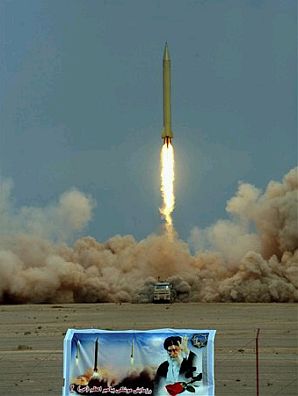
According to a senior Israeli official (in the intelligence business, we would have described him as "a source with direct access to the information"), Iran has not yet mastered the large-scale enrichment process needed to produce sufficient fissile material for weapons production. It might take them another year. After that, it could take a year of production - using cascading centrifuges - to make the required fissile material and a year after that to produce the weapons. Of course, weapons design will not be much of a problem - Iran acquired much of that technology from Pakistani nuclear scientist A.Q. Khan. All in all, the Iranians will likely have a nuclear weapon for their Shihab-3 ballistic missiles (see photo) in three years. The Shihab-3 has a range of over 1000 miles, enough to strike virtually anywhere in Israel.

The Israeli deputy defense minister said this week that Israeli military action against the Iranian nuclear program might be necessary. Ephraim Sneh, a former general, said he considered the military option was the last resort, but "the last resort is sometimes the only resort." Senior military officers believe that they have only a year to resolve the issue diplomatically, or military action will be necessary. The Israelis are fully aware of the potential Iranian reaction (See my earlier piece, When Diplomacy Fails - Reactions to an Air Strike on Iran) to a strike, but believe that the nature of the threat - the existential threat - leaves them no other choice.

In March, I wrote an analysis for MSNBC's Hardball (Iran - Israel's Air Strike Options) in which I stated that the Israeli Air Force does not have the capability to hit the approximately 1500 aim points required to effectively cripple key components of the Iranian nuclear enrichment program. I remain of that opinion.

This issue - the "existential threat" to the State of Israel - will be the main topic of conversation between American officials and Israeli prime minister Ehud Olmert this next week. Olmert arrived in the United States Sunday.

November 12, 2006

Israel's Security Fence

v

A security barrier between the occupied territories and Israel proper was proposed in 1992 by Yitzhak Rabin. Following an outbreak of violence in the Gaza Strip in 1994, the Rabin government constructed a barrier along the 1949 armistice line, effectively walling off the Palestinian area. In that same year, attacks on the Israeli coastal town of Netanya, north of Tel Aviv, caused Rabin to call for a similar barrier around the West Bank.


Click for larger imageIn 2000, Prime Minister Ehud Barak committed to construct a barrier as part of the plan for the establishment of a Palestinian state. However, it was not until the wave of attacks by suicide bombers originating in the West Bank in 2002 that the government of Ariel Sharon began building the barrier.

There have been numerous complaints and court challenges to the route of the fence (see map - right). Palestinians claim that the fence does not adhere to the 1949 armistice line/1967 borders, but rather is an attempt to seize Palestinian Click for larger imageterritory. There is some validity to this claim, and Israeli courts have upheld some of the legal challenges. The basis of the claims is that the barrier juts into the West Bank, what most consider Palestinian areas, to include Israeli settlements located on the West Bank (see photo - left). It's a hard argument to refute.

I just returned from a trip to Israel, which included a briefing on the barrier, a trip to the fence as well as a helicopter tour over the fence (I took the photos on this page). The barrier is about 95 percent fence and five percent wall. Concrete wall sections, about 25 feet high, areClick for larger image used in city areas (including Jerusalem) or in areas where Palestinian areas are close to Israeli areas. The entire system is designed to be, where possible, three fences - stacks of barbed wire for the two outer fences and a lighter-weight fence with intrusion detection equipment and cameras in the middle. Patrol roads are provided on both sides of the middle fence, an anti-vehicle ditch is provided on the West Bank side of the fence, and a smooth dirt strip on the Israeli side for tracking is provided (see photo - right). When completed, the barrier will include more than 400 miles.

According to Israeli officials, the barrier has been extremely effective, reducing terrorist incidents by 90 percent from 2002 to 2005. Read the official Israeli information on the fence at the IDF Security Fence website.

November 10, 2006

Former DCI Bob Gates - New Secretary of Defense

The probable next Secretary of Defense brings a unique background to the table that may have the unintended consequence of healing the rift between current Secretary Donald Rumsfeld and the recently created Director of National Intelligence (DNI) John Negroponte.

Robert Gates began his government service as a United States Air Force intelligence officer, followed by a career as an analyst with the Central Intelligence Agency. He rose to the position of Deputy Director for Intelligence in 1982, then deputy director in 1986. There was a break in CIA service when he served on the National Security Council. Although he was nominated to be the Director of Central Intelligence (DCI) in 1987, he withdrew his name because of controversy over his role in the Iran-Contra affair. Gates served as the deputy National Security Adviser for President George H.W. Bush from 1989 to 1991, after which he was named the DCI.

Gates served in the senior Bush White House with Brent Scowcroft, James Baker and Colin Powell, all three now against the current policy in Iraq. Gates himself has been somewhat critical of the conduct of the war - not the war itself, but the execution of it.

Besides being a perceived breath of fresh air at the Pentagon, Gates may be able to lessen the tension between the Department of Defense and the DNI. After the creation of the DNI, Secretary Rumsfeld directed that all intelligence matters in the Defense Department be coordinated by the Undersecretary of Defense for Intelligence, and that office to be the primary point of contact between the department and the DNI.

In essence, it was Rumsfeld's way of maintaining Defense control over the majority of the country's intelligence assets. Gates, with his intelligence background, may be able to come up with a better arrangement and improve the ailing intelligence system.

November 7, 2006

Defense Language Institute Hall of Fame

I was honored to be named to the Defense Language Institute Hall of Fame. You can read the story here in the local Monterey newspaper.

October 20, 2006

Iraqi Insurgency and the Jihadist Tet?

This article appears on the MSNBC Hardball with Chris Matthews blog

For at least the last two years, government officials and military officers have shied away from comparisons between Iraq and Vietnam – with good reason. There are few parallels between the two situations. New York Times columnist Tom Friedman recently called the current violence in Iraq "the jihadist equivalent of the Tet offensive." I am sure the leadership – both civilian and military – at the Pentagon cringed when President Bush said that Friedman might be right.

The Tet (lunar new year) Offensive of 1968 was a concerted effort by the Viet Cong and the North Vietnamese Army to strike a decisive blow at South Vietnamese and American forces. Militarily, it was a defeat for the North Vietnamese and effectively destroyed the Viet Cong as a fighting force. However, it created what military strategists call the “significant emotional event” that turned the tide of public opinion in the United States against the war and led to the eventual withdrawal of American forces from Southeast Asia. The creation of a “significant emotional event” is an acknowledged tactic for an insurgency, along with attempts to influence the media. Most successful insurgencies do not succeed on the battlefield – they succeed in the national psyche of the occupying country.

Other examples of a “significant emotional event” involving deployed U.S. forces:


- the bombing of the Marine barracks at Beirut airport in 1983 by Hizballah in which 241 American servicemen were killed. Less than four months later, President Reagan ordered the Marines to withdraw.

- the battle in Mogadishu, Somalia in which 18 Army Rangers were killed in a day-long firefight with forces of guerilla leader Mohamed Farrah Aidid. Although the raid technically achieved its objectives, the loss of two helicopters and the mistreatment of the bodies of American troops caused President Clinton to withdraw the troops a few months later.

Foreign militaries and insurgents alike took note of these events. Prior to the American-led invasion of Iraq in 2003, Saddam Hussein provided copies of the book Blackhawk Down (which chronicled the Mogadishu battle) to his senior commanders. Knowing full well his forces could not effectively fight American troops force-on-force, he believed that using such tactics might either delay the battle long enough or cause enough American casualties to achieve some negotiated settlement.

President Bush, his spokesman Tony Snow and Multinational Forces-Iraq spokesman Major General William Caldwell have all stated that they believe the timing of the increase in violence is not coincidental. All three have commented that the insurgents may be trying to influence the upcoming U.S. elections.

It could be – we have seen numerous examples that the insurgents, be they Iraqis or foreigners, are well versed in the American media’s impact on public opinion. They may be increasing the level of attacks on American forces – this has been the bloodiest month for U.S. troops in two years – rather than attacking each other. Their likely goal: creating that significant emotional event that will either turn American public opinion against the war or influence the upcoming election, or both.

--------------
Lt Col Rick Francona is an MSNBC military analyst and a veteran of both the Vietnam and Persian Gulf wars.

Insurgent Parades in Anbar Governorate?

AP Story: Iraqi insurgents stage defiant parades

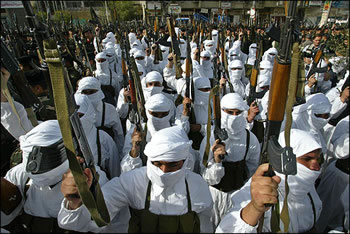
On Friday, the Muslim holy day, Iraqi insurgents staged military style parades in several cities in volatile Anbar Governorate, including the city of Al-Hadithah. Several of these were near to U.S. military bases. This follows a similar parade in Ar-Ramadi (capital of the governorate) on Wednesday.

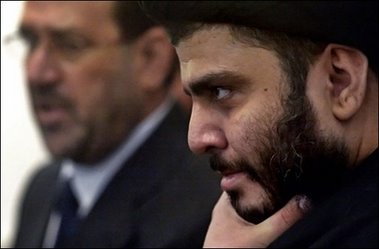
All of this comes at a time when many American troops have been withdrawn from the area and repositioned in Baghdad to try and stem the spiraling violence there. According to the Multinational Force-Iraq spokesman, that effort has largely been unsuccessful. Also going on at the same time is increased activity by the Shi'a militia of radical cleric Muqtada As-Sadr, the jaysh al-mahdi (Mahdi Army). This militia seized control of Al-'Amarah (see my earlier piece, Iraqi prime minister and the militias - ADDENDUM.)

The Iraqi government is either incapable or unwilling to act forcefully to put down this violence and the defiant shows of force. They have got to start or they have rendered themselves irrelevant and a civil war in inevitable. Where are the American forces? How can a band of insurgents brazenly parade through cities brandishing automatic weapons and rocket-propelled grenade launchers?

Get out of your garrisons and start killing these people.

Iraqi prime minister and the militias - ADDENDUM

This is an addendum to my earlier piece, "Iraqi prime minister and the militias."

The Associated Press reported today that the 800 members of the jaysh al-mahdi (Mahdi Army) had taken over the southern city of Al-'Amarah (read story), in direct defiance of the Iraqi government. The militia members destroyed local police stations, set up checkpoints in the city, began armed patrols of the streets and ordered residents to remain indoors. British forces pulled out of Al-'Amarah in August. Since then, the Mahdi Army has tried to enforce adherence to Islamic law. The Mahdi Army is the militia associated with radical Shi'a cleric Muqtada As-Sadr.

Iraqi prime minister Nuri Al-Maliki dispatched a delegation to negotiate the situation in the city. If he handles this like he has dealt with other militia activity, especially that of As-Sadr's Mahdi Army, not much will happen. If he is not willing to use Iraqi security forces to restore order, this will happen in other cities, and the spiral toward civil war will accelerate.

October 18, 2006

Iraqi prime minister and the militias

There was a news story reported by the Associated Press today that concerns me. "Iraq orders US to release Shiite activist" details the release of a senior member of Muqtada As-Sadr organization at the "order" of Iraqi prime minister Nuri Al-Maliki.

According to the story, Shaykh Mazin As-Sa'di was detained by American forces in the heavily Shi'a Al-Kazimiyah section of Baghdad. A spokesman for As-Sadr claimed that the shaykh was arrested to provoke his jaysh al-mahdi (Army of the Mahdi) militia in to an armed confrontation. He further said it will not work because As-Sadr has counseled restraint. As well he should - the last time he tried an armed confrontation with U.S. forces (May 2004 in An-Najaf), his militia was decimated.

What is more disturbing is the prime minister's reluctance to confront any militia in general and the As-Sadr militia in particular. This further plays into the Sunni disdain for Al-Maliki, who they openly refer to as "the Iranian." Al-Maliki is a devout Shi'a and a member of the Dawa' party, pro-Iranian Shi'a hardliners.

As far as militias in general, he openly disagrees with the commander of U.S. forces in Iraq, General George Casey. Casey is on record that the militias - all militias - must be disbanded. He has relayed that belief to Al-Maliki where is seems to have fallen on deaf ears. Casey claims that Al-Maliki understands that the militias need to be disbanded, just not now. Based on my experience with the Iraqis (and Arabs for that matter), this bukrah (tomorrow) attitude is in essence a "no."

This is troubling. Many observers believe that the As-Sadr militia is one of the main factors in the increasing sectarian violence that threatens to plunge Iraq into an all out civil war. American forces are being caught in the crossfire, as well as possibly being directly targeted by these Shi'a hardliners.

In the past, Al-Maliki has bristled following American raids into Sadr City, a strong hold of the Jaysh Al-Mahdi, at one point apologizing for such a raid and promising that it would not happen again.

Meanwhile, Baghdad remains a sectarian battleground. It's time for Al-Maliki to start being part of the solution instead of part of the problem. Otherwise, he has to go.

October 16, 2006

Saddam Husayn Verdict/Sentencing Due November 5

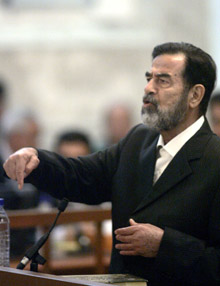
Saddam on trialOn November 5, the Supreme Iraqi Criminal Tribunal will publish the verdict of the first trial of Saddam Husayn; sentencing will occur at the same time. Saddam and his seven co-defendants could be sentenced to death by hanging for the murder of 146 Shi'a Iraqis in the town of Ad-Dujayl following an assassination attempt there. Saddam's co-defendants include his half brother Barzan At-Tikriti, former chief of the Iraqi Intelligence Service.

As the publishing of the verdict approaches, violence directed at the court and prosecution continues. The brother of the top prosecutor in Saddam's second trial was murdered in front of his wife at his home in Baghdad on October 16. This comes just two weeks after the brother in law and nephew of the judge in that same trial were murdered. While awaiting the results of the first trial, Saddam and six co-defendants are being tried on charges of crimes against humanity, specifically the killing of thousands of Kurds in the Anfal campaign during the Iran-Iraq war.

This violence is an attempt on the part of the insurgency - specifically former regime elements - to intimidate the prosecution of the former Iraqi leader. As the November 5 announcement of the verdict, which most observers expect to be "guilty," violence may escalate. If Saddam is found guilty and sentenced to death, there may be a spike in insurgent activity.

As he waits to be found guilty - at some point one of the charges will stick - Saddam is not going quietly into the night. In a letter released via his lawyers (including the despicable American Ramsey Clark - see my earlier comments on that), he urges Iraqis to disregard sectarian differences and unite in forcing American forces out of Iraq. Claiming that victory was close at hand, he signed the letter as the president and commander-in-chief of the "holy warrior armed forces."

Since Saddam's main accusers are the Shi'a and Kurds - together about 80 percent of the population - that suffered so badly under his rule, I wouldn't put much stock in his prediction.

Declaration of "Islamic Iraq" - ADDENDUM

On October 16, the "media committee" of Mujahidin Shura Council of Iraq made the following announcement:


In the blessed month of Ramadan, there is good news from The Land of the Two Rivers [Mesopotamia], the land of the caliphs, from Baghdad, the capital of the caliphate - may Allah free it from the Crusaders and the Shi'a.

The fruits of the monotheism tree, irrigated with the martyrs' blood, has ripened and it is time for the harvest. We are united, and the mujahidin bring good news to the Islamic nation everywhere, especially to the Sunnis in Iraq, about the foundation of the proper state, an Islamic state which will rule the land and people with Allah's law which will protect the Sunnis in Mesopotamia.

The media committee has the honor to present to all Muslims everywhere the message of the establishment of the Islamic State of Iraq in the Iraq in the name of the Ministry of Information. We invite all Muslims in the world to support this state with money, men and prayers.

There are some key phrases in this announcement. They refer to the caliphate, an Islamic governmental structure tying religion and the state into one entity. Further, they reference "Allah's law," which means the imposition of the Sharia', strict Islamic law. Note also the desire to rid Baghdad of not only the Crusaders (the U.S-led coalition), but the Shi'a as well. This is a state for the Sunnis.

Given the chosen name of the new state, the Islamic State of Iraq, I am of the impression that this structure is not within the constitutional provisions of autonomous regions, but an actual independent country.