
This article appeared on MSNBC.com
It's time for Blackwater to leave Iraq
Francona: Private security company is a problem the U.S. doesn't need
COMMENTARY
By Lt. Col. Rick Francona
Military analyst
MSNBC
The killing of two Iraqi women in Baghdad by an Australian private security contractor has again highlighted the ongoing debate about the role of private security companies in Iraq.
Although there are numerous contract security firms in Iraq, one name always comes to mind, Blackwater USA. One of Blackwater’s major contracts is to provide security, mostly convoy security, for members of the American Embassy in Baghdad as they travel around the area.
It was such a mission that has led to the current scrutiny. On Sept. 16, there was an incident in which 17 Iraqis were killed by Blackwater employees and the Iraqi government believes Blackwater is at fault. The Iraqi government is demanding not only $8 million compensation per victim, but that the United States also hand over Blackwater employees involved in the shootings to face Iraqi justice.
The U.S. government's use of contractors is not unique to the Iraq war nor to the present. It goes back to the Civil War and the push west under Manifest Destiny. Sutlers provided rations and supplies as the U.S. Army moved west. In World War II, contractors were a common sight on military installations, and have always been considered a “force multiplier.” Why use trained soldiers, sailors, airmen and marines to do routine, non-military type functions when you can contract them out? Duties such as cooking, cleaning, construction, maintenance, supply, etc. can all be done more effectively by contractors, freeing up trained military personnel for direct combat, combat support and combat service missions.
As the size of American military forces became an issue and troop ceilings were mandated, the use of contractors became even more important. Contractors normally do not count against troop strength. When the Department of Defense is ordered to station only a finite number of troops in a particular area, the use of contractor support allows that lower number to be met more easily. You can maintain a larger force with contractors than without. The advantage is a more potent military force with fewer active troops.
In recent years, the role of contractors has changed, by necessity. With the drawdown of the U.S. military to about one-half of one percent of the population, coincident with a two-front war and our existing global commitments, there are not enough combat forces to meet all the requirements. To meet the demand, contract personnel have moved into roles formerly reserved for military personnel.
Increased contractor roles have provided lucrative opportunities for people with the right skills, including Arabic linguists, interrogators and, of course, former members of elite combat forces, specifically the Navy SEALs and Army Special Forces. The use of contractor linguists and interrogators became an issue during the Abu Ghraib scandal and at Guantanamo.
Why? The problem is accountability and the ambiguous legal status of contractors. At the Abu Ghraib prison, because they possessed skills critical to the mission, contractors operated outside the normal chain of command and in conditions conducive to abuse. Their status was never officially defined and their legal status not negotiated by the organization sponsoring the contract. What we have seen also is a fundamental change in the use of contractors.
In the past, they provided support and now they have become an integral part of the mission. It is hard to imagine a deployed U.S. military force operating without contractors. This may not sound like a good idea, but with the size of the U.S. military, we have little choice.
The issue at hand is the use of private security companies in Iraq. For the most part, these companies provide a necessary service, guarding supply convoys and protecting infrastructure. Unfortunately, the highly visible presence of companies like Blackwater on the streets of Baghdad has made their name almost a household word. In Baghdad it evokes the same negative psychological response as Abu Ghraib.
Fair? Maybe not, but that is not the issue. The issue is perception, and in the Middle East the perception quickly becomes the reality. Blackwater, once an asset to the U.S. Embassy for protection of its diplomats has become a liability for the overall mission of the United States. This comes at a time when there are some positive results in American military operations.
The Blackwater issue is a distraction we don’t need. The State Department needs to cancel that contract, then enter into another contract but this time with better oversight by the Diplomatic Security Service and well-defined legal parameters.
© 2007 MSNBC Interactive
October 11, 2007
It's time for Blackwater to leave Iraq


October 4, 2007
Keep U.S. troops in Iraq for the long haul
This article appeared on MSNBC.com
Keep U.S. troops in Iraq for the long haul
Forces need to stay — with correct mission — to protect interests in region
COMMENTARY
By Lt. Col. Rick Francona
Military analyst
MSNBC
In the last Democratic candidate debate, neither of the two front-runners would pledge that by the end of his or her first term there would be no U.S. troops in Iraq. Sen. Barack Obama said he would “drastically reduce our presence there to the mission of protecting our embassy, protecting our civilians and making sure that we’re carrying out counterterrorism activities there.”
There are two separate but related issues here, the continued presence of American forces in Iraq and the definition of their mission. First, let’s look at the definition of the mission. Limiting the troops to the three specific missions articulated by Sen. Obama is not only unrealistic, it’s virtually impossible. If there are American troops in Iraq, they will have to address any and all threats, be they from Iraqi insurgents, Shiite militias or al-Qaida terrorists. Are the troops supposed to ask the affiliation of a threat prior to taking action? Does the senator propose to restrict the military with impossible rules of engagement such as, “Determine that the opposing forces are in fact members of al-Qaida in Iraq before commencing hostilities
The senator should have added to his list of missions “protecting America’s vital interests in the region.” In real terms, that means protecting access to Persian Gulf oil — yes, it’s about oil — and maintaining the security of the state of Israel. These have been our interests for years, and adequate protection of those interests requires the presence of American military forces in the region.
American troop presence in the region is nothing new. The U.S. Navy has maintained a continuous presence in the Persian Gulf since World War II. The headquarters of the Navy’s forces in the region, now called the Fifth Fleet, is in Mina Sulman, Bahrain. Air Force units began deployments to Saudi Arabia soon after the 1979 Iranian revolution — those units are now located in Qatar and the United Arab Emirates. Although the U.S. Central Command tried to get a land force presence in the region, it was unsuccessful until the Iraqi invasion of Kuwait in 1990. Since the liberation of Kuwait, American ground forces have maintained a facility there for storage of equipment called prepositioning, or “PREPO” in military parlance, and staging of units entering Iraq. The United States now has defense pacts with several gulf countries, and many of these states regard the United States as a counterbalance to increasing Iranian power and influence in the region.
I don’t believe Sen. Obama would disagree with the premise that we need to keep troops in the Persian Gulf region to protect our national interests. Just as we have had troops in Europe and Asia since the end of World War II, we need to maintain a military presence in the Middle East. Our interests there are no less vital than our interests elsewhere and are likely more at risk. The rhetoric of Iranian President Mahmoud Ahmadinejad during his visit to New York and the Israeli airstrike on a possible North Korean nuclear-related facility in northeast Syria underscore the point.
If we can divorce the emotion over the war from the argument, Iraq is an ideal location to project U.S. power throughout the region. It is centrally located and home to excellent facilities such as the sprawling air base at Balad. If we assume that the two primary threats to security in the region are Iran and Syria, an American military presence in Iraq places our forces in a central position to counter those threats with military force if necessary. Combined with effective diplomatic initiatives that have virtually surrounded Syria and almost surrounded Iran, the United States can leverage military presence to bring pressure on these two rogue states.
Iraq is not only centrally located, but it is more accessible via sea, air and land than the other options. The Persian Gulf provides sea access via the newly upgraded ports of al-Basrah and Umm Qasr. Land access from Kuwait and Turkey can be complemented by access from Jordan, whose port at al-Aqaba was Iraq’s proxy port when its access to the Persian Gulf was blocked by Iran during the Iran-Iraq War. Air access via NATO ally Turkey provides excellent access to American military facilities in Europe and Central Asia.
The debate over whether we should have invaded Iraq has become a historical argument. Now that we have forces there, we need to make sure we can address future threats in the region effectively. Troops in Iraq — a stable Iraq, I hope — will give us that ability.
© 2007 MSNBC Interactive
September 30, 2007
Attack the Iranians? It's about time!
 According to an article by Seymour Hersh in the New Yorker magazine, the U.S. military is planning air strikes on Iranian Islamic Revolutionary Guard Corps (IRGC) facilities. This article, if true – consider the source – purports that the planning, being done by the Air Force planners at the Pentagon, has shifted from strikes on key facilities of the Iranian nuclear program to strikes on IRGC Qods Force installations.
These people have been killing our troops – it’s time to hit back.
The Qods Force is the elite special operations unit of the IRGC. They have been sent into action in Lebanon, Bosnia, Chechnya and Iraq, and probably as of late, Afghanistan. They have American blood on their hands in Lebanon and Iraq for sure, and possibly recently in Afghanistan. It is the Qods Force that is providing the Iranian-made weapons components – explosively formed projectiles - being used in roadside bombs that have killed over a hundred American troops in Iraq.
It goes back for decades. In Lebanon, the IRGC was directly involved in the 1983 attack on the Marine barracks at Beirut airport, complicit in the kidnappings, torture and murders of CIA Beirut station chief Bill Buckley in 1984 and U.S. Marine Corps Lieutenant Colonel Rich Higgins (serving with the United Nations) in 1989.
The Qods Force has been involved in other Iranian special operations in Europe, Asia and Africa. It was members of the Qods Force who were dispatched into southern Iraq in 1991 to foment the failed uprising against Saddam Husayn. They provided weapons to fundamentalist Islamic groups in Algeria in the early 1990's. In 1995, the Qods Force was involved in smuggling weapons to Bosnia's mostly Muslim army.
Of course, there are those who fear that any strike into Iran will cause the Iranians to unleash a wave of terrorism against U.S. interests in the region or elsewhere in the world. Maybe, but we cannot hold our foreign policy hostage to what the Iranians might do. Those who counsel against military action also have no alternative plan to deal with the problem. Diplomacy? Has that in any measure slowed the Iranian nuclear program?
The Iranians have attacked our troops - we owe it to them to hit back. At some point, we are going to have to address the growing Iranian threat – terrorism, nuclear, or both. Hurting the IRGC is a good place to start.
September 28, 2007
The Israeli air strike in Syria - what the target wasn’t....

In the aftermath of the September 6 Israeli air strike in northeast Syria, there has been much speculation about the target. Neither the Israelis nor the Syrians are talking about what was hit, only that there was a strike.
Whatever the target was, the Israelis considered it of such importance that it mounted a long-range raid to attack it. The area of the strike, Dayr az-Zawr, is fairly remote, yet on the Euphrates River, providing some infrastructure to support a large industrial facility.
What target would be of such significance? The speculation is that there were some nuclear-related materials from North Korea. The North Koreans have been in Syria since the 1970's. When I was the air attaché in Damascus in the early to mid 1990's, the North Koreans supplied Scud C ballistic missiles and mobile launchers. The North Korean military attaché spoke fair Arabic, so we chatted on occasion – he never denied that his country was in the missile export business. Not a bad guy, just on the wrong side. He was killed in car accident in Lebanon - against direction from the Defense Intelligence Agency, we American attachés attended the funeral, only to be lambasted by his widow for being "imperialists."
I was asked if I believed the target could have been a chemical weapons (CW) production facility. I doubt Israel would go all the way to Dayr az-Zawr to hit a CW facility – the Syrians have had indigenously-produced GB/sarin and VX nerve agents for years. We also believe they have CW warheads for their SS-21, Scud C and Scud D missiles. In 2003, the Central Intelligence Agency prepared a report for Congress (Unclassified Report to Congress on the Acquisition of Technology Relating to Weapons of Mass Destruction and Advanced Conventional Munitions) that detailed Syria’s possession of the chemical munitions.
The Israelis know about Syria’s chemical warfare capabilities and have chosen to accept them. It has been Syria's poor man's mutual assured destruction weapon - if they launch a first-strike CW attack against Israel, they know what is coming back at them. It does, they believe, provide a deterrent against a major Israeli attack on Syria - a properly delivered GB or VX warhead over Tel Aviv could kill 8000 people (based on computer modeling).
I don’t know what the target was, but it had to be more than another CW facility. To me, that means something more menacing, like a nuclear facility.
September 26, 2007
NBC Nightly News
I contributed to an NBC Nightly News report on an operation possibly targeting Usamah Bin Ladin in Afghanistan last month.
The text story:
Bin Laden may have just escaped U.S. forces
August mission in Tora Bora almost snared 'high value target'
By Justin Balding, Adam Ciralsky and Robert Windrem
NBC News
A little more than a month ago, with the anniversary of Sept. 11 approaching and fears of a new al Qaeda attack rising, some U.S. intelligence and military analysts thought they had found one of the world’s two most wanted men just where they last saw them six years ago.
For three days and nights — between Aug. 14 and 16 — U.S. and Afghanistan forces pounded the mountain caves in Tora Bora, the same caves where Osama Bin Laden had hidden out and then fled in late 2001 after U.S. forces drove al Qaeda out of Afghanistan cities. Ultimately, however, U.S. forces failed to find Bin Laden or his deputy, Ayman al Zawahiri, even though their attacks left dozens of al Qaeda and Taliban dead.
One of the officials interviewed by NBC News, a general officer, admitted Tuesday that it was “possible” Bin Laden was at Tora Bora, saying, in fact, "I still don’t know if he was there."
Still, some in the special operations and intelligence community are telling NBC News that there was a lack of coordination particularly in the choice of support troops. But with intelligence limited on who was there, no one is willing to say that the lack of key units permitted Bin Laden or Zawahiri to escape.
When the operation began in early August there was no expectation that Bin Laden or Zawahiri would be there, say U.S. military and intelligence officials. Instead, there was intelligence of a pre-Ramadan gathering of al Qaeda including "leadership" in Tora Bora. Senior officials in the U.S. and Pakistan tell NBC News that planning for the attacks intensified around Aug. 10 once analysts suggested that either Bin Laden or Zawahiri may have be drawn to the conference at Tora Bora. (When U.S. forces attacked al Qaeda camps in August 1998, following the East Africa embassy bombings, Bin Laden was attending a pre-Ramadan conference of al Qaeda in the same general area of eastern Afghanistan).
While the intelligence did not provide “positively identification” that Bin Laden or Zawahiri were at the scene, there was enough other intelligence to suggest that one of the two men was there. Bin Laden and Zawahiri are not believed to have traveled together since mid-2003 for security reasons.
Another official said that intelligence analysts believed strongly that there was a high probability that “either HVT-1 or HVT-2 was there,” using U.S. intelligence descriptions — high value targets — for Bin Laden and Zawahiri. He added that while opinion inside the agency was divided, many believed it was Bin Laden rather than Zawahiri who was present. The reason: “They thought they spotted his security detail,” said the official, a large al Qaeda security detail — the kind of protection that would normally surround only Bin Laden, or Zawahiri.
Also, locals reported the presence of groups known to be part of Bin Laden’s security detail —Chechens, Uzbeks and other Arabs, men willing to die rather than surrender top al Qaeda officials.
The military operation included "several hundred" U.S. and Afghan ground forces, say officials. Elements from the 82nd Airborne blocked off escape routes through the mountains on the Afghanistan side of the border, while helicopters inserted U.S. Navy Seals at night. The Seals pinpointed enemy positions and called in air strikes; the 82nd came in and "mopped up."
On the other side of the border, a senior Pakistani official says the U.S. military helped thousands of Pakistani forces — including their elite commando units — set up a blockade to sweep up any al Qaeda fleeing Afghanistan.
Any operation to take down Bin Laden or Zawahiri would have been formidable.
“He's surrounded by the true believers,” reported Rick Francona, who worked with CIA and special ops teams in Iraq in the 1990s. “And they will fight to the death to protect him, they will probably even kill him before they allow him to be captured. So if you're going to go in that area, you have to go in there with enough force that you think you can accomplish this mission successfully and not lose all of your guys in the process.”
One senior military official said Joint Chiefs Chairman Gen. Peter Pace personally briefed the president on the specifics of the ongoing operation.
The operation closely parallels the killing of Abu Musab al Zarqawi last year. NBC News reported at the time that the U.S. military did not positively determine that Zarqawi was in the house that was bombed. Instead, they had surveillance on Zarqawi's spiritual adviser who led them to the house, and the decision was made to take the shot because they didn’t want to miss the chance to get Zarqawi. One general predicts, "That's the way we'll get Bin Laden." They may not have that positive ID, but there'll be enough intelligence to prompt an air strike and they'll find Bin Laden in the rubble.
What happened this time? Military officials admit there were unidentified "planning and coordination problems" even before it got to execution, “primarily between the operators and the generals who give the go-orders” added an intelligence official. A company of the 82nd Airborne was brought in since a Ranger team trained in special operations was not available. But the combination of the “dark side” — the SEALs — and the conventional — the 82nd Airborne — didn't work. "They didn't gel," said the military official. There was "a lack of responsiveness to the intelligence and a lack of aggressiveness."
Michael Sheehan, a former Army Special Operations colonel and counter terrorism ambassador, says he is not surprised.
“Our response is normally too big, too slow, too cumbersome and too risk adverse and those factors normally come from Washington,” said Sheehan.“The operators normally want to go in much smaller, much more low profile in order to be able to get to the target without being identified and as those plans go up the chain of command they normally get much bigger and much more cumbersome.”
But the bigger part of the picture is the question of allocation of resources from Afghanistan to Iraq. All Delta Force and “dark side” Rangers were moved to Iraq, said a special operations officer involved in the Afghanistan operation. Left behind in Afghanistan were SEAL Team Six and some Rangers. But apparently in this case, not enough “dark side” were available. The 82nd, said a second special operations officer, “is a poor substitute … [it is] a blunder to use them on an op with dark side operators.”
Justin Balding is a Producer for Dateline NBC. Adam Ciralsky is a producer with the NBC News investigative unit. Robert Windrem is an investigative producer for NBC News special projects.
© 2007 MSNBC Interactive
_________________
The video can be seen on this page: http://www.msnbc.msn.com/id/21000298/
September 23, 2007
Italy – you brought this on yourselves

According to reports out of western Afghanistan, two Italian soldiers have been kidnapped by members of the Taliban – many believe they are likely associated with the Italian military intelligence service SISMI (Servizio per le Informazioni e la Sicurezza Militare).
This comes in an area that has not been known for recent violence. Now we have two members of the Italian contingent possibly kidnapped. Why would two Italians be kidnapped in this area? Perhaps it is because Italy has gained the reputation as the country that pays ransoms for the release of its nationals, both in Iraq and Afghanistan.
Their past dealings with insurgent hostage-takers:
In July of this year, the Taliban kidnapped over 20 South Koreans, two Germans and five Afghans. Why? They think kidnapping work. Why not – Italy caved in and paid money and announced a troop withdrawal from Iraq, Karzai released a senior Taliban official as part of the Mastrogiacomo deal, and South Korea paid money. If you are the Taliban, the message is that kidnapping works.
The Taliban has been taking heavy casualties since the spring, after their announced “offensive.” Unable to match US and NATO forces in battle, they have resorted to roadside bombs, suicide bombing and kidnapping as their primary means of insurgency.
The Italians have created this problem for themselves. When the Iraqi insurgents or the Taliban see an Italian, they see a paycheck walking.
September 21, 2007
Pick a side, Mr Barzani
KRG President Mas'ud Barzani and author
Salah ad-Din, Iraq - 1995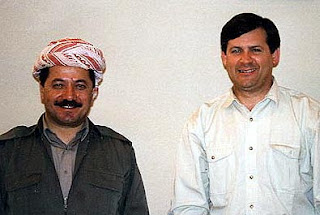
Iran has been providing money, weapons and training to Shi’a militias in Iraq for some time now. These weapons include the lethal explosively-formed projectile (EFP) used in improvised explosive devices that have killed and wounded hundreds of American troops. In recent weeks, both the Secretary of Defense and commander of the U.S. Central Command have accused Iran of providing these same EFP’s to the Taliban in Afghanistan.
As part of the effort to interdict the flow of these weapons into Iraq and to prevent further casualties, U.S. forces have begun hunting down members of the Iranian Islamic Revolutionary Guard Corps’ elite Qods Force who have infiltrated into Iraq. Five such operatives were detained in January in the Kurdish city of Arbil. Iran claims them to be diplomats, and the Iraqi foreign minister (himself a Kurd) demanded their release. They are still in U.S. custody.
Earlier this week, American forced arrested another Iranian accused of smuggling explosive materials into Iraq. The arrest occurred in as-Sulaymaniyah, the major city in northeast Iraq, part of the Kurdish autonomous region. Iran, as expected, called the detained member an economic envoy, and threatened economic retaliation against the prosperous Kurdish area – prosperity largely due to Iranian trade.
Kurdistan Regional Government president Mas’ud Barzani called the action illegal. Mr Barzani, you need to determine whose side you are on. Are you going to blindly support the Iranian regime of Supreme Leader Ayatollah Ali Khamenei and President Mahmous Ahmadinejad, or back the American forces that have been responsible for the security and prosperity of Iraq’s Kurds for the last 15 years?
Of course, many of the KRG’s actions have not been helpful. They have, as is their right under the Iraqi constitution, formed an autonomous region comprising three provinces in the Kurdish area of northern Iraq. Fine, that’s probably the wise thing to do given the situation in the rest of the country - the Kurds have successfully established a prosperous, secure zone.
However, the KRG acts like a sovereign nation, not an autonomous region under the jurisdiction of the central Iraqi government in Baghdad. Earlier this year, KRG President Barzani banned the Iraqi national flag from public buildings in the region, ordering instead the display of the Kurdish flag. Many consider this to be an indication that the Kurds intend to establish an independent state, a step sure to anger Turkey, Iran and Syria.
There are other steps that tend to indicate this intention. Last year, at least four Kurdish airlines opened for business, offering direct flights between cities in Europe and the Middle East and the newly refurbished and improved airports in Arbil and as-Sulaymaniyah.
KRG officials have also made independent deals for oil drilling and oilfield development without consulting or involving the oil ministry in Baghdad. The most recent was this month between the KRG and JB Hunt Oil, a Texas firm.
We all support the Kurds’ right to form and administer an autonomous region. I spent a lot of time with the Kurds in northern Iraq in the 1990’s – they’re my favorite Iraqis, to be sure. That said, they have to be part of Iraq. That entails supporting the American forces that are in the country and are responsible for the Kurds’ successes.
Pick a side, Mr. Barzani. Support the United States, or support Iran. Pick carefully, as I suspect there will be reckoning about Iran in the not too distant future.
September 20, 2007
Bombs for Syria – a message for Iran
Alleged raid into Syrian territory showcased Israeli air force, intelligence
COMMENTARY
By Lt. Col. Rick Francona
Military analyst - MSNBC
 Israeli F-15I Ra'am (Thunder)
 The Israeli air raid into Syrian territory on September 6 caused repercussions far beyond the dusty city of Dayr az-Zawr – the shockwaves of that small, precision attack deep into hostile territory were felt as far away as Tehran.
If media reports are accurate, the Israelis were able to detect, locate and neutralize in a very short period of time a perceived threat to the Jewish state over 600 flight miles away. Operation Orchard again showcased two of Israel’s finest national assets – the Israeli air force and the Israeli intelligence services, both among the best in the world.
There is a lot of speculation about what the actual target was - both Syria and Israel are uncharacteristically tight-lipped about it. Normally the Syrians would have mounted a loud campaign complaining about the violation of their sovereignty, and the Israelis would have released a mountain of data and photographs justifying their actions. In the absence of Syrian complaints, Israel has felt no need to speak out. I think we can dismiss the claims made by an “unnamed American official” that the targets were Iranian arms destined for Hezbollah – weapons destined for Hezbollah would not be in northeastern Syria – they arrive in Damascus by air and are trucked to Lebanon’s Bekaa Valley.
Regardless of Israel’s silence on the Syrian raid, the Israelis hope it sends a loud and clear message to Iran: Israel is capable of – and willing to use – military force against what it perceives as “existential” threats to the state. For the last year, the Israeli drumbeat over the Iranian nuclear threat has been relentless.
Let’s start from the beginning of a potential operation – identification of the threat. Israel has good intelligence capabilities in Iran, and a host of intelligence relationships with other intelligence services around the world, the most important of course being that with the American services. There is no shortage of data on Iranian intentions – the question is how far along are they in the development of a nuclear weapon. As the Israelis just demonstrated in Syria, when they believe there is an imminent threat, they will act.
Time, however, is running out for the Israelis. According to senior Israeli officials, the potential for a nuclear-armed Iran should be considered a world problem, not just an Israeli problem. They also hope for a world solution rather than being forced into an Israeli solution. Assuming that will probably not happen, the Israelis have been acquiring long-range strike capabilities for a possible strike against Iranian targets. That long-range capability is best represented in the specialized design, acquisition and modifications to the American-built F-15I and F-16I fighter aircraft. Both are easily capable of reaching targets virtually anywhere in Syria, however, getting all the way to targets deep inside Iran and back to Israel will stretch their capabilities. Factors complicating Israeli planning: the targets in Iran are spread over the country, are heavily fortified (many are underground) and defended by newly-acquired capable Russian-made air defense systems.
The Israelis have proven themselves to be resourceful military planners and operators. If there is a way to do this, they will find it. That might include flying through Turkish airspace (the two countries have had a defense pact for over a decade) into American-controlled Iraqi airspace, use of American-controlled bases in Iraq, use of American aerial refueling tankers (the U.S. and Israeli air forces have trained together for years), etc. Regardless of the tactics, the key point is that if an when the Israelis believe they must act, they will. They attacked the Osirak reactor in Iraq in 1981, and now a target of some import in Syria.
When Israeli leaders, political and military, believe that Iranian acquisition of nuclear weapons is imminent, they will act. They have stated they believe that there will be no deterrent against Iran’s use of the weapons once they have them. That may or may not be true, but that is what Israelis believe, and they will act on that belief.
Israel’s actions on September 6 in Syria were not a dry run for an attack on Iran, but most certainly a strong signal. Let’s hope the antennas were up in Tehran.
September 19, 2007
The war is about oil but it's not that simple
This article appeared on MSNBC.com
The war is about oil but it's not that simple
Francona: Is this a surprise to anyone?
COMMENTARY
By Lt. Col. Rick Francona
Military analyst
MSNBC Why are former Federal Reserve Chairman Alan Greenspan’s comments that the Iraq war is “largely about oil” raising eyebrows? Of course the war is about oil – much of our involvement in the Middle East is about oil, while the rest is about Israel and Iraq has posed a threat to both.
That said, let’s define “about oil”: It is not about seizing Iraq’s oilfields. If that was the case, we should have seized Saudi Arabia’s and Kuwait’s oilfields while we had over half a million troops there in 1991. We could have stayed in oil-rich southern Iraq as well. That was not the policy then, and it is not the policy now.
But, what is the policy? We are still following one first enunciated by then-President Jimmy Carter at his State of the Union Address in 1980, now known as the Carter Doctrine. The free flow of Persian Gulf oil is a vital interest of the United States and will be protected by military force if necessary. Granted, when he made his remarks, he was referring to the threat from the Soviet Union, but the policy remains.
That free flow of oil is essential to the global economy, and shows no signs of changing. In fact it will become more critical as developing nations such as China and India require more energy for their huge populations. It is estimated that 25 percent of the world’s oil consumption moves through the Straits of Hormuz, at the south end of the Persian Gulf, every day. Iran has expended a large amount of resources developing the military means of closing the Straits. The U.S. Navy has spent a lot of time planning how they will keep that same passage open.
Although the United States imports less than 20 percent of our oil from the Persian Gulf, that is not the issue. Oil is a fungible commodity – it does not matter where it is produced, what matters is how much is available on the world market each day. If 25 percent of the world’s oil flow is disrupted, where are the nations who rely heavily or solely on Persian Gulf oil going to buy it? They’re going to buy it from the countries that produce the 80 percent we don’t get from the Persian Gulf. Prices will skyrocket.
The 1980-1988 Iran-Iraq war was the first test of the Carter Doctrine. In 1987, the Defense Intelligence Agency assessed that former U.S. ally Iran would emerge victorious over Iraq within a year. That victory would give Iran control over huge oil resources, Iran has the second and Iraq the third largest conventional oil reserves, and would likely cause turmoil in the world oil markets. The United States sided with Saddam Hussein and provided the intelligence support to his military that prevented an Iranian victory.
Just a few years later when Saddam Hussein’s army invaded, occupied and even annexed Kuwait in 1990, the initial American reaction was to defend the key supplier of oil in the region – Saudi Arabia. Our deployment to Saudi Arabia, Operation Desert Shield, was to defend the kingdom from a possible Iraqi invasion. We were not defending the Saudi royal family, we were defending the world’s largest producer of oil and venue of the world’s largest proven oil reserves.
By 2002, it was apparent that much of the world had lost its appetite for continuing sanctions against Iraq. Once sanctions were lifted, Saddam Hussein would be free to resurrect his missile and weapons of mass destruction programs. Washington decision makers believed this potential development would pose a threat to America’s two key interests: oil and Israel.
The war was not about the weapons of mass destruction, it was about the threat the weapons posed to the flow of oil from the Gulf. As Chairman Greenspan says, it’s about the oil.
Is this a surprise to anyone?
© 2007 MSNBC Interactive
The Webb Amendment - Good Riddance
In fact, the actual text of the amendment does not say anything about troops being "home." It states, "No unit or member of the Armed Forces...may be deployed for Operation Iraqi Freedom or Operation Enduring Freedom unless the period between the deployment of the unit or member is equal to or longer than the period of such previous deployment."
Military units and personnel do not stay at "home" when not deployed to Iraq or Afghanistan. They deploy to training locations, schools, other missions - all part of the "ops tempo" that keeps them away from families. Under the rules proposed by the Webb Amendment, there would be no prohibition from deploying a unit (or member) returning from Iraq from being almost immediately deployed to Korea for a one-year remote tour, then deployed back to Iraq - this would meet the letter, although certainly not the spirit of the proposed amendment. Things like this would have been the unintended consequences of the Webb Amendment, and probably would have happened as the amendment robbed the Pentagon of flexibility in moving troops as needed.
The notion that the Congress is more concerned about the welfare of troops and their families than the military officers at the Pentagon is ludicrous. An overwhelming majority of Senators and Representatives have never worn the uniform of their country, let alone heard a shot fired in anger. I will be the first to acknowledge Senator Webb's distinguished combat record, but the officers at the Pentagon spend, and have spent, their adult lives in military service.
 However, Webb's comments to Senator John McCain, whose military credentials are above reproach, that John McCain should read the Constitution are offensive. Perhaps Senator Webb might read the sections that state that Congress raises armies, and the President is the commander in chief. I think that deploying troops is the function of the commander in chief.
Senator Webb is an American hero, fervently believes in his cause (declare defeat and come home) and makes his case with passion.
He is a patriot, but he's wrong.


