
I was recently interviewed by Philip Dine of the St Louis Dispatch about the upcoming Baker study group report.
The text:
White House scrambles for exit strategy
By Philip Dine
POST-DISPATCH WASHINGTON BUREAU
Sunday, Nov. 19 2006
WASHINGTON — A "stay-the-course" U.S. policy in Iraq has suddenly veered toward a "change-the-course" posture, but with little certainty about what it will be changed to.
After three years of repeated insistences by President George W. Bush that he would accept nothing short of victory in Iraq and that the proper policy was in place to achieve that end, everything appears up in the air amid an intense flurry of new studies and proposals about the war.
Which of the recommendations the White House will adopt is unclear, but rising public anger over the war reflected in the congressional elections has most observers believing the administration has little choice but to shift gears.
"They're looking for a way out," Rep. Ike Skelton, D-Mo., said of the administration.
The most widely anticipated recommendations are those of the bipartisan Iraqi Study Group, led by former Secretary of State James Baker and former Rep. Lee Hamilton, expected early next month.
"The Baker-Hamilton commission may come up with something," said Skelton, who will be the new chairman of the House Armed Services Committee. "My guess is (the White House) will embrace all or part of it and head for the door. They lost the election on this issue, and it's resonating in the administration."
Loren Thompson, chief operating officer of the Lexington Institute who has close ties to many Pentagon officials, agrees that the White House understands it needs help. He said Bush would love to get a realistic plan for victory but would accept a graceful way out of Iraq.
"The Bush administration would very much like some sort of silver-bullet solution to the Iraq dilemma," Thompson said. "However, it will settle for any reasonable pretext that allows a reduction in the American presence."
Skelton came closer than he ever has to saying the United States already has lost the war.
"The biggest disappointment to me is we have not won the hearts and minds of the Iraqi people," he said in an interview. "That's the bottom line. And the situation keeps getting worse. You say to yourself, 'How can it get worse?', and it is."
Analysts say the Baker panel's proposals are likely to include redeploying American troops to safer spots in Iraq or elsewhere in the region, setting benchmarks for Iraqi progress in working toward stability, and bringing Iran
and Syria into a regional conference to discuss Iraq's future.
"Tough position"
Meanwhile, more ideas — and pressure — will be coming from other quarters in the next few weeks.
— The new Democratic leaders of Congress are pushing for a redeployment of troops in four to six months or sooner.
— Gen. Peter Pace, chairman of the Joint Chiefs of Staff, is doing his own study of Iraq policy.
— Secretary of State Condoleezza Rice delayed a trip to Asia to brainstorm on Iraq.
— British Prime Minister Tony Blair, a key Bush ally, now is calling for a shift in Western policy on the Middle East, including trying to bring in Iran as a partner.
— Confirmation hearings next month for Robert Gates as the new defense secretary will spark more proposals on Iraq, and the White House is conducting an internal review of Iraq policy.
What gives these initiatives significance is that a White House that once criticized anyone who questioned U.S. policy in Iraq as aiding the terrorists is now on the defensive.
After Bush and his top aides met last week with Baker's panel, White House spokesman Tony Snow denied that Bush wanted to "outsource Iraq to the Baker group," but he acknowledged that because the United States was in a "tough position" in the war, ideas were welcome — and needed.
The key questions are whether the administration is open to a major shift in policy, and whether the United States has any room to maneuver at this point. Some analysts suggest that the White House's doing its own review of policy is aimed not at countering the Baker panel but rather at allowing the administration to say that if it makes changes it isn't merely following the recommendations of others.
Skelton said he intended to push for two immediate alterations in policy. The first will be redeployment of some troops out of Iraq within a month. "We have to let the Iraqis know, and let the American people know, that the Iraqis are going to have to protect themselves, and that's the only way they can save their country," he said.
Secondly, the mix of U.S. forces training Iraqis has to change, Skelton said. "You need Special Forces to do that, because that's what they do in life — they train other cultures."
"Reducing our losses"
While insisting that Bush would not change his definition of victory, Snow acknowledged that the current strategy was not working "fast enough." As a result, Snow said, "If there's a proposal to help the Iraqis defend themselves, he's open to it."
But that may be tough to find, says Richard Haass, president of the Council on Foreign Relations and former director of policy planning for the State Department in Bush's first term.
"I'm not sure there are any good options," Haass said, adding that rather than "succeeding in Iraq," more realistic talk now is about "reducing our losses there."
What boxes the administration in, he said, is that the public wants neither "more of the same" nor a hasty retreat.
Whereas U.S. officials have long touted the goal of training more Iraqi troops to stabilize the country, that's becoming problematic as sectarian strife grows. In a sense, Haass said, training Iraqi forces builds armed groups that are "more loyal to a regional leader or religious sect than to Iraq as a country."
What might end up happening, he said, is that U.S. forces will be shifted to advisory roles and away from fighting. On the diplomatic front, it might be necessary to pull together "a forum involving all of Iraq's neighbors, including Iran and Syria," Haass said; but dealing directly with Iran and Syria is an idea Bush has steadfastly rebuffed.
Retired Lt. Col. Rick Francona, who conducted Middle East operations for the CIA and other agencies, said Bush's hope to find "a way to win" from the Baker commission was a long shot.
Francona said he had heard that the panel was likely to recommend that Iran and Syria be brought in. He said this would prove "very hard for the president to do," because whenever Iran was mentioned in any context, Bush's immediate reaction was that it must stop its nuclear program.
Even if Bush relented on that demand, Francona said, Israel strongly opposes any overture to Iran, citing Iran's threats about destroying the Jewish state.
At congressional sessions last week, Gen. John Abizaid, commander of U.S. forces in Iraq, said that progress was being made and that pulling out now would lead to worse violence. But Sen. Carl Levin, D-Mich., who will be
chairman of the Senate Armed Services Committee, strongly disagreed. He called for "a phased redeployment of our forces within four to six months."
House Democrats' defeat Thursday of Rep. John Murtha, D-Pa., as their majority whip, may blunt the Democratic push to get out of Iraq quickly; he is the congressional Democrats' sharpest anti-war critic.
pdine@post-dispatch.com | 202-298-6880
December 2, 2006
Quoted in the St Louis Dispatch


November 29, 2006
Iraq Descends into Civil War

The Iraqi government of Nuri Al-Maliki has proven itself either unwilling or incapable of controlling the violence. Many Sunnis believe he is nothing but a puppet of both Iran and the radical Shi'a cleric Muqtada As-Sadr. (See my earlier piece, Iraqi prime minister and the militias.) His nickname in the Sunni areas is al-irani, "the Iranian." As-Sadr's influence was again evident as Al-Maliki cancelled a meeting with the President of the United States, possibly in response to a threat form Muqtada As-Sadr that he would pull out of the Iraqi government if the meeting was held.
The prime minister of Iraq, who owes virtually everything to the American forces in his country, refuses to meet the commander in chief of those forces? Is this arrogance or mere stupidity? According to a memorandum from American national security advisor Steve Hadley, there are a lot of questions if Al-Maliki is capable, or more importantly, willing, to confront the Shi'a factions that have responded to Az-Zarqawi's challenge and created a civil war that only plays into the hands of the Sunni Iraqis and Al-Qa'idah in Iraq.
Al-Maliki needs to either istayqaz washam al-qahwah ("wake up and smell the coffee") or he should be gone. If he cannot or will not get handle on the security situation in Baghdad - and that means reining in the jaysh al-mahdi ("army of the mahdi") - then he needs to go.
There needs to be someone that can establish control over Baghdad. Most of the rest of the country is fairly ethnically determined. Baghdad is the major place where the Sunnis and Shi'a are mixed - we'll exclude the Kurds since they have pretty much established a quasi-state in the north. (See my Kurdistan - Federalism or Independence?
Recent reports that members of the Lebanese Shi'a Hizballah have been training fighters of Iraqi cleric Muqtada As-Sadr's militia makes perfect sense. The fact that the training is facilitated by Iran and possibly Syria comes as no surprise. Iran has a vested interest in what happens in Iraq. It also has a vested interest that the future government that arises from the current civil war is at best beholden to Tehran or at worst merely friendly to the Islamic Republic. Recent visits by Iraqi government leaders to Iran underscore the strong ties between Shi'a Iran and an Iraqi government dominated by Shi'a members.
So, Hizballah ties to their fellow Shi'a in Iraq make sense, just as ties between Iran's Shi'a and the Arab Shi'a in Lebanon and Iraq make sense. Remember that Iraqi prime minister Nuri Al-Maliki is a member of the Shi'a Dawa' party with close ties to Iran, not to mention his close ties with Muqtada As-Sadr.
According to U.S. intelligence officials, Hizballah has been training As-Sadr militia men in both Lebanon and Iraq. The logistics of this are quite simple. There are routine Hizballah resupply flights between Iran and Syria with overland transportation to Lebanon. Personnel from Iran - such as members of the Al-Mahdi Army - could easily be moved to Lebanon for training. Likewise, trainers from Lebanon could easily be moved to Iraq. Using Hizballah fighters as trainers simplifies matters since the Iraqi and Lebanese Shi'a both speak Arabic, while the Iranians speak Farsi.
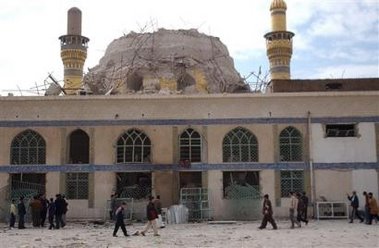
An interesting note - the Iraqis sent to Lebanon for training by Hizballah called themselves the "Ali Al-Hadi brigade," the name of 10th Shi'a imam and the namesake of the mosque (photo) in Samarra' whose destruction ignited the current civil war.
November 28, 2006
Israel Seeks More Aerial Refueling Capability
 Israel Air Force 707 tanker refuels an F-15
In March, I wrote an analysis for MSNBC's Hardball (Iran - Israel's Air Strike Options) in which I stated that the Israeli Air Force does not have the capability to hit the approximately 1500 aim points required to effectively cripple key components of the Iranian nuclear enrichment program. I remain of that opinion.
That said, if Israeli leaders believe that the rest of the world will not address the Iranian program, then they have to. They may try the military option anyway.
November 26, 2006
Another perspective - from a friend
L
She has - read it at Through American Eyes.
My first visit to Israel was a year after my Florida wedding, and I was still a new bride. I knew something of the Holy Land, but not much beyond the essentials of history of the country and the difference between Christian, Muslim, and Jew.
The intifadah, or uprising of the Palestinians in the West Bank had just begun. But all was quiet in the Northern Galilee.
 Growing up a Christian Arab in Israel, my husband attended the Baptist School in Nazareth and learned to read, write, and speak Arabic, Hebrew, and English fluently. His classmates were other Arab children - Christian and Muslim - from affluent families. My husband, a social, easy-going type of individual, had a variety of friends.
During my first visit, I met one such friend, Omar Toom. Omar was an aspiring businessman, who managed his in-laws' baklava bakery shop. Omar was also a Muslim. He did not have a beard, or flowing robes, and used to drink alcohol during his teenage years.
Omar was newly married as well, to a lovely young woman named Sue-Sue. She was pretty and well dressed in the latest styles. One afternoon my husband and I visited the Toom home, just furnished with gorgeous European furniture. Omar and Sue-Sue lived in a Muslim neighborhood, next door to immediate family. Later that evening, the four of us drove to Tiberias for a delicious dinner of St. Peter’s fish and appetizers. Afterward, we took a short sight-seeing cruise on the Sea of Galilee.
Those were happy days and we were two couples lucky in love.
At the end of my stay, Omar and Sue-Sue walked up the steep hill on a primarily Christian street and sat on my in-law’s porch with us. They gave us a gift of baklava from their store and we said a tearful goodbye.
Then came the Ayatollah Khomeini—a time of Islamic revival and influence.
During the last several years, I’ve returned to Israel for weddings, baptisms, or just to visit. Omar brought Sue-Sue and his two children to see me once since our first meeting in 1989.
Sue-Sue now covers her beautiful hair and wears the 'abayah (a robe, worn over her regular street clothes). She is no longer allowed to sit outside with our family and friends. During that brief visit, out of courtesy to Sue-Sue, I went inside the house and sat with her, admiring her blond-haired children. The Muslim women in Sue-Sue’s neighborhood are all covered now, even the little girls who skip together in the street. Some of their husbands have long beards, wear Muslim caps and long flowing traditional robes.
Why?
Before the 1990’s there was no cable television, no satellite dishes, no (rumor has it) money from Iran. Now, Arabic-language stations with conservative imams (religious Muslim leaders) are regularly seen on televisions in Muslim homes. The programming seen there incites Muslims to set themselves apart from their Jewish and Christian neighbors. They seek to define themselves as a culture within Israel that shows solidarity with the Islamic world.
There is also tremendous pressure to conform to society in the Middle East, especially within Islam. If the neighbor’s wife covers her hair and body, then so must you.
This ideology indeed sets the Muslim apart from the Christian. We do not think alike, nor do we look alike. Gone are the days when most Nazarenes had a similar appearance and lifestyle. Respect and friendship held peoples together.
Today, appearance - a cross worn around the neck, or a cover for the hair - is the deciding factor of whether one will be hated or accepted.
This problem is not just in the Middle East—it is found the world over.
------------------------------------------
Some background: Who am I - who are we?
As a child I was fascinated with exotic cultures, food, and traditions. Ideas that are strange to most Americans are considered intriguing and worth investigating for me. This has led to a harmonious relationship between my husband’s family and their foreign daughter-in-law.
In 1989 I made my first visit to Israel, wanting to soak up and view firsthand the subcultures of native Holy Land societies. One opportunity presented itself while traveling across the country from Nazareth to Haifa with my father-in-law, husband, and sister-in-law. I happened to see a Bedouin tent. Expressing my longing to perhaps meet Bedouin one day, my father-in-law (being the best guide in the Galilee) told my husband to pull off the road. The rectangular burlap type tent stood a quarter mile off the paved road in a green grassy field, with a small pickup truck and loose chickens scurrying about. Nervously I asked if Abu Ra'uf, my father-in-law, knew these people? No, he did not.
Somewhat shocked to see an American woman in white pants and red lipstick get out of the car, the traditionally hospitable nomads received us. After the headman of the family served us strong Turkish coffee in the main partition of the tent, he questioned my husband. Was I his wife? Where did he live? Was Ra’uf, my husband, proud to be an Arab?
Even the Bedouin found my husband to be rather perplexing. In the United States, the question Ra’uf always is asked is, “What are you?”
The Christians of the Holy Land define themselves as the descendants of the first community of believers who followed Jesus Christ. It is a notable fact that many of them have Biblical surnames: David, Gideon, Isaac, Abraham, Khuri (priest), Tuma (Thomas), Daniel, Najjar (carpenter).
The majority of these Christians are Roman Catholic, with accompanying denominations of Baptists, Maronites, Greek Melkites, Church of Christ, and my husband’s family, Greek Orthodox. They have kept and protected the Christian holy sites for 2,000 years throughout various incursions and occupations.
These Christians within the Green Line (Israel proper) are 120,000 in number, and another 42,000 live outside the line under the Palestinian Authority. Of that nunmber, some 2,000 are in Gaza and the remainder on the West Bank.
Those from both Palestine and Israel may refer to themselves as Palestinian, Arab, Christian Arab, or Christian Palestinian. The Israelis also may call themselves Israelis or Israeli Christian, depending on their point of view.
Christians from Palestine, Israel, Lebanon, Syria, Jordan and other Arab countries usually consider themselves to be Arabs, because they speak Arabic and follow Arabic cultural traditions. This is not synonymous with Islam. Perhaps they cook the same foods, wear similar styles of clothing, and dance the dabkah (a circular line dance).
Confusing it is! I suppose it’s like being a Native American in China!
Today most Americans assume that all Arabs are Muslim, and all Israelis are Jews. It amazes me to hear from American Jews that because my husband is a Christian and an Israeli, he must be a Christian convert from Judaism!
Christian Arabs are peaceful, educated people. They have been emigrating to the United States for over 100 years. Because of persecution, they have moved to almost every imaginable spot in the world. Our family alone has immediate relatives in Jordan, Israel, Palestine, England, Germany, Australia, Canada, South America, and the United States.
The numbers of Christians in the Middle East are dwindling - it is a dying culture. They have been pushed out by extremists and inhospitable governments. They extricate themselves for the sake of their children. Eventually, the only patrons the Holy Land churches will have will be the tourists.
At this time, Christians in Israel are of two minds: cut and run or hold our own and fight for our rights. Many walk the fence and hold a coveted second citizenship, reserved for an emergency flight. Those who must stay have recently begun a movement, declaring themselves to be a distinct people, separate from Muslim Arabs.
Increasingly, Palestinian Christians too are caught in a stranglehold between Islam and Israel. Their homes’ roofs are used by militants to shoot at Israelis, who in return fire tank shells back. A home I once visited had bullet holes in the front door and a baby inside. Desiring to keep terrorists out of Israel, a security wall has been built, which restricts families from crossing the street to school, work, or to see Grandma.
Because Christians have no country of their own, they are assimilating primarily into Western cultures. There is safety in the West. Someone recently told me, “Keep America safe for us!”
November 21, 2006
Iraq-Syria: Restoration of Diplomatic Relations
I
Iraq and Syria have restored diplomatic relations after 24 years. The countries broke diplomatic ties in 1982 when Syria not only sided with Iran during the 1980-1988 Iran-Iraq War, but provided military assistance to Tehran. In that same year, Syria allowed Iran to deploy members of its Islamic Revolutionary Guard Corps to Lebanon to create the Islamic Resistance to Israeli occupation of the southern part of the country - the organization more commonly known as Hizballah, (the Party of God). That close relationship between Damascus and Tehran continues to this day - the two countries have a formal defense pact as well.
The agreement was reached in Baghdad. Syria was represented by its foreign minister, Walid Mu'alim. Mu'alim is a long-time Syrian diplomat, former ambassador to the United States and previously director of North American affairs for his country. He is well-versed in American interests in the region. Iraq was represented by its foreign minister Hoshyar Zebari. Zebari is a Kurd, formerly the foreign affairs chief of the Kurdish Democratic Party, also well-versed in American affairs.
I know both Mu'alim and Zebari personally - these are two of the most astute individuals in the region when it comes to understanding American issues in the region. It is no accident that the two countries are now talking following revelations that the Iraq Study Group led by former U.S. Secretary of State Jim Baker will likely recommend that the United States engage both Iran and Syria for solutions to the situation in Iraq. Interesting that Iraqi president Jalal Talabani will be visiting both Syria and Iran in the near future.
It is also no coincidence that Syria accepts the presence of American forces in Iraq as long as the Iraqi government feels that their presence is required, especially given the fact that Syria has been a major transit point for insurgents entering Iraq. This is probably indicative of the fact that Syria is concerned about an all-out civil war in neighboring Iraq, a civil war that might draw a reaction from Iran, causing Syria's Arab and Turkish neighbors to intervene as well - countries not favorably disposed to Damascus.
The Iraqi embassy in Damascus was located directly across the street from the American embassy - it remains to be seen where the new embassy will be located.
November 14, 2006
Gaza - the next Lebanon?
m
More from my recent trip to Israel...
Recently, there has been increased weapons smuggling into Gaza across the Egyptian border. The worrisome factor for Israel is not only the quantity of weapons, but the quality. The newly introduced weapons, many of which are smuggled into Gaza via an extensive series of tunnels under the Egyptian border, include:
- the Ra'd rocket (also known as the Iranian Fajr-3, a 240mm rocket with a 26-mile range)
- SA-7 shoulder fired air defense infrared missile
- RPG-29 tandem warhead anti-tank rocket
- AT-5 Konkurs wire-guided antitank missile
- AT-14 Kornet laser-guided antitank missile (follow-on for the AT-5)
With their new arsenals, Hamas hopes to imitate the perceived success of their Islamist brethern in Lebanon in the Gaza Strip. To that end, they are building what they call a "combat infrastructure" (buniyah tahtiyah qitaliyah). They are also increasing their indigenous rocket capability, hoping to replicate the success of Hizballah's rocket salvos on northern Israel. They have a long way to go in this area, as the latest Qassam rocket has a range of only about six miles and a warhead of about 20 pounds.
According to the Israelis, Hamas in the Gaza Strip can mobilize as many as 6,000 fighters. Should the Palestinian Islamic Jihad join forces with Hamas, they can add another 2,000 to that total.
November 13, 2006
Iran - "Existential Threat" to the State of Israel - ADDENDUM
November 13 - "We will not tolerate the possession of nuclear weapons by Iran," [Israeli prime minister Ehud] Olmert told NBC television's "Today Show" program, ahead of talks with President George W. Bush on Iran's nuclear ambitions and the Israeli-Palestinian conflict.
Seems pretty clear to me.
Israeli Air Force F-16I Sufa (Storm)
 I just returned from a tour of Israel as a guest of what many would term "the lobby." I have been to Israel several times during my career as an intelligence officer and Middle East specialist, but this trip was particularly illuminating.
I was invited in the aftermath of the summer Lebanese war between Hizballah and the Israel Defense Forces (IDF). I assumed that much of the discussion would be a post-mortem on the IDF's operations in Lebanon - I had been fairly critical of the IDF's performance against Hizballah.
As I expected, we did have a lot of discussions with IDF officers and government officials, as well as members of the press and academia about the IDF's problems in Lebanon, but the overwhelming message of the trip was the recurring and persistent theme: Iran - specifically the Iranian nuclear program - is an "existential threat" to the State of Israel. Not only did my discussants tell me this, but Prime Minister Ehud Olmert used the phrase in an October meeting with U.S. Secretary of State Condoleeza Rice - "...for the first time in my life I feel that there is an existential threat against the State of Israel."
The "existential threat"
Israel has faced, and faces, numerous threats. What makes the threat from Iran different is Israel's belief that a nuclear-armed Iran poses a threat to the very existence of the Jewish state. Forty percent of the world's Jews live in a 50 mile coastal strip centered on Tel Aviv. A nuclear strike on this area would be tantamount to a second Holocaust and would likely be unrecoverable.
The Israelis further believe that Iran, unlike other countries in the region (like Syria), cannot be deterred from launching a nuclear strike on Israel. Senior Israeli officials told me that they are of the belief that once Iran acquires nuclear weapons and the means to deliver them, it is only a matter of time until they strike. They are taking Iranian president Mahmoud Ahmadinejad at his word.
How close are the Iranians to developing a nuclear weapon?
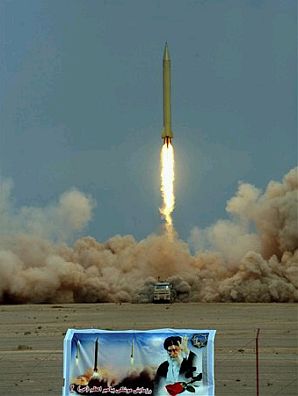 According to a senior Israeli official (in the intelligence business, we would have described him as "a source with direct access to the information"), Iran has not yet mastered the large-scale enrichment process needed to produce sufficient fissile material for weapons production. It might take them another year. After that, it could take a year of production - using cascading centrifuges - to make the required fissile material and a year after that to produce the weapons. Of course, weapons design will not be much of a problem - Iran acquired much of that technology from Pakistani nuclear scientist A.Q. Khan. All in all, the Iranians will likely have a nuclear weapon for their Shihab-3 ballistic missiles (see photo) in three years. The Shihab-3 has a range of over 1000 miles, enough to strike virtually anywhere in Israel.
The Israeli deputy defense minister said this week that Israeli military action against the Iranian nuclear program might be necessary. Ephraim Sneh, a former general, said he considered the military option was the last resort, but "the last resort is sometimes the only resort." Senior military officers believe that they have only a year to resolve the issue diplomatically, or military action will be necessary. The Israelis are fully aware of the potential Iranian reaction (See my earlier piece, When Diplomacy Fails - Reactions to an Air Strike on Iran) to a strike, but believe that the nature of the threat - the existential threat - leaves them no other choice.
In March, I wrote an analysis for MSNBC's Hardball (Iran - Israel's Air Strike Options) in which I stated that the Israeli Air Force does not have the capability to hit the approximately 1500 aim points required to effectively cripple key components of the Iranian nuclear enrichment program. I remain of that opinion.
This issue - the "existential threat" to the State of Israel - will be the main topic of conversation between American officials and Israeli prime minister Ehud Olmert this next week. Olmert arrived in the United States Sunday.
November 12, 2006
Israel's Security Fence
v
A security barrier between the occupied territories and Israel proper was proposed in 1992 by Yitzhak Rabin. Following an outbreak of violence in the Gaza Strip in 1994, the Rabin government constructed a barrier along the 1949 armistice line, effectively walling off the Palestinian area. In that same year, attacks on the Israeli coastal town of Netanya, north of Tel Aviv, caused Rabin to call for a similar barrier around the West Bank. 
There have been numerous complaints and court challenges to the route of the fence (see map - right). Palestinians claim that the fence does not adhere to the 1949 armistice line/1967 borders, but rather is an attempt to seize Palestinian 
I just returned from a trip to Israel, which included a briefing on the barrier, a trip to the fence as well as a helicopter tour over the fence (I took the photos on this page). The barrier is about 95 percent fence and five percent wall. Concrete wall sections, about 25 feet high, are
According to Israeli officials, the barrier has been extremely effective, reducing terrorist incidents by 90 percent from 2002 to 2005. Read the official Israeli information on the fence at the IDF Security Fence website.

November 10, 2006
Former DCI Bob Gates - New Secretary of Defense

Robert Gates began his government service as a United States Air Force intelligence officer, followed by a career as an analyst with the Central Intelligence Agency. He rose to the position of Deputy Director for Intelligence in 1982, then deputy director in 1986. There was a break in CIA service when he served on the National Security Council. Although he was nominated to be the Director of Central Intelligence (DCI) in 1987, he withdrew his name because of controversy over his role in the Iran-Contra affair. Gates served as the deputy National Security Adviser for President George H.W. Bush from 1989 to 1991, after which he was named the DCI.
Gates served in the senior Bush White House with Brent Scowcroft, James Baker and Colin Powell, all three now against the current policy in Iraq. Gates himself has been somewhat critical of the conduct of the war - not the war itself, but the execution of it.
Besides being a perceived breath of fresh air at the Pentagon, Gates may be able to lessen the tension between the Department of Defense and the DNI. After the creation of the DNI, Secretary Rumsfeld directed that all intelligence matters in the Defense Department be coordinated by the Undersecretary of Defense for Intelligence, and that office to be the primary point of contact between the department and the DNI.
In essence, it was Rumsfeld's way of maintaining Defense control over the majority of the country's intelligence assets. Gates, with his intelligence background, may be able to come up with a better arrangement and improve the ailing intelligence system.
November 7, 2006
Defense Language Institute Hall of Fame
I was honored to be named to the Defense Language Institute Hall of Fame. You can read the story here in the local Monterey newspaper.


