
The Al-Qa'idah led Islamic insurgent umbrella organization Mujahidin Shura Council announced that it has established an Islamic Iraqi state comprising four governorates and portions of two others. The area consists mainly of the Sunni areas of the country, and the capital city of Baghdad. It also includes areas that are inhabited by Kurds and Shi'a Iraqis.
This move is yet another indication that the country is fragmenting into three autonomous regions. Ironically, what the insurgents are doing is actually provided for in the Iraqi constitution that was ratified one year ago on October 15, 2006. Under provisions of that document, residents of two or more governorates can establish autonomous regions, effectively setting up states within the state. According to the constitution, certain functions, such as defense and management of oil revenues, would continue to be under the control of the federal government. (Note: Iraq, with its proven oil reserves of 112 billion barrels and huge unexplored oil fields, is surpassed only by Saudi Arabia in terms of potential oil revenue.)
It is this provision that has been fully exploited by the Kurds, who have established the Kurdish Regional Government. They have gone so far as to direct that only the Kurdish flag will be flown in the autonomous region, have established an airline and, contrary to the constitution, negotiated oil deals with European oil companies.
There are indications that the Shi'a are contemplating doing the same thing. The one thing that concerns the Sunnis is the oil revenue issue. Both the Shi'a and Kurds want to control the oil resources in their areas. That means that the Shi'a (60 percent of the population) would control about 80 percent of Iraq's oil, and the Kurds (20 percent of the population) would control the remaining 20 percent. That is why "Islamic Iraq" claims Kirkuk with its huge oil fields.
Sectarian violence has been on the increase since the February 2006 attack on the Al-'Askari mosque (also called the Golden mosque) in Samarra'. The three major factions - Kurds, Sunni and Shi'a - have been staking out their positions for what many believe is the inevitable civil war. Unless the government of Nuri Al-Maliki can secure the country, it will ultimately devolve into anarchy and civil war. Given the government's inability to even secure Baghdad, that possibility is looking more and more likely.
Islamic Iraq - the Sunnis - are probably in the worst position should an all-out civil war erupt. The Kurds have virtually autonomous since 1992, are fairly self-sufficient and fiercely independent. They are capable of defending their territory against the Sunnis, the Shi'a or both. The main area of contention will be their unwavering demand that Kirkuk be part of their area. Kirkuk under Saddam Husayn was "Arabized" - Kurds were moved out and replaced by Arab Iraqis. After the fall of the regime in 2003, the Kurds have been removing the Arabs and Turkoman - sometimes by force. This ethnic cleansing is taking place in neighborhoods all over Iraq.
What happens if there is a civil war? The Kurds will probably declare themselves to be independent. This runs the risk of intervention by Turkey, who along with Iran and Syria have stated that an independent Kurdistan is unacceptable. Turkey is concerned that its Kurdish minority will want to do the same, possibly joining the new state. Of course, the Iraqi Kurds' use of the term "southern Kurdistan" to describe northern Iraq does nothing to assuage Turkish concerns.
The Shi'a and Sunni will be the main antagonists. What may happen is intervention by the Iranians on the side of the Shi'a, and the majority Sunni Arab countries - such as Jordan, Egypt, Saudi Arabia - may intervene on the side of the Sunnis. Regional conflict might ensue between the Arabs and the Iranians/Persians.
What of the American forces? They are the only thing preventing a full-blown civil war now. If it happens, the United States will have no choice but to withdraw and let it happen. As an old colonel once told me, "Sometimes you have to let the train crash to build a railroad."
October 15, 2006
Declaration of "Islamic Iraq" - precursor to civil war?


Iraq: British Army Chief Speaks Out

Fine, Sir Richard. Many in your country and army agree with you. Many in the United States feel the same. While some view your candor as refreshing - candid remarks from not just a serving officer, but the chief of the British army - you may have put your troops in greater danger.
I am sure that was not your intent, but your words were picked up immediately by the Iraqi insurgent website Press Release (read the article), "...lies and media tricks prove the critical situation of the crusader alliance in al-Rafidayn land [Mesopotamia] , especially after the calls of leaving Iraq announced by the British army - the principal ally in the crusader alliance - , which is a threat for the alliance contract . The whole world – by Allah willing- will hear soon about good news...."
If I were the leader of the insurgency or a militia group that wanted to create greater problems, I would now focus my attacks on the remaining 7,000 British soldiers in southern Iraq. The insurgents sense a weakness - they are bound to exploit it.
Evidently, Sir Richard's remarks struck a raw nerve among his superiors. He later backtracked significantly (General Dannant statement October 13):
"We have been in Southern Iraq for three and a half years and we have made significant progress, with two of the four provinces now handed over to Iraqi control and our responsibilities are much reduced in one other province. The point that I'm trying to make is the mere fact that we are still in some places exacerbates violence from those who want to destabilise Iraqi democracy.
"Currently Operation Sinbad is trying to make Basra better and a lot of British soldiers are doing a really good job. In that regard, their presence is helping but there are other parts where our mere presence does exacerbate and violence results.
"But that is not a reason for us to leave. I am on record publicly saying we're standing shoulder to shoulder with the Americans. I am on the record from a speech three weeks ago saying that I'm planning force packages in Iraq through 2007 in to 2008. I'm a soldier - we don't do surrender, we don't pull down white flags. We will remain in southern Iraq until the job is done – we're going to see this through."
Fine, but the genie is out of the bottle, the damage is done.
October 8, 2006
Robert Fisk: The Age Of Terror
In his latest opinion piece "The Age of Terror," published in Monday (October 9)morning's edition of the British newspaper The Independent, Middle East correspondent Robert Fisk writes this about me:
"No wonder US Lieutenant Rick Francona noted indifferently in a report to the Pentagon that the Iraqis had drenched Fao in gas when he visited the battlefield during the war."
I have responded to him:
"Actually, I was a captain at the time, and don't think I ever used the term 'drenched' in my report back to the Defense Intelligence Agency. We were fairly certain the Iraqis had used nerve gas, making it the first time nerve gas had been used on a battlefield. I was certainly not 'indifferent' to Iraqi nerve gas usage. " Lt Col Rick Francona, USAF (Ret)
Overall, it's worth a read - it's long (6,770 words). Fisk has the reputation of knowing his way around Middle East topics, albeit a bit to the left. He has lived in Beirut for the last 25 years and speaks good Arabic.
I just wish he wouldn't put words in my mouth.
October 6, 2006
Israel: Is There a Peace Process Anymore?
Good question. I think the answer, regrettably, is no.
At one time in my career dealing with Middle East issues, I was optimistic. Optimistic and probably naive - most of my time I spent dealing with Syria, Lebanese, Jordanian and Iraqi issues. By default, much of that involved Israel. During my involvement, we have seen agreements between Israel and Egypt, Jordan and Lebanon (although this was later abrogated through Syrian intervention).
While I was the air attache at the U.S. Embassy in Damascus (1992-1995), we were very close to brokering an agreement - unfortunately those days have passed.
Since the Palestinian elections of January 2006 in which the Islamic Resistance Organization (HAMAS) won control of the government, the question has been, "Will Hamas recognize Israel?" Hamas, regarded by the United States as a terrorist organization, has consistently refused to recognize Israel's right to exist. This has led to almost complete isolation of the group by the Western world.
There have been several attempts to come with a workable solution to the impasse, some way in which the West can support the elected government of the Palestinians. No matter the wording or machinations, the bottom line is that Hamas will have to recognize Israel. None have worked.
I think that screeching halt was amplified today. Palestinian prime minister Isma'il Haniyah remarked repeatedly and heatedly, "I tell you with all honesty, we will not recognize Israel, we will not recognize Israel, we will not recognize Israel. We say we will be in every government, we will stay in the government." (read article)
I think there is no doubt that Hamas has been emboldened by what many to perceive as Hizballah's victory over the Israelis in "The Sixth War" this summer. Whether correct or not, Hamas is now of the belief that they can stand up against the Israelis. When, they might say, is the last time you heard anyone ask about Corporal Gilad Shavit?
At some point, the Israelis will have had enough with Hamas in the Gaza Strip. The Israel Defense Forces are looking to regain their fearsome reputation, and Gaza does not have the privileged status in the West that Lebanon does.
I think Hamas is playing a dangerous game.
October 5, 2006
Syria and Iran Increase Signals Intelligence Cooperation

According to Janes Defence Weekly (read article), Syria and Iran have expanded their joint signals intelligence (SIGINT) collection efforts, increasing the number of joint intercept sites from two to four. The two existing sites, one located near the Israeli-occupied Golan Heights and the other located in northeast part of Syria are in excellent location to intercept communications of Israeli forces in Israel and American forces in Iraq, respectively. Of course, the site near the Golan Heights was likely of immense value to Iran's Islamic Revolutionary Guard Corps (IRGC) efforts to support Hizballah with weapons and intelligence on Israeli forces during the recent conflict in Lebanon.
The two new sites will be located near Bab Al-Hawa' in the mountains near and overlooking the Turkish border, and near Abu Kamal, where the Euphrates flows from Syria into Iraq's Anbar province, the site of the fiercest fighting between Iraqi insurgents and American forces. According to the article, these sites will complement IRGC intelligence collection capabilities. As Iran emerges as the leading power in the region, they need accurate and timely intelligence on their neighbors. Syria is willing to provide them a platform to do just that.
This expanded cooperation comes in the wake of, and probably because of, a defense cooperation agreement proposed in February 2005 and signed last November. (See my earlier Syria and Iran Common Front - Nothing New) Syria and Iran have been allies since Damascus sided with Tehran during the 1980-1988 Iran-Iraq war.

Of course, Syria and Iran are not the only ones collecting signals intelligence in the area. The Israelis have a huge SIGINT collection site in the Golan Heights (see photo at right).
On the Syrian side, the SIGINT effort is under the control of Syrian Military Intelligence. Most people are not aware that women serve in the Syrian military, in the medical and administrative fields as you would expect, but mostly they serve in the signals intelligence directorate.
When I was the Air Attache at the U.S. Embassy in Damascus, we attaches were invited to the graduations of all the service academies. On the airport road in Damascus is the Al-Kuliyat Al-'Askariyah Lil-Banat, The Military College for Girls*. Upon completion, they are commissioned as second lieutenants.
There's just something about a 21-year old dark-eyed Syrian girl/woman in fatigues with an AK-47, but I digress. While chatting them up at the reception at the Officers Club following their graduation - it was pretty easy, they all wanted to have their pictures taken with Al-Amirki (the American), since we are, after all, the bad guys. They told me that almost all of them had been studying Hebrew for four years and were going to be intercept operators.
This expanded cooperation beetween Iran and Syria should come as no surprise.
____________
* "Girls" is the actual translation, rather than the expected "women."
September 30, 2006
Kurdistan - Federalism or Independence?
The area of northern Iraq inhabited by the Kurds - they refer to it as Kurdistan - is easily the safest part of the country. There are only a few foreign forces stationed there since the area is mostly pacified and under the control of the local police force. The Iraqi constitution allows for the establishment of autonomous regions, and the Kurds are taking advantage of that, having established the Kurdish Regional Government that oversees the three almost homogeneous provinces of Arbil, Dohuk and Sulaymaniyah.
Earlier this month, KRG president Mas'ud Barzani banned the Iraqi national flag from public buildings in these provinces, ordering instead the display of the Kurdish flag. (See my earlier Iraq - Replacement of Iraqi flag with Kurdish flag.) Many considered this to be yet another indication that the Kurds intend to establish an independent state.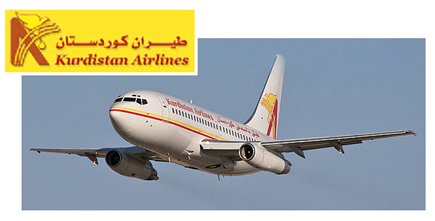
There are other steps that tend to indicate this intention. Last year, at least three Kurdish airlines (Kurdistan Airlines, Azmar Airline and Sawan Airline) opened for business, offering direct flights between cities in Europe and the Middle East and the newly refurbished and improved Arbil airport and Sulaymaniyah airport.
KRG officials have also made independent deals for oil drilling and oilfield development without consulting or involving the oil ministry in Baghdad. This move is particularly threatening tot he Sunnis in Iraq. If Iraq devolves into a civil war and fragments into three separate enclaves (Kurdish, Sunni and Shi'a), or if a federation is established with three regions, oil revenue will be a critical issue as it is almost the sole source of income for country. If the regions are able to control oil revenues, the Kurds and Shi'a are well-placed, as almost all the oilfields are in the Kurdish are in the north and the Shi'a area in the south. The Sunnis will be cut out of Iraq's most lucrative asset.
The Kurds will likely be satisfied with a federal structure as long as they can exercise autonomy in their region. One problem will be the status of mixed areas adjacent to the three Kurdish provinces, particularly Kirkuk and to some extent Mosul. Kirkuk may be contentious as Kurds try to reclaim what they believe is a Kurdish city at the expense of the Turkomen and Arabs.
Should Iraq erupt into a civil war, the Kurds may just declare themselves independent. They will not have much a of a problem with the Sunnis or Shi'a - neither are strong enough to take on the Kurds. The question is what will Iran and Turkey do.
September 29, 2006
Lebanon-Israel: Nasrallah Makes it Clear
 On September 22, an estimated 800,000 Lebanese - that's almost a quarter of the population of the country - attended a rally in Beirut in support of Hizballah. Hizballah leader Shaykh Sayid* Hasan Nasrallah made his first public appearance since the five-week war between Hizballah and Israeli forces.
More important than Nasrallah's appearance were his words. Even if his appearance was somewhat of a surprise, his message was not. Despite the fact that he has declared victory over the Israelis, he remains mostly in hiding out of fear of an Israeli attack. There is probably good reason for that. At least one member of the Israeli cabinet has renewed calls for his assassination.
As for his message, he reiterated his previous positions. First, he declared that he would not release the two captured Israeli soldiers unless it was part of a larger prisoner exchange for Lebanese held by the Israelis. This is direct contravention of United Nations Security Council Resolution 1701 - quote: "including by the unconditional release of the abducted Israeli soldiers."
It gets better. Nasrallah stated that Hizballah would neither disarm nor disband, again in contravention of 1701 - quote: "there will be no weapons without the consent of the Government of Lebanon and no authority other than that of the Government of Lebanon," and "require the disarmament of all armed groups in Lebanon, so that, pursuant to the Lebanese cabinet decision of 27 July 2006, there will be no weapons or authority in Lebanon other than that of the Lebanese State."
He went on to say that Hizballah was still in possession of 20,000 rockets. This is a much larger number than Israel believed the militia had in its arsenal. Israeli estimates were that Hizballah had as many as 13,000, and perhaps almost half had been used or destroyed in the conflict. Nasrallah also gloated that regardless of any kind of blockade, Hizballah would still maintain (and no doubt restock) its arsenal.
Although 1701 called for Hizballah to withdraw north of the Litani River, Nasrallah's comments left little doubt that he has no intention of complying with this provision either. He implied that international forces should stay clear of Hizballah positions, but did welcome the deployment of the Lebanese Army south of the Litani. That makes sense. International forces may feel compelled to actually enforce the UN resolution, although that would be a marked departure for the ineffective United Nations Interim Force in Lebanon (UNIFIL) that has done nothing since its inception in 1978 except build itself nice facilities and watch Hizballah fortify the area after the Israeli withdrawal in 2000, much as it did with the Palestinian Liberation Organization before that. Worthless is the word that springs to mind. On the other hand, deployment of the Lebanese Army, which is neither willing nor capable of doing much of anything, suits Nasrallah just fine.
In his remarks, Nasrallah chided the government of Fu'ad Sinyurah, claiming it is "unable to protect, rebuild or unify Lebanon." He may be right, and no doubt willing to have Hizballah fill that role.
* Sayid is an honorific title for male descendants of Muhammad.
September 12, 2006
Syria - Attack on U.S. Embassy
 AP Report: Three killed outside U.S. embassy in Syria
The American embassy compound is shown in the image to the left. It is the triangle in the center of the image. I served at this embassy from 1992 to 1995 as the air attaché.
The embassy is not one of the new hardened State Department facilities, but an older large house, two small buildings and a garage facility that have been converted to embassy use. It sits in a crowded urban area. The Chinese and Italian embassies are across the street.
There is a blast wall around the compound, as well as reinforced guardrails made of I-beams along the main street, the location of today's attack. Fortunately, the main bomb - a series of pipe bombs wrapped around propane tanks - did not detonate. Four perpetrators, described by Syrian security officials as "terrorists," were killed. The attackers were heard shouting "Allahu Akbar" (God is great, a common Islamic phrase) during the incident.
The security situation is Syria and the capital city of Damascus overall is good. The security in this section of Damascus - Abu Rumanah - is very good. It is home to not only many embassies and diplomatic residences, it also is the home of the family of the late president Hafiz Al-Asad, the Ministry of Foreign Affairs and the Ministry of Defense liaison office (that's where the Syrians managed the foreign attaches). The embassies are protected not only by their own staffs, but by Syrian guards armed with automatic assault rifles as well.
That said, there are some risks. The American embassy has been the scene of protests, some even getting violent. During the Gulf War, despite the fact that Syria was part of the American-led coalition, Syrian protesters were able to scale the walls and do some looting. In the late 1990's, the embassy was attacked by an angry mob. There was property damage, but no casualties. In these attacks, you are always wary of the role of the Syrian government. Are these attacks sanctioned to send a message to the American government?
Additionally, there was an attack on a United Nations facility in the Al-Mizzih section of the city, but this is believed to be staged to support Syrian claims that it was tough on terrorism.
Who is behind today's attacks? The most likely culprit is the outlawed Muslim Brotherhood, the Al-Ikhwan Al-Muslimin. This group has been active in Syria for decades. In 1982, Hafiz Al-Asad sent a Syrian army unit commanded by his brother Rif'at to put down a Brotherhood-inspired uprising in the northern city of Hamah. As many as 40,000 Syrians died in the fighting as Syrian artillery pounded the city into submission. This incident gave rise to the phrase, "Hamah rules" to describe Syria's method for handling dissent. While in Damascus, there were occasional gunbattles between security forces and the Brotherhood - in almost all cases, they had to be killed as they would not surrender.
Is there the possibility of Syrian complicity in this attack? Certainly relations between Syria and the United States are tense now. Syria has recently suffered diplomatic setbacks that they attribute to American policy, most notably the Cedar Revolution in Lebanon that forced Syria to withdraw its troops that had been there for 30 years. Associated with that is the withdrawal of the U.S. ambassador; the embassy functions under the leadership of a Charge d'Affaires. In the recent Israel-Hizballah clashes, Syria was accused of resupplying Hizballah - in fact Syria is the almost exclusive conduit for money, weapons and training for the terrorist group.
We will never know exactly who did this. To be sure, there will be an investigation with little or no American participation. Someone will be named as the perpetrator and the Syrians will claim the case solved and security tight.
September 6, 2006
Israel Agrees to Lift Blockade of Lebanon???

One has to ask why Israel agreed to lift the blockade. First, its major concerns is the resupply and rearming of Hizballah by Iran and Syria via the long and porous border with Syria. Although UNSCR 1701 (and UNSCR 425 and UNSCR 1559 - is there a pattern here?) call for the disarming of Hizballah, it is obvious that neither the Lebanese Army nor UNIFIL is willing or capable of the task. Lebanese Army officers said they will not disarm their Hizballah "brothers," and UNIFIL says that is not its mandate (why am I not surprised?). Hizballah itself says it will not disarm, stating that the time is not right, and reiterating the worn-out claim that Israel still occupies the Lebanese area known as the Shaba' Farms - which the United Nations and Israel agree is part of Syria. Given this, I would assess that Hizballah will not disarm, nor will it be disarmed.
Perhaps Israel believes that it has damaged Hizballah to the point that if it is not resupplied or rearmed it is not a significant threat. Personally, I do not think that is the case - Hizballah still retains a sizeable arsenal of long and medium-range rockets, thousands of which it fired at Israeli cities during the month-long war. It also believes that it held its own with some of the world's best armed forces.
Perhaps Israel correctly assesses that maintaining the air and sea blockade will have no effect on Hizballah's status. Syria and Iran do not move weapons and supplies into Lebanon by sea or air - they come overland from Syria, mostly on the Beirut-Damascus highway, which just happens to service the Damascus International Airport. The airport has been Iran's preferred port of delivery to Syria for Hizballah's weapons since 1982.
Israel finally bowed to world opinion and pressure from the United States. UN Secretary General Kofi Annan and American Secretary of State Condoleeza Rice assured the Israelis that UNIFIL and the Lebanese Army were in place and ready to prevent the resupply and rearming of Hizballah.
Color me skeptical.
Israel wanted international (even UNIFIL) troops on the Syrian border, however Syria stated that the presence of international forces on its border would be considered a foreign "occupation" of Lebanon and would be "resisted." Thus, we have the pitiful Lebanese Army on the border where it counts - the same troops who do not want to disarm their Hizballah "brothers."
To dispel our doubts about the Lebanese Army, Syria claims to have beefed up security on its side of the border. Really? These are the people that have in the past trained and supplied Hizballah, and allowed the Iranians to do the same from their territory.
So, now Israel has agreed to withdraw from southern Lebanon despite the fact that Hizballah will not disarm and will not be disarmed, it has agreed to lift its air and sea blockade of Lebanon while the Lebanese Army and Syrian troops guard the overland resupply routes, and agreed that the two captured Israeli soldiers - the reason this all began back on July 12 - really don't have to be released unconditionally, but might be part of a prisoner swap after all.
Who's in charge in Tel Aviv and what are they thinking?
September 1, 2006
Iraq - Replacement of Iraqi flag with Kurdish flag

The president of the Kurdistan Regional Government, Mas'ud Barzani, ordered that the Iraqi national flag be replaced by the Kurdistan flag in the autonomous region of northern Iraq. This order comes at a time when increasing sectarian violence has raised the specter of a civil war.
Sectarian violence between Sunni and Shi'a Arab Iraqis has been at unprecedented levels since February when Sunni insurgents affiliated with Al-Qa'idah in Iraq (also known as the Az-Zarqawi group) heavily damaged the Al-'Askari mosque in Samarra', believed my many to be the fourth holiest shrine in Shi'a Islam. (See my earlier Attack on Major Shi'a Shrine in Samarra'.)
Iraq's Kurds have always yearned to be independent. In the early to mid-1970's, they waged an unsuccessful rebellion against the Iraqi government. They were supported in this rebellion by Iran and the United States (at the request of Iran). In the early 1980's, Saddam Husayn agreed to the formation of the Kurdish Autonomous Region as promised in 1970, but never really allowed it. In 1987 and 1988, Saddam ordered the Iraqi armed forces to attack the Kurds, including chemical weapons attacks, in a campaign known as "the Anfal." Saddam is now on trial for crimes against humanity in this campaign.
The Iraqi constitution allows for the formation of autonomous regions - the Kurds have taken advantage of this provision. The constitution does not allow for secession from the republic, which is what many fear the Kurds are planning. The Sunnis are concerned that an autonomous Kurdish area in the north might control the northern oilfields, while a Shi'a region in the south would control the southern oilfields, leaving the Sunnis with no oil resources.
I am a big supporter of the Kurds, having served with them in northern Iraq in the 1990's as part of the Iraqi opposition. Should Iraq devolve into a civil war, the Kurds will likely try to declare an independent Kurdish state. That will certainly raise problems with neighboring Iran, Turkey and Syria, all of whom have Kurdish populations and have stated they will not tolerate an independent Kurdistan.
_______________


