
The recent Israeli operations nominally to free one of its soldiers taken hostage by Palestinian Hamas gunmen highlight a series of complex, Byzantine relationships. On the surface, it appears to be a confrontation between the Israelis and the Palestinian Islamic Resistance Movement, more commonly know by its Arabic acronym HAMAS. It is that, to be sure, but the conflict is much more complex, stretching from Gaza north to Lebanon and Syria, and from there east to Iran.
It seems that whenever terrorism and the Middle East are discussed, Iran always seems to be involved. There is good reason for that. Iran’s direct involvement in Lebanon goes back to 1982 when elements of the Islamic Revolutionary Guard Corps (IRGC) were dispatched to Lebanon to provide support to Hizballah. The IRGC contingent provided the necessary ingredients for successful insurgent/guerrilla operations – money, weapons and training. Their operations soon expanded south to the various Palestinian groups – including the Popular Front for the Liberation of Palestine – General Command (PFLP-GC), several factions of the Palestinian Islamic Jihad (PIJ) and of course, HAMAS. By 1992, Iran was the primary sponsor of these groups.
How do money, weapons and training get from Iran to the Palestinians living in areas ostensibly controlled by the Israelis? There are several routes, but the hub of the transshipment system is Syria, a close ally of Iran going back decades – Syria was the only Arab state to back (and provide support to) Iran during the eight-year Iran-Iraq war (1980-1988). Syria and Iran recently renewed their formal defense cooperation agreement.
Over the years, the Syrians made no effort to hide their support of this transshipment system, the key component of which is the Damascus International Airport. From the airport it is a short drive (30 minutes) to the Lebanese border and the Biqa’ Valley. For years, Iranian Air Force 747 cargo aircraft routinely delivered arms and supplies to Hizballah and Palestinian groups at the airport – and still do. They did not try to hide it on the military side of the airport – this was done on the civilian side in plain view. I was the air attaché at the American embassy in Damascus – often while at the airport, I observed this activity. The aircraft were clearly labeled, as were the Hizballah trucks.
When all is said and done, it will become obvious that the money, weapons and training used to fuel operations of HAMAS in Gaza, as well as those of the PIJ’s ‘Izz Ad-Din Al-Qassam Brigades (where did they learn to make and launch the Qassam rockets?) can all be traced to Iran.
Why did four Israeli fighter jets buzz Syrian president Bashar Al-Asad’s summer palace in Qurdaha (on the Syrian coast)? The Israelis believe that without Syria’s cooperation with Iran allowing money, weapons and personnel to flow through Damascus, HAMAS and the PIJ would not be able to conduct effective operations.
June 30, 2006
HAMAS, Israel, Syria, Iran – Pieces of the Same Puzzle


June 29, 2006
Bin Ladin "videotape" - a misnomer
 An edited version of this article appears on the MSNBC Hardball Blog
After the Al-Qa’idah "tease" - a media term hinting at a big story to come - that a new videotape from Al-Qa’idah leader Usamah Bin Ladin was about to be released, the group's propaganda arm finally posted it on an Islamist internet site. It's almost fraud.
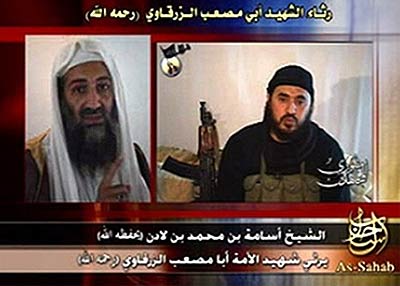
Yes, the voice is Bin Ladin. Yes, what was released is in fact a videotape. In reality, however, the “videotape” is merely a voice recording showing an old still image of the Bin Ladin in a split screen with video footage of the late Abu Mus’ab Az-Zarqawi. Hardly what we expected when we heard the word “videotape.“
We analysts who study Al-Qa’idah and Bin Ladin were understandably excited when we heard the videotape tease. We were not excited about hearing Bin Ladin’s voice, but about the opportunity to see new video footage of the world’s most wanted fugitive. While there have been at numerous audiotapes from Bin Ladin since that time (today’s makes four this year alone), there has not been any available footage of Bin Ladin since October 2004. Most analysts regard the audiotapes as mere propaganda and proof of life. That’s all we have here – the usual rhetoric and proof that Bin Ladin was still alive on June 7, the date Az-Zarqawi was killed.
The videotape - or more accurately, an audio tape with an old graphic - lionizes the late terrorist Az-Zarqawi. After Az-Zarqawi's death, there seems to be a concentrated effort on the part of the larger Al-Qa’idah leadership to project the image of a united front when it is apparent that there was a serious rift between the larger Al-Qa’idah organization and Az-Zarqawi's Al-Qa’idah in Iraq. In mid-2005, Az-Zawahri chastised Az-Zarqawi for his efforts to start a civil war in Iraq between the Sunni and Shi’a communities - an effort that continues to this day.
Bin Ladin’s failure to release video always causes speculation about possible medical conditions, wounds, etc. Descriptions of his voice as weak and fatigued fuel that speculation. Some analysts are of the opinion that Bin Ladin cannot make a videotape, that he is in hiding and on the run, moving from hideout to hideout in the desolate Afghanistan-Pakistan border area. Possibly, but that has not prevented his deputy Ayman Az-Zawahri from making and releasing three videotapes this year. When there is only audio from Bin Ladin and video from Az-Zawahri, there is speculation as to his physical condition.
If Az-Zawahri can make a videotape under those conditions, Bin Ladin can make a videotape. Why hasn’t he?
________________________
About the photo:
The logo in the lower right is that of As-Sahab, the production element of Al-Qa'idah. The photo on the right side of the screen is Abu Mus'ab Az-Zarqawi and bears the logo of the Mujahidin Shura (Council). On the left, of course, is Usamah Bin Ladin. The Arabic text across the top reads: "Eulogizing the martyr Abu Mus'ab Az-Zarqawi (God have mercy on him)." The Arabic text across the bottom reads: "Shaykh Usamah bin Muhammad bin Ladin (God keep him) eulogizes the martyr of the (Islamic) nation Abu Mus'ab Az-Zarqawi (God have mercy on him)."
June 21, 2006
Iraq: No date for the insurgents
This article also appears on MSNBC's Hardball HARDBLOG.
Senators John Kerry and Russ Feingold sponsored an amendment to the defense authorization bill that would have required the “redeployment” – read pullout - of U.S. combat troops from Iraq by July 2007, in other words, a date certain for the removal of American forces. It also called for an “over-the-horizon military presence to prosecute the war on terror and protect regional security interests.” The amendment was defeated 86-13. Senators Carl Levin and Jack Reed offered an alternative amendment that would have urged President Bush to begin a phased troop withdrawal from Iraq with in a year. That amendment failed by a vote of 60-39.
What messages would these amendments have sent to the various groups that comprise the insurgency in Iraq?
Of the two proposals, the Kerry-Feingold amendment would have sent a much clearer message to the insurgents – a message devastating for U.S. policy in Iraq and the region.
The tactical message would have been that their methods are working. Indiscriminate killing of Iraqis, escalating sectarian violence, continued use of suicide bombers and roadside bombs, the recent seizure and brutal murder of two American soldiers, etc. all have weakened American resolve to the point where the Congress was not only calling for withdrawal, but actually set a date when it must be completed. The timing of this debate in the wake of the brutal murder of two US troops is unfortunate and only reinforces the perception that these tactics are having an effect.
The strategic message would have been that if the insurgents are able to survive another year, Iraq is theirs. If this amendment had passed, there would likely be an immediate drop in the level of violence – false encouragement for the Americans to stick to the timetable. The insurgents would merely wait, plan and consolidate their power for July 2007 to re-engage the fledgling Iraqi government and its untested security forces.
A date-certain timetable for withdrawal of forces is in essence doing one thing you do not do in fighting an insurgency – cede territory to the insurgents. This proposal would have done exactly that – after July 2007, Iraq is yours. Maintaining an "over-the-horizon presence" says to the insurgents that we’re going where they aren’t – again ceding territory. What happens when the insurgents show up there as well? Will we “redeploy” somewhere else?
Additionally, this amendment would have had the unintended consequence of forcing the military command in Iraq to expend its resources preparing to withdraw troops and materiel rather than focusing on combating the insurgency and completing the training of Iraqi security forces.
There should be debate over the prosecution of the war, but setting a timetable would have sent the wrong message. It could have been a recipe for failure.
June 17, 2006
Two Soldiers Taken Hostage? (Revised)
Click on map for larger view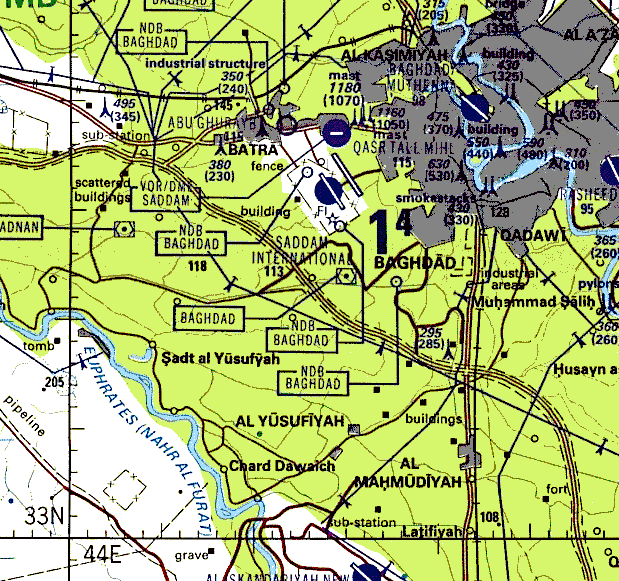
First, how did this happen? Normally when setting up checkpoints, they are placed in positions that can see at least one other position, either a checkpoint or a firing position. The theory is that the positions can provide what is termed mutual support - covering and supporting fire and a quick reaction. From the official reports, it was 15 minutes before an American reaction team arrived on the scene.
** New information: The three soldiers from the 101st Airborne Division were part of the three-vehicle element operating a checkpoint in the Yusufiyah area. Two of the HMMWV's gave chase to a suspicious vehicle, leaving the third vehicle alone. It appears that this was a planned ambush - the suspect vehicle drew off two of the three vehicles, leaving the third vulnerable. Insurgents then attacked and overpowered the three soldiers, killing one. There are reports from locals that the two were seen being taken away by car.
Second, who most likely attacked the checkpoint? The Yusufiyah area has been a hotbed of "Al-Qa'idah in the Land of the Two Rivers" (Al-Qa'idah in Iraq) activity over the last three years. It would not be surprising that this group, formerly headed by the recently killed Abu Mus'ab Az-Zarqawi, would mount this type of attack. What better way to prove that the group retains operational capability than to capture two American soldiers?
Third, what now? I think it is unlikely that they will be found. As I once learned in training, if you can avoid capture for 20 minutes, you have an excellent chance of escape. Every minute beyond that, the size of the search area expands exponentially to the point that it is extremely difficult to be effective. It has been well over 24 hours since the incident.
I fully expect that within the next few days we will see a videotape on Al-Jazeera or another Arabic language network showing the two soldiers in the hands of an insurgent group. If this happens, the tape will no doubt have a significant psychological impact on the American public.
Unfortunately, there are now two American soldiers probably being held hostage by an Al-Qa'idah group - the result of an incident that should not have happened.
My comments on MSNBC (video).
June 16, 2006
Al-Qa'idah in Mesopotamia Document
A document (read the text) found in the house in which Al-Qa'idah in Mesopotamia leader Abu Mus'ab Az-Zarqawi was killed reveals the status of the organization and proposals to counter recent reverses.
My review of the document leads me to the conclusion that this is an analysis prepared by some in the Az-Zarqawi organization, more likely for Az-Zarqawi rather than by Az-Zarqawi. According to the document, the Iraqis and coalition forces have succeeded in damaging the organization. Notably, the author cites the establishment of Iraqi security forces as limiting the amount of casualties that the group has been able to inflict on American forces. Because the group cannot inflict an increasing number of casualties on the Americans, time is no longer on the side of the insurgency.
Previously, Az-Zarqawi was of the opinion that if he continued to cause American casualties, adverse public opinion in the United States would lead to demands for the troops to be withdrawn. The author believes this is no longer the case. The advantage of time has shifted to the coalition and Iraqi government. The author provides several reasons for this conclusion. Of significance are the increased operations by Iraqi security forces and effective coalition operations in "resistance areas." I think this refers to the series of American-led operations over the last six months in the Euphrates River valley aimed at destroying the supply line between Baghdad and the Syrian border, as well as increased troop presence in the volatile cities of the Sunni triangle - Ar-Ramadi, Ba'qubah, Fallujah, etc.
The author goes on to list a few things that should be done. Of interest, he cites "mistakes that blemish the image of the resistance." I take this to mean the videotaped beheadings and the continued attacks on Shi'a shrines. These activities are in direct contravention of the instructions sent in a letter from Al-Qa'idah's number two leader Ayman Az-Zawahri to Az-Zarqawi in July 2005.
The author's solution to the "current bleak situation" is to foment a conflict between the United States and either the Iran or the Shi'a Muslims in general, citing the positive impact on the Az-Zarqawi group that resulted from the battle between the Al-Mahdi Army of Shi'a leader Muqtada As-Sadr and American forces. The author lists a series of options to cause this type of conflict, including battles between the various Shi'a factions, the Shi'a and the Kurds, the Shi'a and the Americans, etc.
In the end, the author comes to the conclusion that the best course of action, the one that will help the insurgency the most, is to foment a war between Iran and the United States. The author believes this will be difficult, assessing that Iran is actively assisting the United States in both Afghanistan and Iraq. The key, according to the paper, is to play up the danger to America and the west from Iran.
The paper presents an interesting look at the insurgency and its analysis of the situation in Iraq.
June 8, 2006
Az-Zarqawi's Fatal Misjudgment
An edited version of this piece appears on the MSNBC Hardball Blog Abu Mus'ab Az-Zarqawi,the leader of the Al-Qa'idah in Iraq organization, was killed in an American air strike on June 7, 2006.
It is likely that Az-Zarqawi would be alive today had he not made what I regard as a fatal misjudgment.
On November 9, 2005, followers of Az-Zarqawi conducted suicide bomb attacks in three tourist hotels in Amman - the Radisson SAS, the Grand Hyatt, and the Days Inn (two at which I have stayed) - in which 60 people were killed. A woman with a bomb strapped to her body was detained before she could detonate the device in the Radisson. Her husband was successful in detonating his own device, killing 38 people attending a wedding, including the bride and groom, and American filmmaker Mustafa Al-'Aqad.* Interrogation of the woman revealed that the mastermind behind these attacks was Abu Mus'ab Az-Zarqawi.
A believable rationale for these attacks has never been articulated. Up until this incident, Az-Zarqawi enjoyed almost cult status in Jordan, sort of a Salah Ad-Din figure battling the forces of the west, "crusaders" of a sort. However, this operation which killed almost exclusively Arabs and Muslims, turned public opinion against the Jordanian-born Az-Zarqawi.
Az-Zarqawi had already been sentenced to death in absentia twice in Jordan, once for an attempted attack in 1999 on the same Radisson SAS hotel in Amman, and again for complicity in the 2002 murder of US Embassy officer Lawrence Foley in the 'Abdun section of Amman. Despite these sentences, the Jordanian authorities never really pursued him as long as he remained outside the country.
In response to this senseless operation, King 'Abdullah II met with Muhammud Zahabi, director of the Jordanian General Intelligence Department (da'irat al-mukhabarat al-'amah), the GID. The king told Zahabi to find Az-Zarqawi and eliminate him.
This order was Az-Zarqawi's downfall. The Jordanian GID is easily the most professional of all the numerous Arab intelligence organizations. They are professional, well-trained, disciplined and effective. The key to the successful elimination of Az-Zarqawi would be predicated on timely, accurate intelligence delivered to an operational element with the capability to put weapons on the target. That's exactly what happened. The Jordanians provided much of that timely accurate intelligence based on their much greater understanding of the region and long-time intelligence sources in Iraq.
It is important to note that the air strike was conducted in concert with a series of as many as 17 other raids of suspected Al-Qa'idah safe houses. Hopefully, the intelligence gained will allow the Iraqis and coalition to eliminate the remainder of Az-Zarqawi's group. At the very least, the organization will be is temporary disarray as they try to determine how their operational security was compromised.
____________
* On a personal note, Mustafa Al-'Aqad was the brother of one of my Arabic language instructors at the Defense Language Institute, and friend Usamah "Sami" Al-'Aqad. My condolences are with Sami's family.
June 4, 2006
Haditha and the Sunnis
This article appears on the MSNBC Hardball Blog.
Incidents in two Iraqi cities have focused world attention on possible misconduct by US forces in Iraq. Although US forces were cleared of misconduct allegations stemming from a March 15 incident in Ishaqi where at least 13 people were killed, a criminal probe has been launched into the November 19, 2005 incident in Haditha where US Marines are accused of killing a group of unarmed Iraqi civilians.
First, if there was misconduct, if the Marines did kill innocent civilians in a rage after losing one of their own, they should be – and will be – held accountable. If there was an attempt anywhere in the chain of command to cover up what happened, those responsible should also be held accountable. Those of us who served in the post-My Lai Vietnam conflict know full well how important this is. The investigation will eventually determine what happened last fall. Guilt or innocence will be determined, punishment, if warranted, will be meted out, and policies may be changed.
That’s the black and white. Now let’s look at the grey.
Haditha (and Ishaqi) is located in the Sunni area north of Baghdad, the so-called “Sunni triangle.” It has been a hotbed of insurgent activity since the war began in 2003. US forces there have been subjected to unending attacks, mostly with improvised explosive devices (IED’s), homemade bombs placed alongside the roads the troops must travel to patrol the area. The November 19 attack involved such a device – a 155mm artillery shell wired to a detonator. IED’s have been the insurgents’ only effective means of attacking US forces – directly confronting the better trained and equipped Americans has proven futile.
Making and planting IED’s cannot be done in a vacuum. Someone - or more likely many – in Haditha were aware of insurgent activities. Although the residents may not be direct participants in the insurgency themselves, they have not provided information to either the US or Iraqi forces. To the soldiers and Marines on the ground, this amounts to tacit cooperation with the insurgents. The biggest complaint among the American troops is not knowing who the enemy is and whom to engage. When troops come under these anonymous IED attacks, they are naturally disposed to strike back. The question is, against whom? It is extremely frustrating for these young soldiers and Marines to get hit with these IED’s, suffer casualties and not be able to respond.
We don’t yet know exactly what happened at Haditha. I am surprised we don’t have more of these incidents. I have maintained for a long time that the residents of these towns, particularly in that area north of Baghdad, know exactly who the bad guys are, and when and where they set up these devices. I am not excusing the alleged actions of the American troops in this case, but I can understand the frustration that causes them.
The potential for more of these incidents, and the insurgency itself, will continue until the Sunnis decide they are going to be part of the solution and not part of the problem.
May 22, 2006
Baghdad ER: I give it a B- to a B

My take:
I wish they would have been a bit more journalistic or scientific in their methodology. I couldn't tell if this was over a shift, a week, a month, or if they cherry picked cases they thought were interesting.
Also, the Army CSH in Baghdad is not the premier medical facility in country - the Air Force theater hospital at Balad Air Base is. The CSH primarily stabilizes and transports, doing surgery only if necessary. The theater hospital does almost everything.
I would have liked for them to explain why 90 percent of the casualties that make it to the CSH survive - and 96 percent that make it to Balad survive. Is it the battlefield care, better field trauma dressings, better body armor, etc.?
They went to great pains for OPSEC reasons to not say where the CSH was located, except that it was in the Green Zone ("I can't say anything more than that."). Anyone with a computer who does a search on 86th CSH (then) or 10th CSH (now) will locate them at the Ibn Sina* hospital. (Example: Combat Support Hospital Still Saving Lives.) The location of the hospital is well known. Anyone who reads Arabic - and the people we are trying to keep the information from can - would know as soon as they showed the first ten minutes.
I give it a B- to B.
________________
* Ibn Sina (980-1037AD) was a Persian physician considered by many to be "the father of modern medicine." His most famous works are The Book of Healing and The Canon of Medicine.
May 20, 2006
Israeli Targeted Killing of Ad-Dahduh
x
Ad-Dahduh has been the leader of the Saraya Al-Quds, or the Jerusalem Companies, the military wing of the PIJ, since at least September 2005. At that time the Israelis carried out an almost identical operation against the man believed to be Ad-Dahduh's predecessor, Muhammad Al-Khalil; Al-Khalil was killed. This operation was likely in response to the April 17 bus station homicide bomber attack in Tel Aviv, conducted by the PIJ.
The precision of this operation points to the excellent intelligence capabilities in the Israeli security and military services, their ability to get the information into the hands of a shooter, and the political will to do it. Although the missile was fired by a military aircraft, the intelligence that was able to pinpoint a specific car on a specific road at a specific time was likely provided by the ruthless Israeli internal security service, commonly known by its Hebrew initials Shin Bet. To provide this level of detail requires either an Israeli operative on the ground or a well-placed Palestinian reporting asset - either of which are difficult and dangerous, but necessary.
This is how you hunt down and kill the bad guys. CIA, DIA and U.S. Special Operations Command - pay attention.
Iraq's New Government
x
On Saturday, May 20, the Iraqis swore in a democratically elected government. Finally. We have been waiting for this since the fall of Saddam Husayn in April 2003.
As expected, the majority Shi'a have emerged as the main power brokers in the country. Although the elections were held in December, it has taken these last almost five months to form a government acceptable to all parties.
Good news, but significant challenges lay ahead. Of course,the overriding concern of all Iraqis is security. That is closely followed by the economy, and in Iraq "economy" is synonymous with oil. Thus, the most important portfolios in the government are those that deal with security and oil - the ministries of defense, the interior, national security and oil. These were also the most contentious appointments.
Let's take a look at how prime minister Nuri Al-Maliki has addressed filling these critical positions. Since these are contentious positions, several have been filled by interim ministers.
Oil: The oil portfolio is held by nuclear scientist Husayn Ash-Sharistani. Ash-Sharistani is a fairly devout Shi'a who was imprisoned for ten years by Saddam Husayn for objecting to Iraq's nuclear weapons program in the 1980's and 1990's. Although he is a Shi'a, he is regarded as non-political and acceptable to the two other major factions, the Sunnis and the Kurds. He has his work cut out for him - Iraq's oil production is still below the pre-war level of 2.5 million barrels per day. Much of this is due to the continued attacks on the oil sector infrastructure. Again, security is the issue.
Defense: This is one of the unresolved portfolio assignments. Control of the Iraqi armed forces is a position of tremendous power. The Iraqis are wary of the military since in the past it was used to maintain the regime that oppressed them. The portfolio is temporarily held by Salam Az-Zuba'i, a Sunni. I imagine there will be pressure from the Shi'a to name a Shi'a to this post.
National Security: Barham Salih, a Kurd (and a personal friend of mine), retains this portfolio. This is more of national security advisor rather than a minister. Barham is politically savvy and is in a good position to advice the Shi'a prime minister.
Foreign Affairs: Hoshyar Az-Zabari, also a Kurd (and acquaintance of mine), retains this post. Hoshyar is a capable diplomat for the new government, is respected abroad, and is acceptable to all three factions. Good choice.
Interior: This is undoubtedly the most contentious of the ministerial positions. The Minister of the Interior (MOI) is not anything like the U.S. Department of the Interior, which oversees national lands and parks. The Iraqi MOI is responsible for internal security and oversees the police organs of the state - the border patrol, highway patrol, national police, special police, etc.. People are wary of this ministry, because, like the armed forces, it was the primary source of control under Saddam Husayn. The Sunnis are concerned that a Shi'a-dominated internal security apparatus will mean oppression for them. There are claims of MOI "death squads" extracting revenge for decades of Sunni domination and perceived mistreatment on the part of the Shi'a. For now, Al-Maliki is filling the position himself, probably as a way to get the government up and running. He will then address the sticky issue of who to appoint to this portfolio permanently.
Al-Maliki said his first priority was to address the security situation and having Iraqi security forces take the lead, allowing foreign forces to depart. He's going to have to do just that as American patience runs out and demands the drawdown of U.S. forces.


