July 11, 2016

U.S. to deploy 560 more troops to Iraq - further down that slippery slope?


During a visit to Baghdad, Secretary of Defense Ash Carter announced that the United States will deploy an additional 560 troops to Iraq to assist in the fight against the self-declared Islamic State in Iraq and Syria (ISIS).

That will bring the number of American forces in Iraq to almost 6000, far higher than the Pentagon-cited figure of 4,647 - the Defense Department does not include personnel on temporary assignments in the official count.

The stated reason for the additional troops is to assist Iraqi forces as they prepare for the eventual campaign to retake the city of Mosul. Mosul is Iraq's second largest city - it has been under ISIS control since it fell to the group in June of 2014. One of the tasks assigned to the new troops will be the rehabilitation and reconstruction of facilities at the large al-Qayyarah air base - the base was recaptured from ISIS on July 9.

The base will be a key staging area for Iraqi forces as they mount the attack on Mosul. The base is about 40 miles south of Mosul and west of the Tigris River. This assault was successful in crossing the river and reclaiming territory from ISIS west of the Tigris Valley, further reducing the amount of Iraqi territory in the country under the group's control.

The air base, formerly known as al-Qayyarah West, is a large facility with long runways capable of handling heavy transport aircraft, as well as scores of helicopters. The base provides an excellent base from which to launch attack sorties against ISIS positions in Mosul. Additionally, Iraqi or American long-range artillery or rocket launchers will complement the existing American firebase located at Makhmur on the east bank of the Tigris.

The recapture of the air base is an important step, one of the many needed before the operation to liberate Mosul can start. The liberation of Mosul is necessary to defeat ISIS and eject them from Iraqi territory - it is the group's major holding in the country. Mosul and the Syrian city of al-Raqqah, which ISIS claims as its capital city, are major centers of gravity for the group.

The loss of Mosul will effectively end their claims on Iraq. Only then can the government in Baghdad begin the rebuilding of the country as a viable, united political entity.

Preparing for a campaign to retake Mosul has been a long and slow process. The Iraqis have thus far expelled ISIS from Tikrit and Bayji (and now al-Qayyarah) in the Tigris Valley, as well as ridding the entire al-Anbar province by successful - if not devastating - operations in al-Ramadi, al-Hit and recently al-Fallujah.

It was hoped that the removal of ISIS from al-Anbar would reduce the number of ISIS bombing attacks in and around Baghdad - July was a month of a series of high-profile bombings in the city. Unfortunately, ISIS used its lingering presence in Diyala province (east and southeast of Baghdad) to launch the most devastating truck bombing in the upscale Shi'a neighborhood of Karradah on July 4. That attack, in which almost 300 people died, was the worst single attack since the invasion of Iraq in 2003.

Although the recapture of Mosul is arguably the key to the eventual defeat of ISIS in Iraq, the Iraqi government of Prime Minister Haydar al-'Abadi has another concern - the security of Baghdad. As long as ISIS is able to mount devastating bombings in and around the capital, the residents will demand that he focus on their immediate security rather than the eventual recapture of Mosul. Should al-'Abadi decide to allocate security resources - army, militia or police - to Diyala to deal with the ISIS threat emanating from that province, it will delay the Mosul operation.

The Mosul operation will be a large-scale undertaking. Retaking cities like al-Ramadi and al-Fallujah were much smaller operations, and took much longer than expected. Mosul is going to require virtually all of the combat power Iraq has and then some.

The "then some" will be the assets committed by the U.S.-led coalition - airpower, artillery and rocket fire support, intelligence, logistics, communications, command and control, engineer support, as well the placement of U.S. military officers in Iraqi combat battalions.

It is those capabilities that Secretary Carter cited in his remarks: "These additional U.S. forces will bring unique capabilities to the campaign and provide critical enabler support to Iraqi forces at a key moment in the fight."

The increased American support will be necessary for the Iraqis to recapture Mosul. As we have seen in recent military operations, there is great reliance on American airpower, intelligence, fire support, etc. Since Mosul will be a much larger, more complex operation, there will likely be calls for an even higher level of support.

The Administration's decision to deploy additional troops to Iraq reflects the realization that Iraqi forces as they stand today are not capable of conducting that operation, and certainly not on the timetable promised by Prime Minister al-'Abadi - he has pledged to retake Mosul before the end of the year.

To those of us who served in Vietnam, the gradual escalation of American troop presence in Iraq over the last two years reminds us of how a small advisory mission grew into a large-scale military operation lasting over a decade and costing over 58,000 American troops.

The words "mission creep" come to mind. It is not only the troop presence in Iraq that concerns many observers - it is the continuing build up of forces in the region that directly conduct operations against ISIS in Iraq and Syria.

It is critical that ISIS be defeated - and key to that defeat is the retaking of Mosul. Should the Iraqis prove incapable of doing that with the current levels of American support, will we continue to escalate our troop presence? Are we in danger of sliding further down that slippery slope? Are we going to reach the point when we see the re-introduction of American combat formations into Iraq?

We haven't even started talking about ejecting ISIS from Syria yet.


July 8, 2016

The battle after Fallujah - an Iraqi strategy shift?

Iraqi Army officers and dead ISIS fighters in al-Fallujah, al-Anbar province

After a month of intense fighting between fighters of the Islamic State in Iraq and Syria (ISIS) and a mixture of Iraqi security forces supported by Iranian-backed Shi'a militias and U.S.-led airpower, the city of Fullajah (al-Fallujah, الفلوجة‎‎) is now back under Iraqi government control. The city had been occupied by ISIS since January 2014 - Fallujah was the first major Iraqi city to fall to the group.

As with previous Iraqi military operations aimed at retaking cities from ISIS - Ramadi, Tikrit, Bayji, etc. - it took much longer than predicted and has reduced substantial sections of the city to little more than rubble. The areas not devastated by airstrikes, bombing, artillery and street-to-street fighting is riddled with booby traps and mines. It will be weeks, possibly months before the city is inhabitable by its former residents.

The liberation of Fallujah came against the backdrop of a series of high-profile bombings in and around the city of Baghdad. The government of Prime Minister Haydar al-'Abadi was criticized for allocating resources to the fighting in Fallujah at the perceived expense of security in Baghdad. Al-'Abadi maintained that the operations in Fallujah would increase public safety in Baghdad since he believed that many of the bombings in the capital were planned in and staged from Fallujah.

Almost immediately after the initial government claims of victory in Fallujah, Iraqi military leaders declared that they are planning a military operation to retake Mosul, Iraq's second-largest city. Mosul has been in ISIS hands since they seized it from a hollow, weakened Iraqi Army in June of 2014. That statement was echoed by a few American senior officers currently "advising and assisting" Iraqi forces.

The proposed timeline - Mosul back under government control by the end of this year - in my opinion is exceedingly optimistic. The Iraqi Army has still not regained its competence since its humiliating defeat in Mosul in 2014.

The Iraqi Army collapsed not because ISIS was such a superior military force, but because Iraqi forces had atrophied due to the devastating policies of former Prime Minster Nuri al-Maliki following the complete - and I believe premature - withdrawal of American troops from the country at the end of 2011.

The withdrawal was the result of the failure of the United States to secure an updated status of forces agreement that would allow the continued presence of a limited number of American troops in the country to assist with the training and development of Iraqi security forces. In my opinion, the Obama Administration was so anxious to leave Iraq that it ignored the still tenuous security situation in the country.

On July 3, in retaliation for the Iraqi government's successful retaking of Fallujah, ISIS detonated two truck bombs in Baghdad, one in the upscale Shi'a neighborhood of Karradah and one in the less affluent Sha'ab neighborhood. The death toll from the bombings has reached almost 300. The blasts - the deadliest since the 2003 invasion - have caused anger and fear in the city.

Much of the anger has been directed at the prime minister - his claims that removing ISIS from Fallujah would make Baghdad safer now ring hollow. The two suicide bombers mounted their attacks from Diyala province, located to the east and northeast of Baghdad, not from Fallujah in al-Anbar province to the west. Again, the residents have called on the government to provide security for the city.

Iraqi political leaders and military planners are now reassessing their strategy. Given the continued presence of ISIS fighters in Diyala province and the group's demonstrated capability to mount large-scale attacks in central Baghdad, Iraqi leaders may now opt to completely clear Diyala province of ISIS prior to moving its forces north for the eventual assault on Mosul. The residents of Baghdad are more concerned about their own security than an artificial timeline to retake Mosul.

ISIS has taken a page from the manual of asymmetric warfare - they have been successful in creating a "significant emotional event" that has caused the Iraqi government to reassess its strategy. If the leadership in Baghdad postpones its plans to mount an attack on ISIS in Mosul and instead focuses its immediate attention on the ISIS presence in Diyala, that gives ISIS more time to develop its defenses for what it knows will be the definitive battle in the country.

It is merely a delaying tactic, to be sure. The Iraqis, with support from the U.S.-led coalition and Iranian-supported Shi'a militias, will eventually marshal the forces and resources necessary to retake Mosul. However, it does appear that ISIS has forced Baghdad to reassess its strategy.


May 18, 2016

Iraq - Goals of the ISIS bombing campaign


Over the past few months, there has been a dramatic increase in the number of bombings in and around Baghdad - it has become almost a daily occurrence. The bombs include improvised explosive devices, car bombs and suicide vests.

As was to be expected, the self-proclaimed Islamic State in Iraq and Syria (ISIS) has claimed responsibility for the all of the bombings. The attacks have killed over 200 hundred Iraqis, virtually all of them Shi'a Arabs - avowed enemies of the Sunni extremists of ISIS.

The bombing campaign represents a shift in tactics for the group and follows a series of battlefield losses for ISIS. As the Iraqi Security Forces (the catch-all term for the Army, national police, special units and Shi'a militias) regroup after dismal showings following the collapse of the units defending Mosul in 2014, they are beginning to retake territory from ISIS.

Much of that success is due to increased effectiveness of U.S.-led coalition airpower and effective targeting of ISIS leaders and facilities based on more accurate intelligence. This reflects the increased presence of American troops on the ground and development of better intelligence sources.

As the more effective military operations take their toll on ISIS, the group has fallen back, giving up territory in al-Anbar province and the Euphrates River valley. Their supply and communications lines used to move forces and resources between Iraq and Syria have been cut.

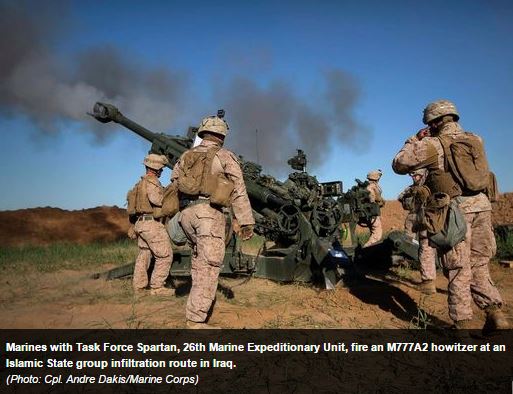
At the same time, Iraqi forces - this time with not only American airpower, but direct fire support from U.S. Marine field artillery and rocket launcher systems - have pushed north up the Tigris River valley. These forces are shaping the battlefield for the inevitable assault to re-assert Iraqi government control over Mosul and the northern parts of the country now occupied by ISIS.

According to U.S. officials, ISIS is no longer attempting to seize more territory in Iraq, or Syria for that matter. I agree with that assessment - the group is consolidating its defense of Mosul and limiting its offensive operations to re-establishing its lines of communications. This, however, is a losing strategy - they must find a way to stop the Iraqi forces' momentum at a time when U.S. and coalition support to the Iraqis is on the rise.

After almost two years, the now-constant air strikes - finally, the increased operations tempo I have been calling for - are taking a toll. Unless ISIS changes its strategy, it is only a matter of time before the resources available to the Iraqi government isolates and destroys it.

Hence, ISIS's renewed relentless bombing campaign. The number of attacks and the breadth of the areas being struck reminds us that the organization is still capable of inflicting large numbers of casualties, especially against relatively undefended targets. The targets ISIS has selected for this campaign certainly meet that description - markets, sporting event venues and any areas where large numbers of people gather.

ISIS has several goals in this bombing campaign. The ultimate goal, of course, it to create so much mayhem and resulting public outcry against the government of Prime Minister Haydar al-'Abadi that the Iraqis reassess their military operations aimed at retaking Mosul. Taking a page from the basic guerrilla handbook, they are attempting to create "significant emotional events" - events that so traumatize the body politic that the people will demand the government change its tactics.

It has a small change of success, depending on how effective the bombing campaign becomes. The Iraqi people - more accurately, the Shi'a population of Baghdad and its environs who are the focus of the bombings - are already criticizing the government's seeming impotence to stop the attacks, and demanding increased security measures to protect them.

The government is vulnerable to this tactic, and ISIS is smart to exploit this vulnerability, The Iraqi government has finite resources in the security forces. These forces are spread thin trying to fight ISIS in the Euphrates valley and moving up the Tigris valley while at the same time providing security in the capital. The Shi'a population in and around Baghdad is more concerned with its own security than the eventual liberation of the Sunni areas around Mosul.

ISIS has forced the Iraqi government into a situation in which it has two choices: continue the military operations against ISIS and risk alienating the Shi'a population - its political power base in Baghdad, or pull forces back from the various combat fronts to provide better security in the capital, which in essence cedes territory to the terrorist group. Unfortunately, the Iraqis cannot do both.


May 4, 2016

OPINION - Obama press secretary Josh Earnest insults American killed in combat

This is a personal opinion piece.

I was offended and insulted by statements made by President Obama's press secretary Josh Earnest concerning the death of U.S. Navy SEAL Charles Keating IV. Petty Officer Keating died in combat in Iraq on May 3 - he was one of a group of SEALs assisting Kurdish peshmerga troops in their defense of an Assyrian Christian town north of Mosul against an assault by more than a hundred fighters of the Islamic State in Iraq and Syria (ISIS).

The SEALs were in the area as part of their mission to "advise and assist" Iraqi security forces in their fight against ISIS. According to the Obama Administration, the deployment of members of the U.S. armed forces to "advise and assist" does not constitute a combat mission, despite the fact that the units being provided advice and assistance are engaged in combat operations, and much of that assistance comes in the form of direct control of U.S. Air Force and U.S. Navy airstrikes.

The Administration can spin that as it likes, but anyone with a modicum of common sense realizes that this is nothing more than political drivel to fit a narrative that American troops are not involved in combat operations. It fails the common sense test.

You can listen to Earnest's pitiful attempts to parse the difference between "combat" and "combat mission" in this video clip. I wonder if he actually believes his own words - then again, how would he know the difference? He, nor virtually anyone else on the White House staff, has ever worn a uniform.


"What I am trying to do though is to be as precise as possible with you and the American public about what exactly our Commander in Chief has asked our service members to do. Secretary Carter earlier today described this death as a combat death – that’s accurate. This is an individual who was not in a combat mission but he was in a dangerous place…and his position came under attack. He was armed, trained and prepared to defend himself. Unfortunately, he was killed…and he was killed in combat, but that was not part of his mission. His mission was specifically to offer advice and assistance to those Iraqi forces fighting for their own country."

Mr. Earnest, I realize your job is to spin reality into a form that fits a narrative dictated by your political masters at the White House, but the more you speak the less believable the words are. I suppose you have a tight definition that somehow explains that our pilots - of all services - flying over Iraq and Syria, many of them dropping ordnance on ISIS personnel and positions - are not "in a combat mission." How do you spin delivering ordnance as an "advise and assist" mission.

Additionally, on the day the Petty Officer Keating was killed, you began the daily press briefing with a detailed litany of the President's scheduled visit to Flint, Michigan, adding your remarks on the the death of an American sailor killed in action in Iraq only when specifically asked by members of the press. Your canned remarks appeared to be an afterthought. One has to wonder if you would have mentioned it at all had you not been prodded by a reporter.


“I can tell you the president has been briefed on this incident, and everyone here at the White House, including the First Family, extends our condolences to the family of the service member that was killed today in northern Iraq. This individual was the third U.S. service member killed in action since the beginning of Operation Inherent Resolve, and this service member’s death reminds us of the risks our brave men and women in uniform face every single day."

Rings hollow, doesn't it?

ADDENDUM: In memoriam.


May 3, 2016

Iraq - Muqtada al-Sadr flexes his political muscles

Al-Sayyid Muqtada al-Sadr
Caption on right: Yes, yes to Iraq / Lower caption: Love of country comes from faith

In a demonstration of his political power, radical Shi'a cleric Muqtada al-Sadr engineered a huge demonstration on Saturday, April 30 inside Baghdad's heavily fortified and defended "Green Zone" (officially the International Zone).

Thousands of al-Sadr's followers moved blast walls and fences, pushed their way into the zone and entered several of the government buildings that constitute the seat of power of the Iraqi government. The zone is also the home of the huge American embassy as well as other foreign missions.

The ease by which the demonstrators entered the facility is telling. Iraqi security forces are perfectly capable of defending the zone and repelling the demonstrators, but there was little resistance from the guard force. Many of the demonstrators remarked that they were treated fairly by the soldiers and police as long as they did not pose a threat. Reportedly, the general in charge of security personally welcomed al-Sadr to the restricted area. Why was there no armed confrontation?

I suspect there was almost no violence because Muqtada al-Sadr and the demonstrators are demanding the same thing Iraqi Prime Minister Haydar al-'Abadi has been advocating for months - the end of the rampant corruption and cronyism that permeates virtually every level of the Iraqi government.

The nonviolent demonstrations are a departure from al-Sadr's past. The cleric has a long history of violent confrontations with the Iraqi government, and his Iranian-trained and supplied jaysh al-mahdi (JAM, or Army of the Mahdi) was responsible for the deaths of hundreds of American troops between 2004 and 2007. It was only the American "surge" of 2007-2008 that saw the demise of the JAM - al-Sadr assessed, correctly, that his thugs were no match for the newly-deployed U.S. Army combat battalions tasked with securing Baghdad. Al-Sadr fled to Iran.

The cleric remained in Iran for over three years, returning to Iraq in early 2011. Ostensibly, al-Sadr was in Qom to continue his Islamic studies and attain the title of ayatollah; he had been a hawjat al-islam prior. I suspect this claim was only for his followers, since he has not attained the title of either mujtahid (one authorized to issue fatwas, or religious rulings) or ayatollah. His return to the Shi'a holy city of al-Najaf, site of the martyrdom of the first Shi'a imam 'Ali (son in law and cousin of the prophet Muhammad), was greeted with almost uncontrollable revelry in the streets.

Why is this 42-year old such an influential figure in Iraqi politics?

Muqtada al-Sadr is a sayyid. Sayyid is the Arabic word for mister, or sir. However, in Shi'a Islam it denotes a person who is a direct descendant of the prophet Muhammad through his daughter Fatimah and Imam 'Ali. Sayyids are entitled to wear the black turban.

The Shi'a believe that leadership of the faithful should have been restricted to the prophet's bloodline, and al-Sadr clearly qualifies. His family lineage is traceable back to the sixth iman, Ja'afar al-Sadiq, and the seventh imam, Musa al-Khadhim. The shrine of the seventh imam is located in the northwest section of Baghdad, appropriately named al-Khadhimiyah. While Westerners sometimes dismiss the cache of direct lineage to the prophet, Iraqis do not. Coincidentally, the annual remembrance ceremony for the seventh imam is this week.

Muqtada al-Sadr is arguably now the key power broker in Iraq. When he called his followers back from the demonstration in the Green Zone, he issued an ultimatum to Prime Minister al-'Abadi that the Iraqi leader has until Friday (May 6) to effect changes in the Iraqi cabinet, replacing corrupt politicians with qualified technocrats. If that deadline is not met, the demonstrations will resume. Al-Sadr has further threatened to bring down the al-'Abadi government and force early Parliamentary elections - elections he can greatly influence.

Al-'Abadi should take Muqtada al-Sadr seriously. The firebrand cleric has proven that he can mobilize thousands of disciplined demonstrators and create problems for the Iraqi government - at a time when the government needs to devote its time and energy to the ongoing fight against the Islamic State in Iraq and Syria (ISIS).

Of note, Muqtada al-Sadr flew to Iran this morning - is he there to get his marching orders? I guess we will find out when al-'Abadi does not meet the Friday deadline.


April 30, 2016

Syria: The impending fall of Aleppo

The city of Aleppo will fall in the near future - the anti-regime rebels in the remaining contested areas of the city will not be able to hold out much longer.

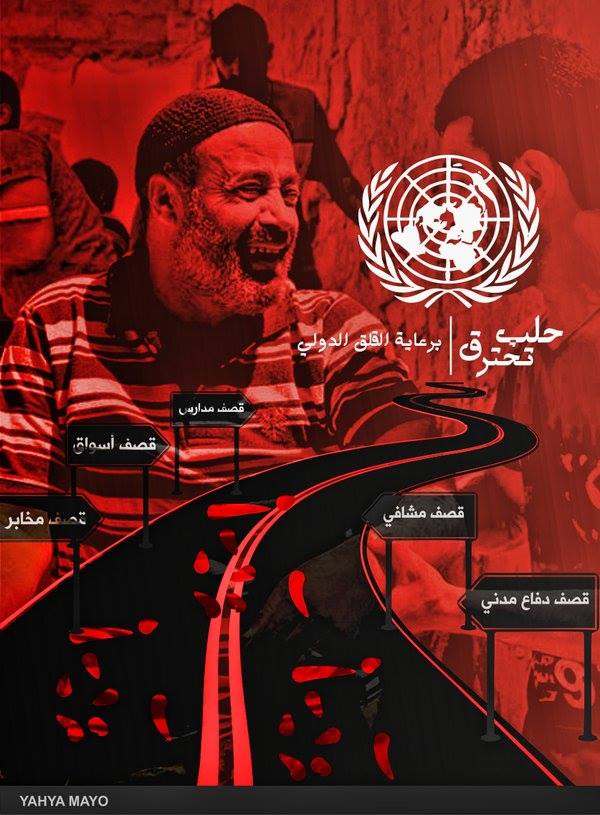
The graphic (left) epitomizes the pessimism that pervades the rebel-controlled areas of the city.

It is titled "Aleppo is burning - under the auspices of international organizations." It is a direct criticism that the United Nations is doing nothing to stop the relentless air strikes being conducted by both the Syrian and Russian air forces.

The targets, according to the graphic, are civil defense (fire and rescue) services, hospitals, schools, markets and bakeries. The complaints are accurate - over the last two weeks, Syrian and Russian fighter-bombers have conducted a coordinated campaign against these target sets across northern Syria, particularly in Aleppo and Idlib governorates, areas in which the bulk of the anti-regime rebels are located.

The increased air attacks are being conducted in conjunction with increased pro-regime ground forces operations in these same areas - the troops are Syrian armed forces supported by units of both the Iranian Islamic Revolutionary Guard Corps (IRGC) and now the regular Iranian Army, as well fighters from Lebanese Hizballah. Russian advisers are also on the ground with these forces, coordinating air attacks and artillery fires to great effect.

The timing of the renewed focus on Aleppo is somewhat surprising. Rather than press the attack on retreating forces of the Islamic State in Iraq and Syria (ISIS) following the regime victory in the strategic city of Palmyra, most of the regime forces were re-tasked for an assault on Aleppo. Militarily, it does make sense - the regime needs to secure the Aleppo area and close off the ISIS resupply lines from Turkey that lie to the northeast of Aleppo.

The situation in Aleppo has changed dramatically since September 2015 - it was then that Russian forces entered the fight, while at the same time increased numbers of IRGC and Hizballah units were deployed to Syria. It was the liberal (some would say indiscriminate) application of Russian airpower to support the revitalized Syrian government operations on the ground, allowing the regime to virtually erase all of the recent gains of the anti-regime rebels.

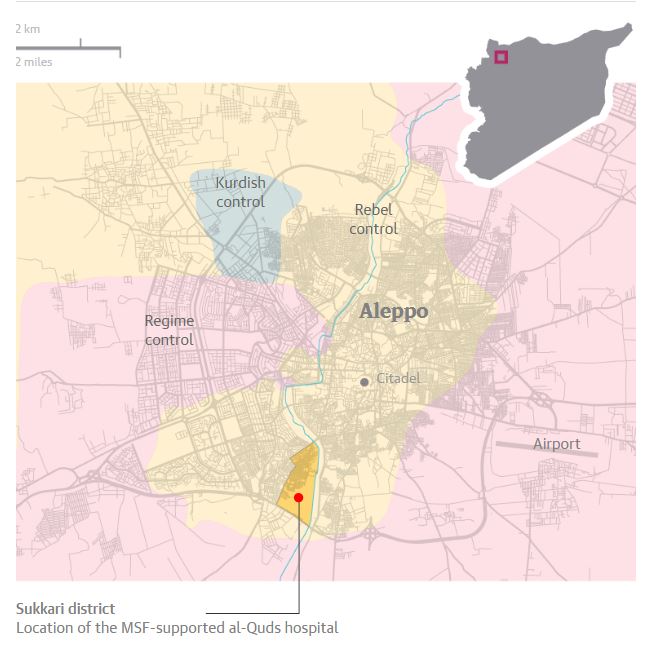
Prior to the Russian intervention, Syrian forces were on the defensive, retreating south from Aleppo and much of Idlib governorate. Soon after Russian aircraft began providing direct air support, the rebels were pushed back into enclaves in and north of the city of Aleppo. It is those enclaves that are now under renewed - and increased - air attacks. The recent attack on the Médecins Sans Frontières hospital in the Sukkari district of Aleppo is symptomatic of the stepped-up air campaign.


The cessation of hostilities, by all accounts, has collapsed. U.S. Secretary of State John Kerry and Russian Foreign Minister Sergey Lavrov are trying to revive the ceasefire, but it is doubtful that it will be any more effective than the previous failed agreement. In any case, the renewed ceasefire will exclude Aleppo - that is basically giving Bashar al-Asad the green light to press the attack and take the city.

It really does not matter if a new cessation of hostilities is enacted. Many observers, including me, believe any ceasefire is merely a ruse on the part of the Syrians (and Russians) to continue military operations, taking advantage of a loophole in the agreement that permits attacks on "terrorist" groups - specifically, but not limited to the al-Qa'idah affiliate in Syria known as Jabhat al-Nusrah (The Victory Front) and ISIS. The Syrian regime labels anyone in the opposition as terrorists, making them valid targets.

A look at the map above clearly shows the dire situation facing the opposition fighters in Aleppo. The regime has been able to pressure them from the west, south and east. It is obvious what the regime and its allies are attempting to do - continue the push on these same three axes and cut off the enclave, then pivot to the north and retake the entire city.

The fall of Aleppo will cripple much of the rebel activity in the northern part of Syria - it will also have significant psychological impact on both sides. The retaking of Aleppo will be a major morale booster for the regime, and a major blow to the opposition. It will be a hard fight - both sides realize the importance of controlling Syria's largest city.

With the regime in control of the capital of Damascus and Aleppo, the perception will grow that the forces supporting Bashar al-Asad are on the path to defeating the opposition. It is analogous to controlling both Washington, DC and New York City.

I see no good options for the opposition in Aleppo - their military situation is untenable. With the Russian Air Force bringing effective airpower to the fight, and the Syrian Army refocusing its efforts on the rebels in Aleppo rather than on ISIS to the north of Palmyra, it is too much force for the opposition to withstand.

The coming battle might not be a rout, but it is only a matter of time until an army with the resources of a state, willing allies on the ground (Iran and Hizballah) and a committed air force (the Russians) capable of massing a large number of sorties in a concentrated area, wear down any resistance.

What does this impending defeat mean for U.S. interests? Cynically, it clears the way for all parties to concentrate their efforts against ISIS. Thus far, the U.S. coalition has limited its operations to attacks on ISIS and occasionally al-Qa'idah elements in the country.

Ironically, coalition operations have indirectly assisted the Syrian regime by relieving pressure on the government from ISIS, allowing the Syrians and their allies to focus their efforts on the rebels. The bulk of American support in Syria has been to anti-ISIS groups, not anti-regime groups. While there has been some support to anti-regime groups, it has been too little to make a difference.

It does not appear that the U.S.-led coalition is willing to provide protection or support for the rebels in Aleppo. They are on their own, facing the Syrian Army and Air Force, the Russian Air Force, Iranian IRGC and Army troops and Hizballah fighters.

How long will it take? Hard to say exactly, but time is running out.


April 25, 2016

President Obama orders 250 more American troops to Syria - what's the plan?


President Obama has ordered the phased deployment of an additional 250 U.S. troops to Syria to intensify the fight against the Islamic State in Iraq and Syria (ISIS). It is expected that most of these troops will be special forces, primarily U.S. Army Special Forces and U.S. Air Force Combat Controllers.

The Army soldiers will be used to advise and assist the Syrian Democratic Forces (SDF) in their fight against ISIS with training, intelligence, logistics, medical help, etc. This is a core mission of the Green Berets - forming coherent fighting units among the local population. Rather than having to introduce large numbers of American troops into an area, the concept is that the locals will do the bulk of the fighting, with American guidance and assistance.

The Air Force combat controllers will serve as what used to be called forward air controllers, now called tactical air control parties (TACP). This puts American eyes on the ground in direct contact with coalition aircraft - primarily U.S. Air Force fighter and bomber aircraft - flying overhead.

These "battlefield airmen" have the capability to designate targets on the ground via laser or GPS coordinates, and to feed targeting data directly into the guidance systems on weapons carried on board the aircraft. It is a proven tactic we have perfected over the years, devastating and accurate - no one does this better than us.

The recent deployment of the venerable B-52 to the Middle East - flying sorties from an air base in Qatar - fits into this operation. The B-52 has been transformed from a wide area saturation bomber (sometime inaccurately described as "carpet bombing") to a precision guided munitions carrier, capable of releasing one GPS-guided weapon at a time from its huge bomb bay. (See my article on this, B-52 deployment to the Middle East - let's drop the term "carpet bombing")

Let's address the "elephant in the room." The President's order expands the U.S. military presence on the ground in Syria - continued deployment of advisers reminds those of us who served in Vietnam how we got there. The words used in the description of the additional troops - "non-combat troops" deployed in phases - are troubling.

First, to label these troops headed for Syria as non-combat is not only ludicrous, but insults the courage and commitment of the men being sent into harm's way. They will be on the ground fighting arguably the most ruthless enemy we have faced in half a century.

As for phasing troops incrementally into the fight, that too smacks of Vietnam. Last month, after a U.S. Marine was killed in Iraq, I wrote:


So, we have the incremental expansion of the size and scope of our military presence in Iraq. I fear we are sliding down a slippery slope with no clear mission or plan. If ISIS is indeed a threat to American national security, then let's address it. Stop the half-hearted measures and make the tough decisions. Forget the "boots on the ground" myth - that die is cast, that lie is past.

Make up your mind, Mr. President - are we in this fight or not? If we are, go big. If we are not, go home.
Read the entire article, More U.S. ground troops to Iraq - further down that slippery slope?

There is a plan, but I am not sure our political leadership is fully committed to its implementation. Over the last few years - since ISIS demonstrated that it is a threat rather than an aberration - the Obama Administration has gradually realized that the threat must be addressed.

President Barack Obama and Secretary of State John Kerry are wont to decree that "there is no military solution" to the situation in Iraq and Syria, yet they keep sending more troops into the region. While the ultimate solution to the problems may not be strictly military, it will be military action that leads the parties to that illusive political solution. Diplomacy only works when there is military force backing it up.

The new leadership at the Department of Defense - Secretary of Defense Ash Carter and Chairman of the Joint Chiefs of Staff U.S. Marine Corps General Joe Dunsford - seem to have gotten the ear of the President.

The plan must be - it's just common military sense - to isolate the two cities that represent the centers of gravity for ISIS: al-Raqqah in Syria and Mosul in Iraq. Separate them and take them down, either simultaneously or sequentially. It is apparent that the current thrust of U.S.-led coalition operations is to cut the lines of communication between Mosul and al-Raqqah. The recapture of Sinjar, Iraq and the capture of al-Shadadi in Syria are part of that strategy.

The major problem remains - there is little to no coordination between efforts in Iraq and Syria. The situations are very different and very complicated. Iraq almost makes sense; Syria defies rationality.

The President's decision to deploy another 250 troops to Syria is a good thing, and hopefully enough to start taking back ground from ISIS. That said, it will be a long difficult fight. ISIS will not easily surrender the ground they have taken in either Syria or Iraq - there will be no diplomatic solution to the situation on the ground. As in most of these situations, the ground will be retaken by force of arms.

I hope that realization has taken hold at the White House and the National Security Council. If ISIS to be defeated - I believe the President's words were "degrade and ultimately defeat" - it will require force of arms beyond what has been committed thus far. I have no problem committing the force required to defeat ISIS - we have the requisite military power; all we lack is the political will to do so.

Again, Mr. President - are we here to win, to defeat ISIS? If so, call Ash Carter and order him to get it done. You will say it's not that simple, that I don't understand. Actually, it is that simple, and I do understand.

Go big, or go home.


April 22, 2016

The "Kerry Collapse" continues - U.S. to buy Iranian illicit heavy water


You can't make this up.

In the photo, Iranian Foreign Minister Javad Zarif is smiling - he should be. He continues to outplay his American counterpart, Secretary of State John Kerry, who appears next to him with the "I'm not sure what just happened" look on his face. Add Mr. Zarif to the list of people who have outplayed Mr. Kerry.*

According to an article in the Wall Street Journal, the United States will purchase 32 tons of "heavy water" (deuterium oxide) from the Islamic Republic of Iran. For those of us who are not nuclear physicists, heavy water is used to produce weapons-grade plutonium. This issue is important because one of the provisions of the Iranian nuclear deal (officially the Joint Comprehensive Plan of Action, JCPOA) prohibits Iran from maintaining a stockpile of more than 130 tons of heavy water at any one time.

The JCPOA states that Iran, in cooperation with the six nations who are signatories to the agreement (China, France, Germany, Russia, United Kingdom and United States), will rebuild the Arak heavy water research reactor to support peaceful nuclear research and production needs, but in a manner that minimizes the production of plutonium.

All excess heavy water beyond Iran's needs for the redesigned reactor will be made available for export to the international market, and Iran will not build any additional heavy-water reactors or accumulate heavy water for fifteen years.

The agreement also states that the signatories will "support and facilitate" construction at the Arak complex. I am not sure how that obligates the United States - are we supposed to pay for an build the Iranian nuclear program? The more we discover about this "deal" the worse it looks.

Interesting that since the agreement took effect in January 2016, the Iranians have continued to produce heavy water, bringing them out of compliance with the terms of the JCPOA. In February, they exported enough to bring them back into compliance. So, imagine my surprise when I read that the Iranians still continue to produce heavy water and are now out of compliance again, this time by 32 tons of the material.

To assist the Iranians in getting back into compliance with an international agreement they signed, the Obama Administration will purchase the 32 ton overage from the Iranians. Since when is it the responsibility of the United States to assist the Iranians in meeting their international obligations?

Here is a great quote from David Albright, head of the Institute for Science and International Security: "We shouldn’t be paying them [the Iranians] for something they shouldn't be producing in the first place."

Are President Obama and Secretary Kerry so intent on salvaging what appears to be a bad deal just for the sake of having a deal? If the Iranians cannot adhere to this simple provision, what other provisions are they violating that the ineffectual monitoring protocols have not detected?

It appears to me that the Obama Administration, led by the easily-duped John Kerry, is determined to side with Iran as they violate several parts of the nuclear agreement, either in letter or spirit. Kerry collapsed on virtually every key point in his negotiations (I hate to even call his actions by that word) with his Iranian counterpart. Now Kerry seems to be facilitating every continuing Iranian maneuver to go beyond the provisions of the agreement.

Two other issues in which John Kerry has taken the side of the ayatollahs:

- Kerry refuses to acknowledge that the changing of the wording of the UN resolution on Iranian ballistic missile development from "shall not" to "is called upon not to" has any difference. The Iranians - and their Russian supporters - sure believe there is a difference, and are exploiting it. There has been a series of Iranian missile launches, which I read as permissible now, thanks to a "Kerry collapse." (See my article, Iran's ballistic missile program - more fallout from the "Kerry Collapse")

- Kerry (with Treasury Secretary Jack Lew) is working with the Iranians to allow them access to the U.S. financial system, something the Administration made a commitment not to do. The Iranians are demanding this, and Kerry is on the verge of yet another collapse.

Now with Mr. Kerry working to help the Iranians come into compliance with the nuclear deal which they area actively circumventing, one might ask Kerry, "Are you our Secretary of State, or Iran's?"

__________
* See Syria: Cessation of hostilities - was John Kerry outplayed?


April 21, 2016

Truce in Syria collapses as pro-regime forces move on Aleppo


It was a noble effort to staunch the bloodshed in Syria - by some estimates the war has claimed over 450,000 lives - but the truce was doomed from the start. The terms of the "cessation of hostilities," as it was officially titled, were too vague, too open to interpretation, and did not apply to several of the major combatant groups. Ceasefires only work when all parties agree to stop fighting - clearly not the case here.

The agreement, brokered by Russian Foreign Minister Sergey Lavrov and U.S. Secretary of State John Kerry, specifically excluded the Islamic State in Iraq and Syria (ISIS), the al-Qa'idah affliliated Jabhat al-Nusrah ("the Victory Front"), and "other terrorist groups" designated by the United Nations. That list of other terrorist groups was never clarified - hence the problem.

That last clause was a major factor in the failure of the truce. In several CNN interviews, I identified it as a huge loophole that the Russians and Syrians were prepared to exploit - and exploit it they did.

The term "terrorists" has always been used by the government of President Bashar al-Asad to describe any armed group that opposes it - the Russians adopted a similar definition. Thus, anyone not on the regime side was considered outside the scope of the agreement and thus subject to continued military action. The Russians and Syrians continued air operations against virtually everyone.

When the Lavrov-Kerry agreement was announced, I wrote: "I am afraid we have set up a long-term stalemate where hundreds of Syrians will continue to die while Russia and Syria diplomatically fend off accusations that they are violating the ceasefire - they will continue to strike any target they wish regardless of American and Western objections. They have done it before, and they will do it again. Well played, Messrs. Putin and Lavrov." (Read the entire article, Syria: Cessation of hostilities - was John Kerry outplayed?)

The truce was conceived to provide an opportunity to reach a political solution to the five-year old conflict between the Syrian government and the myriad opposition groups seeking to overthrow al-Asad's Ba'ath Party regime. Despite the ceasefire agreement, the fighting continued. The Russians followed up the agreement with an announcement by President Vladimir Putin that he had ordered most of Russian forces to withdraw from Syria.

What actually happened was not a withdrawal, but merely a rotation of forces - the Russian expeditionary force in northern Syria is as potent as ever, but with different types of aircraft. Rather than a large number of fighter-bombers, the force is now composed of mostly attack aircraft and helicopter gunships. When the Syrian Army liberated the city of Palmyra from ISIS, Russian air assets were heavily involved - and controlled by Russian special forces soldiers embedded with the Syrian forces.

While several rounds of talks did take place in Geneva, for the most part the two sides were talking past each other. The opposition groups' primary demand was that any agreement include the removal of Bashar al-Asad from office. Syrian government officials insisted that the continuation of Bashar as president was a non-negotiable condition in any agreement. Neither side was willing to move away from those diametrically-opposed positions. Despite the maneuverings of John Kerry, neither side was open to compromise.

On April 18, the committee representing the opposition groups announced a "postponement" of the talks in Geneva, pointing to the lack of progress in the talks and the continued military buildup and operations in the Aleppo area. Not only is the Syrian Army moving more forces to the area, there are deployments of Lebanese Hizballah units, as well as forces from the Iranian Islamic Revolutionary Guard Corps and now the regular Iranian Army, and not to be overlooked, Russian advisers and artillery troops.

It is likely that without the foreign forces, the Syrian Army would be hard pressed to retake the city. Without retaking Aleppo, the regime cannot reassert control over the country.

The day after the announcement by the opposition groups that they were leaving the talks, Syrian Air Force fighter-bombers struck the produce market in the rebel-held city of Kafr Anbal, followed immediately by an attack on the produce market in Ma'arat al-Nu'aman, just five miles distant. The death toll approached one hundred.

Two markets hit one after the other just five miles apart - that appears to be deliberate targeting of civilians to me. A high-casualty attack on two cities, each with the reputation of being "poster children" for the rebellion, coming just one day after the opposition pulls out of the talks - a coincidence? Hardly.

It is a harbinger of things to come. The Syrian regime, with its Russian and Iranian supporters, will continue to kill thousands of Syrians. The introduction of Russian forces into Syria last year saved the Syrian Army from having to cede a large portion of northern Syria to the rebels. The impact of virtually indiscriminate bombing by the Russian Air Force allowed the Syrians to retake most of the ground they had lost in Idlib province, move back towards Aleppo and begin an encirclement of the city.

At the same time, the Syrians pushed east in Homs province, retaking the strategic - and culturally significant - city of Palmyra. It was a major victory for the Syrians - both real and symbolic - and a major defeat for ISIS. The Syrians appeared to be poised to advance further east towards the oil center of Dayr al-Zawr and relieve the besieged Syrian military garrison at and adjacent to Dayr al-Zawr air base. Things finally seemed to be going the Syrians' way - thanks to the Russian air umbrella.

However, with the collapse of the talks in Geneva, the Syrians have a tougher task. The focus for the next round of fighting will necessarily be Aleppo. Given the amount of military power being deployed by the Syrians and allies, I believe it is only a matter of time before Russian air strikes and artillery fire create the conditions by which the Syrian and Iranian ground troops encircle the city and eventually starve it into submission. We've seen this tactic work before.

It appears that the quagmire and bloodletting will continue unabated. Casualties will climb on both sides, but the majority of the dead and wounded will continue to be noncombatant civilians caught in the crossfire - most caused by the regime and its allies. Neither the Syrians, Iranian nor even the Russians are concerned about "collateral damage."

The eventual winners? Syrian President Bashar al-Asad, Russian President Vladimir Putin and Iranian President Hassan Rouhani.


April 10, 2016

B-52 deployment to the Middle East - let's drop the term "carpet bombing"

USAF B-52 bombers arriving at Al Udeid Air Base, Qatar

The first U.S. Air Force B-52 heavy bombers deployed to the Persian Gulf to participate in Operation Inherent Resolve have arrived at Al Udeid (al-'Udayd) Air Base, located just a few miles outside Qatar's capital city of Doha. The huge jets from the 2nd Bomb Wing at Barksdale Air Force Base, Louisiana, represent the first operational BUFF* deployment to the Middle East since the Gulf War (Operation Desert Storm) in 1991.

For the record, this deployment does not represent an increase of U.S. forces in the region - the B-1 bombers now present in theater are being rotated back to the United States for maintenance and system upgrades. The B-1 Lancer** is credited for critical air support to Syrian Kurdish fighters in their successful defense of the border city of Kobani in 2014.

Al Udeid Air Base is home to the 379th Air Expeditionary Wing - the base sits about 900 air miles from the Iraqi city of Mosul (al-Mawsil), and about 1000 air miles from the Syrian city of al-Raqqah - both easy prey for the B-52. The two cities are the primary centers of gravity for the self-proclaimed Islamic State, more commonly known as the Islamic State in Iraq and Syria (ISIS).

At some point in the near future, the fight against ISIS will be waged in and around those two cities. In Iraq for sure and probably in Syria as well, American airpower - including bombers such as the B-52 - will play a key and integral role in those battles.

That role needs clarification.

Many people associate the B-52 with the term "carpet bombing." Carpet bombing is a Vietnam-era term meaning wide-scale - some would say indiscriminate - bombing of areas suspected to be enemy troop concentrations or areas in which they have sought refuge. To be sure, the B-52 was used in Vietnam to bomb large areas where we believed either Vietcong or North Vietnamese Army (NVA) troops were present.

Much of that bombing was based on sketchy intelligence. By way of disclosure, I was involved in the collection of tactical intelligence on NVA troop locations - the threshold to select targets was not high.

That targeting paradigm changed with the development and deployment of precision-guided munitions (PGM). Granted, during Operation Desert Storm, we did what some might consider carpet bombing, although with great restrictions.


What we see in the photograph above from Operation Desert Storm is as close as we have come to carpet bombing since the end of the Vietnam War.

This is more accurately called "saturation bombing" against massed Iraqi troops in the deserts of Kuwait and southern Iraq in 1991. The targets were exclusively military and located far from civilian areas. Based on our interrogations of Iraqi prisoners of war (in which I participated) following B-52 strikes, the saturation bombing was very effective against entrenched Iraqi troops.

However, most of the American aircraft dropping ordnance on Iraqi cities and areas in which civilians might be present carried PGMs - bombs and missiles designed to be guided to their targets to maximize the effectiveness of the military objectives while at the same time minimizing collateral damage (military-speak for civilian casualties).

American use of PGMs as the routine method of delivery has changed the face of aerial attack - airpower is now almost required to be accurate and sterile.


Today's employment of the B-52 was systemically defined during the 2001 American invasion of Afghanistan in the aftermath of the attacks on the United States on September 11, 2001.

In conjunction with U.S. Air Force tactical air control parties (TACP) or U.S. Army Special Forces teams on the ground, the B-52 provided a tremendous firepower advantage - accurate airpower on demand guided by American forces with eyeballs on the target.

The B-52 massive gravity bomb (also known as "dumb bomb") carrier of Vietnam has been transformed into a huge flying magazine. The aircraft was modified to carry PGMs and drop weapons one at a time rather than the "bombs away" emptying of the bomb bays - the weapons are now guided primarily by Global Positioning System (GPS) guidance modules. The B-52 remains a key asset in modern air support operations.

That said, we no longer "carpet bomb." It would be useful if that phrase was erased from the lexicon of the current presidential campaign - it does a gross disservice to the men and women who place themselves in harm's way every day in the fight against ISIS. This includes flying the B-52 Stratofortress, the aircraft almost instinctively identified with the outdated phrase.

Despite its age and the fact that we now have more capable bombers in the inventory, the U.S. Air Force B-52 remains an iconic symbol of American military power, or as we said in my day, "when you care enough to send the very best."

____________
* BUFF is military slang for the B-52 Stratofortress. In polite company, the acronym expands to Big Ugly Fat Fellow. Those who have ever worn an Air Force uniform know the actual terminology.

** Lancer is the official name of the B-1, but the bomber is more commonly known in Air Force circles as "the Bone" - the letter B and the word 1 - "B ONE."