February 24, 2009

UAE defense spending in a global recession

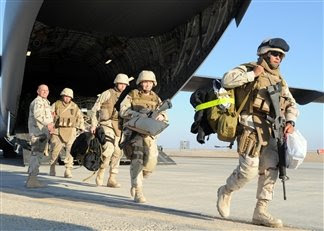
Stryker Armored Vehicle being loaded onto USAF C-17 - Click for larger imageStryker Armored Vehicle being loaded onto USAF C-17
Click for larger image (DOD photo)

The United Arab Emirates announced a series of arms deals this week totaling over $4 billion. The Persian Gulf nation ordered four Boeing C-17 long-range airlifters and 12 Lockheed Martin C-130J tactical airlifters. Earlier, it ordered three Cobra air defense surveillance radars from a European consortium and 12 combat vessels from the Abu Dhabi Shipbuilding Company. In December 2008, the UAE signed a contract for over $3 billion to purchase the advanced version of the Patriot air defense missile system.

Seven billion dollars committed to military hardware despite a global economic downturn indicates the importance the UAE attaches to its own defense. The United States and the UAE have a close working military relationship going back to the days of the Iran-Iraq war in the 1980's. U.S. Navy ships conduct more port calls in the UAE than anywhere in the world except the United States itself. U.S. Air Force fighter, reconnaissance, tanker and unmanned aircraft have used al-Dhafra air base for decades.

I was the acting defense attaché at the U.S. Embassy in Abu Dhabi for a period of four months in late 1992. At that time, I had great relationship with the UAE military, especially the UAE military intelligence staff. One of the roles of my office and the Security Assistance Office was to advise the UAE military leadership of the threat (my job) and recommend force structure and weapons (the SAO job) for effective defense of the oil-rich country.

Given that the main threat to the UAE was (and remains) Iranian adventurism, we advised the UAE defense minister to tailor his country's armed forces to defend UAE airspace and territorial waters against Iranian aircraft and naval vessels. Iran and the UAE have argued over the legal ownership of some Persian Gulf islands for decades. Since then, Iranian missiles have emerged as a real threat to the UAE.

We recommended that the UAE develop a first rate air force and air defense system, if necessary at the expense of the ground forces. A navy is important as well, but should be a coastal defense force rather than on ocean-going force. To that end, the UAE has purchased the F-16E/F Block 60 (officially the Fighting Falcon but more commonly called the Desert Falcon). With the addition of the Patriot air defense system, the UAE has a good capability against not only Iranian aircraft and ships, but against ballistic and cruise missiles as well.

The C-130J tactical airlifter will be useful to move personnel and materiel around the UAE and the region. There is some question as to why the UAE needs four long-range C-17 airlifters. The official explanation is to support future humanitarian efforts. Fine, but when many fellow Muslims suffered in the aftermath of the 2004 tsunami, there was little relief provided by the Arab states. I suspect the UAE is acquiring airlift capability to assist in bringing foreign (read: American) troops and equipment into the Emirates in case of Iranian (or other) threats.

The contract for the four C-17's and 12 C-130J's totals about $3 billion. The per unit cost of a C-17 is about $300 million, and the C-130J about $65 million. Doing the math for that package adds up to about $2 billion. Where is the other $1 billion? When these contracts are made, the package usually includes training and initial maintenance. There is nothing sinister here.

We are awaiting the award of yet another high-dollar contract, $7 billion for the Terminal High Altitude Area Defense system that will improve the UAE's anti-balistic missile defense capability.

Many have questioned the reliability of our Gulf Arab allies. The UAE has stood with us for decades and with these purchases appears committed to continue that stance. Good allies.

February 23, 2009

Israeli coalition building

Benjamin "Bibi" Netanyahu and the author

The Dallas Morning News February 23 edition included an editorial titled "Time for Moderation in Israel." It is an excellent analysis - of course, if one agrees with it, it is excellent....

I have a few comments on the piece. Selected editorial text is in red.

Israel faces a rare opportunity to revive Middle East peace talks with a unity government representing the major conservative, liberal and centrist points of view. Conservative Likud leader Benjamin Netanyahu is tasked with forming a government, but his initial efforts to include the left-leaning Labor and centrist Kadima parties have been rebuffed.

If those parties are hoping for a better balance, they could wind up waiting a long time in Israel's cold political wilderness. By balking at Netanyahu's offer, they are pushing him toward a government of far-right extremists, which would bring Middle East peace efforts to a screeching halt.


A key point. The centrist Kadima party under Foreign Minister Tzipi Livni won the most seats in the election - 28 seats to Likud's 27 - and clearly has a following among the Israeli electorate. Livni is well regarded in conservative and liberal circles and would be an asset to the harder line Likud. While she may want to lead the opposition since she was not asked by President Shimon Peres to form a new government, her party could bring a lot to a coalition with Likud. it would send a message to the Palestinians that Israel is united in its dealings with Hamas and Palestinian President Mahmud 'Abbas (Abu Mazin).

In my recent trip to Israel, many of the officials and journalists that I spoke with believe the greatest short-term threat to Israel is Hamas and the Gaza situation. Iran remains the strategic and "existential" threat to the Jewish state - I was surprised how much less I heard about Iran than I did when I was there two years ago.

The third-place finisher in this month's elections was the far-right Yisrael Beiteinu party of Avigdor Lieberman, a man described by various Israel observers as a borderline racist who seeks to force Israel's Arab citizens to swear an oath of loyalty. Lieberman can bring Netanyahu close to gaining the parliamentary majority he needs to govern, but at a steep political price.

Moderate leaders are holding out in hopes of negotiating power-sharing arrangements. Kadima and Labor are playing a dangerous game of political chicken at a crucial moment in Obama administration efforts to rekindle peace talks.


If Kadima/Livni and Labor led by current Defense Minister Ehud Barak do not agree to join a Likud/Netanyahu-led coalition, Netanyahu will have no choice but to bring Yisrael Beiteinu (Israel, our home) and its 25 seats into the governing coalition. If that happens, Likud will have to make concessions to Yisrael Beiteinu and take a hard line on Israel's Arab citizens, not to mention the stance the resulting coalition will have to take against Hamas.

The conservatives' strong showing in Israel's elections shows that a wide swath of the population is fed up with rocket attacks from Gaza and the intransigent stance of Hamas. If Hamas leaders are serious about initiating contact with the Obama administration, a mere cease-fire won't be enough.


This is almost an understatement. The Israelis are united in their anti-Hamas stance. The more than 8000 rockets fired into southern Israel from the Gaza Strip since the Israeli withdrawal in 2005 has seen to that. Hamas's stock is pretty low in the United States as well.


If Israeli moderates are serious about peace, they must remain engaged from inside the government. An Israeli Cabinet full of extreme right-wingers would be a disaster for all.


Mrs Livni and General Barak - hear, hear.

February 22, 2009

Iran has sufficient uranium for a nuclear weapon

Iranian centrifuges Iranian centrifuges

A recent report by the International Atomic Energy Agency (IAEA) revealed that Iran has accumulated sufficient enriched uranium for at least one nuclear weapon, and that the country had understated by a third how much uranium it has enriched. The report also claims that the discrepancy is the result of a "technical error" rather than Iranian subterfuge. I doubt that last assessment.

This IAEA report should come as no surprise - Iran has consistently lied about almost every aspect of its program. All of its talk of wanting to cooperate with the West has been nothing more than a delaying tactic. While it dragged out the talks - or talks about having talks - the centrifuges at Natanz continued to spin.

During my recent trip to Israel, I met with several Mossad analysts who provided their assessment of the Iranian program - they agree with this recent revelation by the IAEA. According to their information, there are 5000 centrifuges enriching uranium at Natanz. They also believe that Iran has, or will have shortly, enough low-enriched uranium (LEU) for a nuclear weapon. As of now, the Iranians have not produced highly-enriched uranium (HEU), the fissile material required for a weapon. Iran's efforts to develop plutonium, another type of fissile material, at Arak will probably not be successful until 2013.

The next step for Iran is to further refine the LEU into HEU. At that point, Iran will be in violation of the Non-Proliferation Treaty (NPT) - Iran is a signatory of the agreement. At that point, of course, Iran's intention to develop nuclear weapons will be clear to all.

American intelligence analysts believe that once Iran completes the enrichment of LEU into HEU, it will be two to five years before the Iranians will be able to design and build a weapon. If, however, Iran has acquired the design and related technology from Pakistani nuclear proliferator A.Q. Khan, the time line will be significantly shorter.

I am of the opinion that Iran fully intends to develop a nuclear weapon. Anything it does to appear to cooperate with the IAEA or the P5+1 (the five permanent Security Council members plus Germany) is nothing more than a tactic to delay further sanctions while continuing to enrich unranium. At some point, they will either covertly divert LEU to another facility to develop it into HEU, or they will declare themselves out of the NPT and process the LEU at Natanz.

Since it does not appear the United States and its allies are willing to stop Iran from acquiring nuclear weapons, we should be developing policies on how to deal with a nuclear Iran.


February 19, 2009

Kerry wants Syria to help disarm Hizballah?

Senator John Kerry Senator John Kerry, on a visit this week to the Middle East, made some interesting statements while in Beirut. These two passages stand out.

"We want Syria to respect the political independence of Lebanon, we want Syria to help in the process of resolving issues with Hizballah and with the Palestinians. We want Syria to help...with the disarmament of Hizballah."

"Unlike the Bush administration that believed you could simply tell people what to do and walk away and wait for them to do it, we believe you have to engage in a discussion. So we are going to renew diplomacy, but without any illusion, without any naivete, without any misplaced belief that, just by talking, things will automatically happen."

There is a lot of "we" in those statements. One could ask in what capacity Kerry was speaking. The statement that "we are going to renew diplomacy..." is especially confusing. The last I heard, he is chair of the Senate Foreign Relations Committee - that's the legislative branch that makes laws and oversees the executive branch. He is not the Secretary of State, head of the executive branch department charged with the conduct of U.S. foreign policy.

That begs the question: Where is the Secretary of State? One would assume she would be engaged in the Middle East. The latest threat assessment
issued by the Director of National Intelligence contained 45 pages of text - 19 were devoted to the Middle East.

Senator Kerry's office did state that the trip to the region had been coordinated with the White House. I hope that the talking points in the above passages were not provided by the White House. If so, I worry about the new administration's foreign policy process.

Hizballah has refused to disarm, although it has committed to do just that numerous times. For a brief discussion of Hizballah's abysmal history on living up to international agreements, including United Nations Security Council resolutions, see my recent article, Hizballah has the "right" to air defense weapons?

I am puzzled by Senator Kerry's proposal that Syria help with the disarming of Hizballah. No one would be happier than me if my former antagonists at Syrian Military Intelligence (SMI) and Syrian Air Force Intelligence (SAFI) were to take on disarming Hizballah. I spent a significant part of my career working against Hizballah, not to mention SMI and SAFI. SAFI agent Nizar Hindawi's attempts to smuggle a bomb onto an Israeli airliner in 1986 caused me no end of grief - that is another story.

Hizballah, literally "the Party of God," was created by the Iranian Islamic Revolutionary Guard Corps with Syrian Military Intelligence assistance in Lebanon's Biqa' Valley in 1982 as a reaction to Israel's invasion of Lebanon, the "Peace for Galilee" campaign. Hizballah has grown into the most effective irregular military force in the world. Syria, as well as Iran, uses the group as a proxy military force in Lebanon.

In the aftermath of the 2006 war between Hizballah and Israel, Iran - via Syria - resupplied Hizballah. Hizballah is now a - if not "the" - major power broker in Lebanese politics. Hizballah provides a unique capability for either Iran or Syria to exert political pressure on Israel with plausible deniability. What a great capability for the Syrians - to be able to manipulate events in Lebanon without a military presence.

The thought that Syria would help to disarm Hizballah, to dismantle Damascus's proxy capability, without significant concessions is hard to believe. What is Senator Kerry proposing we give the Syrians as an incentive, and why is he and not the Secretary of State making the case?


More American troops to Afghanistan

DOD photoPresident Barack Obama has ordered the deployment of 17,000 additional American troops to Afghanistan. This will bring the total number of U.S. forces in the country to almost 50,000. While that sounds like a formidable force, when you look at the command structure in place in Afghanistan, it is not the case.

The 32,000 American troops in country now are not all under American command. Almost half - 14,000 - are assigned to NATO's force of 50,000 troops. Effectively, they are not American troops, but NATO troops.

Anyone who has ever served with or dealt with (I have) NATO realizes what that means: bureaucracy and inefficiency raised to an art form. One only hopes that the additional American forces are being assigned to the American-led coalition force commanded by an American general and not to the NATO force.

There are multiple problems with the NATO force in Afghanistan. Among them is the fact that NATO forces are commanded from Belgium, and there are numerous restrictions - the "rules of engagement" - on the employment of troops imposed by the host countries. For example, German forces in the country are severely restricted in engaging the enemy. See my earlier article, German soldiers in Afghanistan - don't shoot the bad guys!.

courtesy Francona AdvisorsThe presence of a NATO force separate from the coalition force led by a U.S. Central Command (CENTCOM) general creates operational problems. NATO units - including the 14,000 American assigned to NATO in Afghanistan - receive orders via the NATO command in Belgium.

American units assigned to the American-led coalition receive orders from CENTCOM, while Afghan National Army units are separate from both NATO and CENTCOM (see chart). Anyone who has attended any military staff college anywhere will recognize the problems with this arrangement. See my earlier article, American troops in Afghanistan deserve a better command structure.

The troop increase is part of an ongoing review of American operations in Afghanistan. That review should address the broken command structure - someone has to be in overall command. Given the U.S. commitment in terms of troops and resources, it makes sense that the American force commander should be directing all military operations in the country.

The review should also address the paltry commitments by many of our NATO allies. The troops doing almost all of the fighting are the Americans, British, Canadians, Dutch and Polish. If NATO is to be an effective organization in the future, it has to function effectively now.

American commanders want to double the 17,000 troop increase. Perhaps if there was a workable command structure and a bit more commitment on the part of our allies, that number may not need to be so high.


February 18, 2009

Hizballah has the "right" to air defense weapons?

Shaykh Hasan NasrallahAccording to Shaykh Hasan Nasrallah, leader of Hizballah, his group has the "right" to possess and use air defense weapons. Nasrallah made this pronouncement at a ceremony marking the one-year anniversary of the assassination of infamous Hizballah operations chief 'Imad Mughniyah. Mughniyah was killed in the upscale Kafr Susah section of Damascus - virtually everyone believes the Israelis were responsible.

Why Nasrallah believes Hizballah has the right to possess air defense weapons is puzzling. According to the United Nations Security Council Resolutions and other agreements Hizballah has signed, Hizballah should not even have an armed militia. There is a litany of broken accords, including the Ta'if Accords of 1989 and UNSCR 1559 of 2004. Both call for all militias in Lebanon to be disarmed. All militias except Hizballah adhered to the agreements and disbanded.

Hizballah has refused to disband its militia, claiming that Israel was not in compliance with previous UN resolutions (UNSCR 425 and 426) calling for Israel to withdraw from Lebanese territory. Israel claims that it has complied with UNSCR 1549 when it left Lebanon in 2000. The United Nations has certified Israel to be in compliance.

Hizballah claims Israel still occupies some Lebanese land - the Shaba' Farms. It's a myth, but no one is willing to call Hizballah on it (see my earlier post, The Shaba' Farms - Hizballah's Fig Leaf.) This myth is Hizballah's justification to maintain what it calls "The Islamic Resistance."

The latest agreement to be ignored by Hizballah is UNSCR 1701. It is also ignored by the United Nations Interim Force in Lebanon (UNIFIL) which is tasked with its enforcement. This resolution ended the fighting between Hizballah and Israeli forces in the summer of 2006 and calls for Hizballah to remove its fighters from south of the Litani River and turn in its heavy weapons. UNIFIL was expanded and given the specific mandate to prevent the rearming of the militia. None of this has happened.

In fact, after the fighting in 2006, Hizballah has emerged as the key power broker in Lebanon. It has de facto veto power in the Lebanese Parliament and openly brandishes its heavy weapons - Syria and Iran have completely replenished Hizballah's stocks to greater than pre-conflict levels with absolutely no interference from UNIFIL.

In his statement, Nasrallah also added that Hizballah would fire on Israeli aircraft that routinely violate Lebanese airspace. Hizballah is generally believed to possess ZU-23 antiaircraft artillery guns and shoulder-fired SA-7 and SA-18 surface-to-air missile systems. None are capable of reaching the daily Israeli medium or high altitude reconnaissance flights.

If Hizballah plans to acquire more-capable missile systems - there are rumors that they want the SA-8 GECKO - they should reflect on the history of air defense weapons in Lebanon. In 1982, Syrian forces moved SA-6 missile systems into Lebanon. They were struck almost immediately by Israeli aircraft.

Introduction of these types of air defense missile systems is an Israeli red line. It's pretty simple: if Hizballah brings them into Lebanon, Israel will destroy them.

February 17, 2009

Pakistan caves to the militants

The Swat Valley


On February 16, the Pakistani government made a deal with a group of Taliban militants in the Malakand region. That region includes the Swat area - 100 miles northwest of the capital of Islamabad - which allows the group to establish fundamentalist Islamic Shari'ah law in that region. In return, the militants have agreed to a ceasefire with the Pakistani military.


There are areas of Pakistan, the Federally Administered Tribal Areas (FATA), that are semi-autonomous. These areas - in blue on the map - are between the border with Afghanistan and the North West Frontier Province (NWFP). The NWFP is shown in green.

The Swat area - shown above in yellow - is not in the FATA. Swat is well within the NWFP, part of the totally sovereign area of Pakistan proper. Well, at least it was until this agreement was signed.

The acquiescence of the Pakistani government to enter into this type of agreement with a group of fundamentalist Islamic clerics is pathetic. The government is acting tactically, not strategically. They hope to stem the rising tide of violence in the region, violence instigated and perpetrated by the Taliban active in the area. They need to address the long-term interests of Pakistan.

The Islamic group that the Pakistani government has dealt with has beheaded people, burned girls schools and taken on the sovereign government. These actions are consistent with the strict interpretation of Islamic law, the Shari'ah. Yet, the agreement for a ceasefire between Pakistan's armed forces and the militants includes a provision that this same Shari'ah law will be implemented in the region.

The chief minister in North West Frontier Province, Amir Haider Khan Hoti, claimed that Pakistani troops would revert to defensive operations, fighting only when attacked. They will standby as the courts implement Shari'ah law. That means that Muslim clerics will "advise" judges on cases. In reality, fundamentalist Taliban clerics will run the courts.

Technically, the agreement does not ban female education - we'll see. When the Taliban seized power in Afghanistan, girls were barred from schools. These are the people the Pakistani government, our allies in the war on terrorism (read: war on radical Islam), made a deal with?

If this agreement was focused on an area in the FATA, one might understand. This agreement deals with territory in Pakistan proper. What's next? Give the city of Quetta or Karachi to the Taliban?

February 16, 2009

Expanded Israeli settlements on the West Bank

Settlement on West Bank - click for larger imageIsraeli Settlement on West Bank

In the last few weeks, while everyone's attention has been focused on the yet unproductive Egyptian-brokered talks between Israel and Hamas over Gaza, the Israeli army has delineated more Palestinian land for Israeli settlement expansion on the occupied West Bank. Israeli settlements in areas that the Palestinians consider part of their future state are a sensitive and controversial issue.

Over the years, Israeli governments have made commitments to stop the development of new settlements in the occupied territories. The presence of Israeli settlers is an obstacle to the eventual return of occupied territory to either the original owners or the Palestinians. This was the case with the return of the Sinai to Egypt and the withdrawal of the Israelis from Gaza in 2005, and it will be an issue with the return of the Golan Heights to Syria.

The Sinai, Gaza and the Golan issues pale in comparison to the ramifications of the settlements on the West Bank. The Israelis are split over whether they should ever return all of the West Bank to the Palestinians. Many believe that the lands are rightfully part of Israel - those who favor this position refer to the West Bank as Judea and Samaria. They also support the expansion of Jewish settlements in the area to provide in-depth security to Israel. Not only do settlements create an Israeli presence in the territory, protection of these Israeli citizens requires the continued presence of Israeli troops.

The Israelis that support the principle of "land for peace" favor the return of almost all of the West Bank for the creation of a Palestinian state. There are three blocs of settlements that almost all Israelis believe should remain under Israeli control, mostly for security reasons. These Israelis also are willing to redraw the borders slightly to provide compensatory land to the new Palestinian state.

Palestinian President Mahmud 'Abbas (Abu Mazin) warned that continued settlement expansion would halt peace talks. Unfortunately, Palestinian actions have robbed 'Abbas of any credibility. When the Israelis withdrew from Gaza in 2005, they uprooted many settlers by force. It took only hours after Israeli troops pulled out of Gaza for attacks to begin. Since 2005, over 8,000 rockets and mortar rounds were fired at southern Israel, and continue to this day.

Many Israelis look at the West Bank and wonder why they should remove the almost 300,000 settlers and turn the area over to the same people that refuse to stop shooting at them from Gaza. Remember, Israel is as narrow as 7.5 miles in areas adjacent to the West Bank.

'Abbas said recently that peace talks will only resume after Israel declares a freeze on new or expanded settlements. If Benjamin Netanyahu becomes the next prime minister, the talks are over. Netanyahu favors expansion of the settlements and has gone on record saying that talking to the Palestinians is a waste of time. He favors the "no-solution solution." See my earlier article, Israel-Palestinians: The "no solution" solution.

Site of roposed new settlement noted in red

The proposed new settlement area sits on the main road between Jerusalem and Hebron. It is very near the existing settlement of Efrat, home to 1,600 families. The new settlement will house as many as 2,500 additional families over an area of 425 acres.


February 15, 2009

Saudi king orders long overdue reforms

King 'Abdallah bin 'Abd al-'Aziz Al Sa'ud (DOD photo)King 'Abdallah bin 'Abd al-'Aziz Al Sa'ud

Saudi Arabia's King 'Abdallah issued a series of orders recently that hopefully will begin long overdue reforms in the oil-rich kingdom. Long regarded as an ultra-conservative Islamic state with little tolerance for other religions or value systems, Saudi Arabia is a major foreign policy concern for the United States - it will remain so as long as we are dependent on fossil fuels for energy.

King 'Abdallah of Saudi Arabia, as all the country's kings before him, must tread lightly when making reforms, especially when the reforms impact on the Islamic nature of the society. The social contract between the royal family - the House of Sa'ud - and the people is almost totally based on religion, in this case the Wahhabi sect of Sunni Islam.

One of the sensitive and controversial elements of Saudi society is the religious police, the mutawa'in, the short name for the Commission for the Promotion of Virtue and Prevention of Vices.

These zealots enforce Koranic law - they ensure that businesses close during prayer times (the sign to the left reads "Closed Because of Prayer [time]"), that men and women are not engaged in any prohibited social contact, that women are dressed appropriately in public, there is no alcohol in the country, etc.

On February 14, the king replaced the hard-line head of the religious police with a more moderate cleric. There will be outcries from the ultra-conservative religious leadership, but based on my time in Saudi Arabia, it will be welcomed by most of the population, both Saudi and foreign.

It is of note that the king chose to make this replacement on the Western (Christian) holiday of Valentine's Day. The mutawa'in had mounted a very unpopular campaign to prevent any celebrations by Saudis, to the point of prohibiting items colored red from being sold in stores.

In addition to replacing the head of the religious police, King 'Abdallah expanded the membership of the Grand 'Ulama' (religious scholar) Commission to include representatives of branches of Sunni Islam other than the Wahhabis. This move is more than cosmetic - it will change the autocratic hold the Wahhabis have had on religious thought in the kingdom. This is not without risk.

The changes go even further. The head of the Supreme Council of Justice, Saudi Arabia's highest administrative court, was removed as well. The fired jurist, Shaykh Salih al-Lahaydan, gained international attention last fall when he ruled that is was legal to kill the owners of satellite television stations that broadcast "immoral" programs. Given the actions of the religious police over Valentine's Day, I can guess what al-Lahaydan's definition of "immoral" might be.

Saudi fourth grade textbookPerhaps one of the more significant of the king's changes with long-term implications is the naming of his son-in-law Prince Faysal bin 'Abdallah bin Muhammad Al Sa'ud as education minister. (Photo right: Saudi fourth grade textbook.)

Of note, the king also appointed a woman to be Prince Faysal's deputy minister for girls' education. Remember, this is a country where women still cannot drive automobiles. She is the first woman to be appointed to this level in the Saudi government.

The Saudi education system has been an issue between the United States and the kingdom for years. Since 15 of the 19 hijackers that perpetrated the September 11, 2001 attacks were products of the Saudi education system, Americans have demanded reforms in the anti-Western, anti-Jewish and anti-Christian curriculum. To be fair, the curriculum also targets many non-Wahhabi Muslim sects as well. With the expansion of the religious leadership council and the appointment of Prince Faysal as education minister, there may be hope for change.

The U.S. State Department has been working since at least 2003 with the Saudi Ministry of Education to alter the curriculum. Although Saudi Arabia has claimed it has changed the textbooks by editing out the more offensive sections, studies over the last two years show that is not entirely the case.

King 'Abdallah's shakeup of the power structure in the country is far-reaching. It is also long overdue. Perhaps they will yield positive change in the kingdom.

February 14, 2009

Israel-Hamas truce - not even close

Israel - Gaza borderIsrael - Gaza border

For the last few weeks, there has been a constant stream of announcements from the Egyptian negotiators that a long-term truce agreement between Israel and Hamas was imminent. It sounded like there were only a few remaining obstacles that were about to be worked out.

Just a few days ago, there was a statement from Musa Abu Marzuq, deputy leader of Hamas, that the group had agreed to an 18-month ceasefire and that Egypt would announce the truce by February 14. What Marzuq meant to say was that Hamas and Egypt had agreed to terms for a truce. Apparently, they neglected to secure Israel's agreement to those terms.

One of Hamas's key demands is that Israel open the border crossings and lift the restrictions on the importation of anything other than humanitarian aid. Israel is willing to do this under on the condition that someone other than Hamas controls the border crossings with Egypt.

It is that border where virtually all of Hamas's weapons enter the Gaza Strip. There also needs to be an inspection or observer protocol to ensure that no additional weapons are smuggled into the Gaza Strip. However, Hamas claims that it has already replenished much of the weaponry used or destroyed in the conflict with Israel.

Another issue in which Hamas may have not coordinated fully with Egypt is the fate of Israeli soldier Gilad Shalit. Shalit has been in Hamas custody since he was captured in a 2006 raid on the Israel-Gaza border. Marzuk said that Shalit's release - in exchange for the release of hundreds of Palestinian prisoners in Israeli jails - would be settled "later." Today, Israeli Prime Minister said that Shalit's release is not an issue for later, but an integral part of this truce agreement.

For now, the negotiations brokered by Egypt seem to have stalled. This is yet another instance of Hamas and Egypt agreeing on a set of conditions and claiming a breakthrough in the talks. The problem is that Egypt and Hamas are not the two opposing sides, Hamas and Israel are. Egypt's agreement is meaningless unless they can sell it to the Israelis. Thus far, they have not.

Egypt wants to be successful in this mediation effort. It needs to make itself relevant again in the Middle East. Unfortunately, it does not appear to have sufficient influence with Hamas to deliver the conditions Israel considers the minimum to agree to a truce.

Pressure will continue to mount on Hamas to acquiesce to Israel's demands. The Israeli government has broad popular support for standing firm against Hamas and will continue to respond to the occasional Hamas rocket attack with punishing air raids and tighter border restrictions.

Hamas and the people of Gaza whom they claim to represent, on the other hand, suffer more each day.